


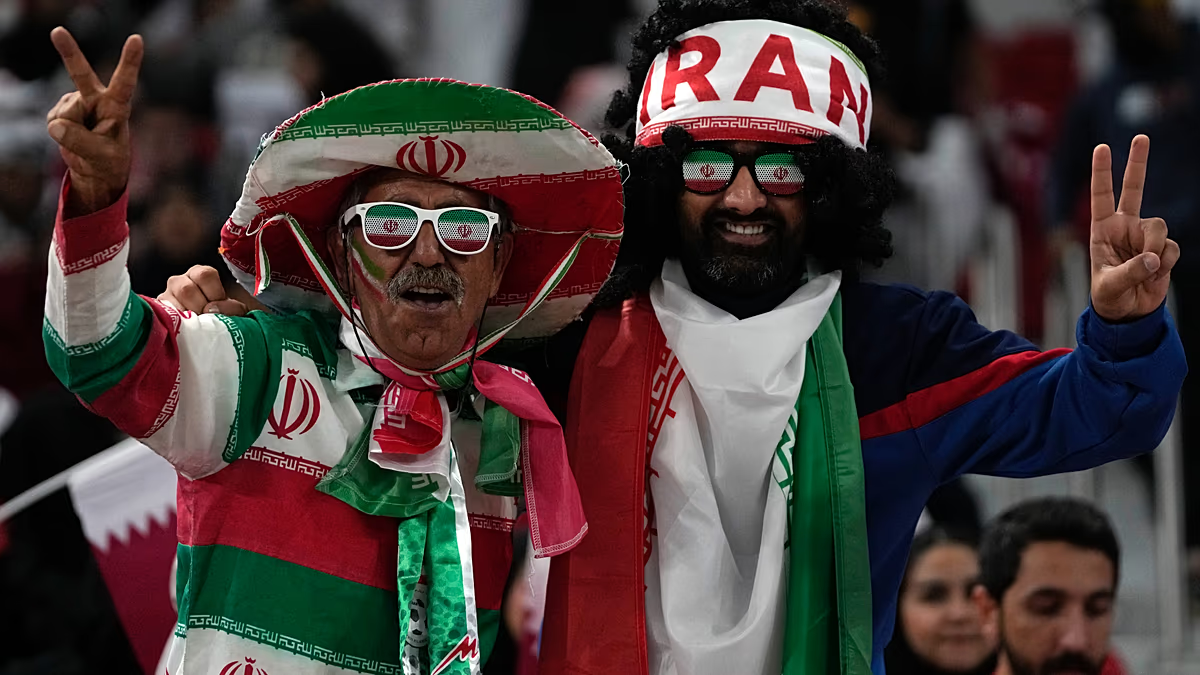
In the complex and often divided landscape of international sports, FIFA President Gianni Infantino has made a definitive and hopeful statement regarding Iran’s participation in the upcoming World Cup. Speaking at CNBNC’s Invest in America Forum, Infantino confirmed, “The Iranian team is coming for sure, yes,” directly addressing the cloud of uncertainty that has lingered since late February. At that time, a significant escalation in the Middle East, involving airstrikes by the U.S. and Israel on Iranian territory, cast serious doubt on the nation’s ability or willingness to compete on the global stage. Infantino’s declaration was not merely administrative but carried a tone of urgent optimism, as he expressed a heartfelt hope that the tournament would unfold against a backdrop of peace. His words underscored a fundamental belief in the power of sports to persist and even thrive amid geopolitical turmoil, serving as a beacon of normalcy and unity for people around the world.
Infantino’s confidence stems from a very human and recent connection. Just two weeks prior to his announcement, he traveled to Antalya, Turkey, to meet personally with the members of the Iranian national team, who were training there away from the conflict at home. This was not a distant diplomatic gesture but a face-to-face encounter that left a tangible impression on him. He recounted being genuinely impressed by the squad, noting, “I went to see them. They are actually quite a good team as well.” More importantly, he felt the palpable desire and determination of the players themselves. “They really want to play and they should play,” he emphasized, framing their potential absence not just as a bureaucratic or political issue, but as a deep personal disappointment for the athletes who have trained for years for this moment. This personal testament shifts the narrative from abstract geopolitics to the very real dreams of individual players and coaches.
Central to Infantino’s argument is the enduring, though often challenged, ideal of separating sports from politics. “Sports should be outside of politics now,” he stated, advocating for the World Cup to be a sanctuary of fair competition and human achievement. He champions the tournament as a global platform where nations can engage through the universal languages of athleticism and passion, rather than through conflict or discord. However, Infantino is not naive. With a dose of pragmatic realism, he acknowledged the difficulty of this ideal, quipping, “OK, we don’t live on the Moon, we live on planet Earth.” His point was poignant: while complete separation is impossible in a world woven with political threads, the conscious effort to build and maintain bridges is a responsibility worth undertaking. In essence, he positioned FIFA’s role as that of a stubborn bridge-builder, striving to keep channels of connection open when others might see only division.
The logistical and symbolic weight of this participation is particularly pronounced given the tournament’s host nations. The 2026 World Cup will be co-hosted by the United States, Canada, and Mexico, with Iran scheduled to play two of its group-stage matches on American soil—in Inglewood, California, and Seattle, Washington. This setup adds multiple layers of complexity, intertwining the practicalities of security, diplomacy, and international travel with powerful symbolism. The prospect of the Iranian team competing in a country whose government has been a direct adversarial force in recent conflicts is a stark embodiment of the very tensions Infantino seeks to transcend. It raises profound questions about safety, protocol, and the atmosphere that will greet the players and fans, turning each match into a significant moment watched by the entire world.
Despite FIFA’s clear stance, the path to the tournament remains fraught with mixed signals and external pressures. From within Iran, there have been conflicting public statements from government officials and football authorities, reflecting an internal debate about participation amidst ongoing war. Externally, former U.S. President Donald Trump has publicly discouraged the Iranian team from attending, citing safety concerns—a comment that adds another volatile element to an already delicate situation. This cacophony of voices highlights the immense pressure on the players, who must focus on their sport while navigating a minefield of political rhetoric. Their journey to the World Cup is thus about more than football; it is a testament to their resilience and a quiet defiance against forces that would see them isolated from a celebration meant for the entire world.
In the end, Gianni Infantino’s firm assurance is a gamble on hope and on the unifying spirit of sport. By insisting that Iran “has to come” because “they represent their people” and have rightfully earned their place, he is advocating for a principle that feels increasingly fragile in the modern era. The 2026 World Cup, with Iran’s participation, has the potential to be a powerful narrative of perseverance and shared humanity. It promises to be a tournament where the roar of the crowd for a skillful goal might, for a fleeting moment, drown out the echoes of distant conflict. The world will be watching, not just to see who wins, but to witness whether the beautiful game can indeed build a bridge sturdy enough to connect shores divided by a sea of discord.