



In the ever-evolving landscape of global aviation, the crown for the world’s busiest airport remains firmly in place. For 2025, Hartsfield-Jackson Atlanta International Airport, a titan of American infrastructure, once again welcomed more passengers than any other facility on Earth, with over 106 million travelers passing through its concourses. This achievement, however, is set against a nuanced backdrop of shifting global patterns and regional recoveries. According to the definitive rankings from Airports Council International (ACI) World, which counts each passenger boarding or disembarking only once, Atlanta’s throne saw a slight erosion in its absolute numbers. Passenger traffic there actually dipped by 1.6% compared to 2024 and was 3.8% lower than its pre-pandemic 2019 level. This suggests that while its operational scale is unmatched, the forces driving global travel are recalibrating, with growth surging elsewhere around the world.
The ACI’s list reveals a fascinating story of geographical resurgence and established dominance. Occupying the second position is Dubai International Airport, a glittering nexus of global connectivity for the United Arab Emirates. Tokyo Haneda Airport in Japan follows in third, showcasing the robust recovery of Asia-Pacific travel hubs. Dallas Fort Worth International Airport and Shanghai Pudong International Airport round out the top five, representing the sustained strength of U.S. domestic networks and China’s rapid return to international prominence. Notably, Shanghai Pudong leaped from 10th place in 2024 to 5th in 2025, even surpassing its 2019 position. Similarly, Guangzhou Baiyun Airport’s remarkable journey from 57th in 2022 to 9th in 2025 highlights the extraordinary rebound of China’s aviation sector post-pandemic. These Asian airports are not just recovering; they are aggressively climbing the rankings, reshaping the map of the world’s busiest travel corridors.
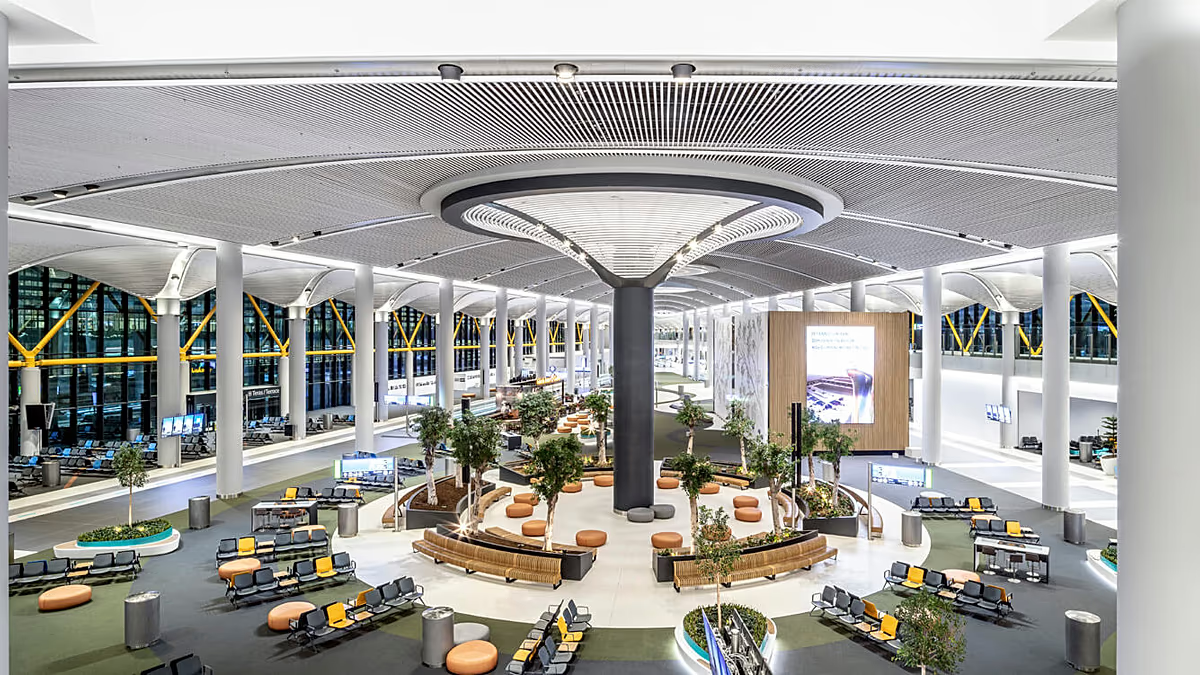
Europe’s presence in the top ten remains concentrated but powerful, with only two airports making the list. London Heathrow, a perennial gateway, secured seventh place with over 84 million passengers, though it fell from fifth in the previous year. Just behind it, Istanbul Airport in Turkey captured eighth position. Istanbul’s story is one of meteoric rise; compared to its 28th place ranking in 2019, its ascent to the global top ten underscores its strategic role as a bridge between continents. This European duo underscores a continent where travel is mature and networks are dense, but where growth dynamics differ from the explosive expansions seen in Asia and the Middle East. The rankings remind us that busiest does not always equate to fastest-growing, as established hubs manage immense, stable flows while newer or recovering hubs capture the rising tide of demand.
When the lens shifts from total passengers to international travel specifically, the picture transforms dramatically. Here, Dubai International Airport reigns supreme, hosting over 95 million international passengers in 2025—a figure magnified by the UAE’s small size, which precludes a domestic air market. London Heathrow takes second place in this category, with nearly 80 million international travelers. The list of top international hubs then becomes a showcase of global crossroads: Incheon International (Seoul), Changi Airport (Singapore), and Amsterdam Schiphol fill the next spots, followed by Istanbul, Paris Charles de Gaulle, and Frankfurt. This international ranking highlights cities that function as critical intercontinental connectors, hubs where cultures and economies intersect on a massive scale. Overall, international passenger traffic globally soared to four billion in 2025, growing significantly compared to both 2024 and the pre-pandemic benchmark, signaling a world eagerly re-engaging across borders.
ACI World Director General Justin Erbacci framed these statistics not just as metrics of volume, but as testaments to resilience and economic vitalilty. He congratulated these busy hubs for “managing growing air travel demand amid increasing operational complexity,” emphasizing that they are the engines that “keep people and goods moving, supporting global trade, tourism, and economic growth.” His statement carried a forward-looking call to action, stressing that for this momentum to be sustained, “governments must prioritize sustained investment in airports and the broader aviation ecosystem.” This need for investment is underscored by the favorable conditions that partly fueled 2025’s growth: a 13% year-on-year drop in jet fuel prices and easing inflation, which boosted consumer purchasing power and stabilized demand. However, the report ominously notes that such favorable conditions “won’t be the case this year…”, hinting at the volatility and challenges that lie ahead for the industry.
In summary, the 2025 rankings paint a portrait of a global aviation industry in a state of dynamic rebalancing. Atlanta stands as the undisputed king of total passenger volume, a behemoth of efficiency and scale. Yet, the soaring international numbers and the dramatic climbs of Asian airports like Shanghai and Guangzhou tell a parallel story of a world leaning back into cross-border exploration and trade, with Dubai as its premier international portal. The data reveals the dual nature of modern air travel: vast domestic systems like those in the United States, and intricate international webs connecting global megacities. As these hubs navigate the complexities of demand, infrastructure, and economic headwinds, they collectively form the circulatory system of our interconnected planet, facilitating the movement that defines our modern era. Their continued success will depend not only on their own operational excellence but on the broader, sustained commitment to investing in the arteries of global connection.