


Of all the pleasures contained within a long train journey, perhaps the most profound is the simple, passive act of gazing out the window. The rhythmic clatter of the wheels becomes a meditation, and the ever-changing panorama framed by the carriage window offers a unique theatre of landscapes, cultures, and natural wonders. It is a form of travel that prioritizes observation over speed, connection over isolation. This timeless appeal has inspired countless subjective rankings of the world’s most scenic routes. Now, however, one company sought to introduce a novel layer of objectivity to this romantic pursuit. Insurance experts InsureandGo employed eye-tracking technology to scientifically analyse the visual pull of some of the globe’s most celebrated rail journeys, measuring not just how long participants looked at scenes, but how quickly their eyes were drawn to them. The results offer a fascinating, data-informed snapshot of what truly captivates the human eye on a rail-bound adventure.
According to this study, the crown for the world’s most scenic train journey goes to Japan’s Sagano Romantic Train. This is not a marathon cross-country expedition, but a concentrated, 25-minute poetic interlude along the Hozu River between Saga-Arashiyama and Kameoka. The journey’ magic is amplified by its open-sided carriages, which offer an immersive sensory experience. The iconic passage through the towering, whispering Arashiyama bamboo forest is a highlight, but the scenery’s appeal shifts with the seasons, drawing crowds for the delicate cherry blossoms in spring and the fiery reds and golds of autumn maples. Its brevity and intensity make it a precious gem in the world of rail travel, a short ride that leaves a lasting impression, necessitating advance booking to secure a seat in its fleeting theatre.
Europe’s most beautiful route, and the study’s runner-up, is the Bernina Express in Switzerland. This is a journey of epic, Alpine grandeur, running along a UNESCO World Heritage railway for four hours between Chur in Switzerland and Tirano in Italy. It is an engineering marvel that conquers the landscape, climbing to the dizzying altitude of 2,253 metres at the Bernina Pass. The vistas here are monumental and transform dramatically with the seasons: the stark beauty of frozen lakes in winter, the lush green of valleys in summer, and the golden blaze of larch forests in autumn. It is arguably one of Europe’s most iconic rail experiences, offering a slow, deliberate procession through some of the continent’s most stunning topography.
Switzerland claims another spot in the top three with the Glacier Express, aptly nicknamed ‘the world’s slowest express train’. This eight-hour journey between Zermatt and St. Moritz is slow by design, a conscious choice to grant passengers every possible moment to absorb the passing majesty. The route is a panoramic feast, featuring the iconic, pyramid-like peak of the Matterhorn and traversing the deep, dramatic cuts of the Rhine Gorge, often called ‘the Swiss Grand Canyon’. It is a journey that redefines “express,” prioritizing the depth of the experience over the speed of the transit, inviting travelers to settle in and let the sublime landscapes of the Swiss Alps dictate the pace of the day.
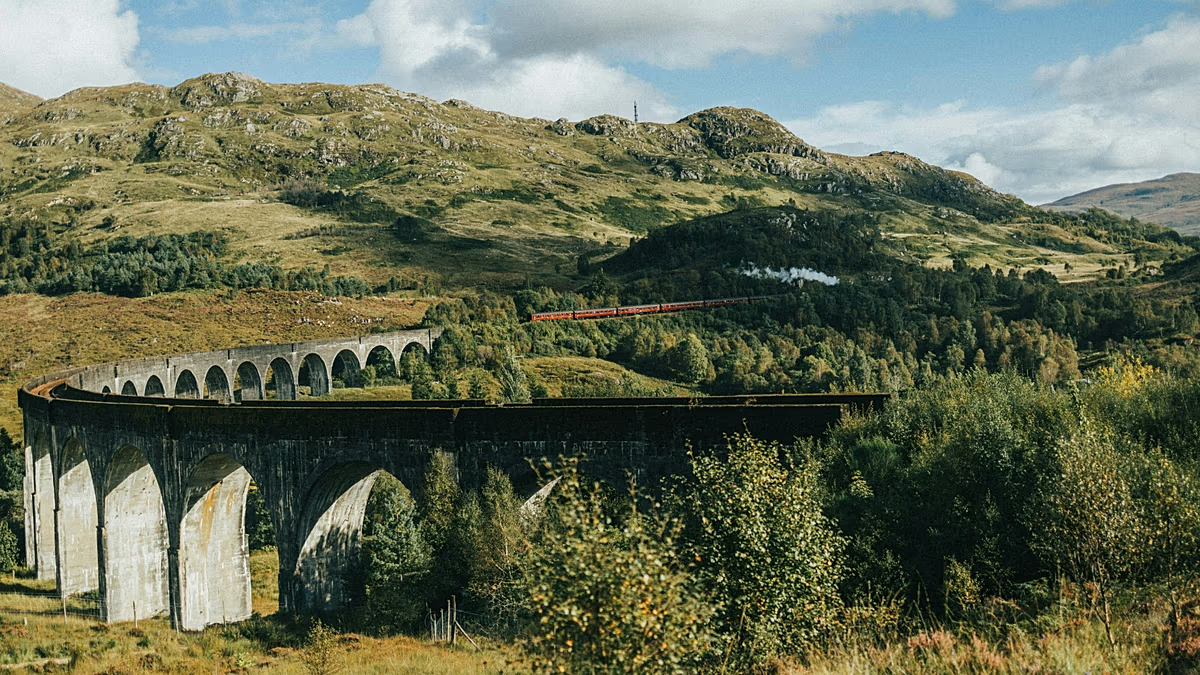
The sole United Kingdom entry to earn a place in the ranking is Scotland’s West Highland Line, a regularly scheduled service traveling between Glasgow and the port of Mallaig. This route offers a journey into the wild, romantic soul of Scotland. Passengers gaze upon the serene beauty of Loch Lomond and the dramatic, sparse Highlands. For many, a highlight is the crossing of the Glenfinnan Viaduct, an arched stone bridge instantly recognizable to Harry Potter fans as the path of the Hogwarts Express. Unlike many specialized tourist trains, this is a line integrated into the national network, accessible without a special pass. Yet, for a more nostalgic experience, the seasonal Jacobite Steam Train offers a vintage voyage along a portion of the same route, complete with the aroma of coal smoke and the sound of a historic engine.
Rounding out the top five is Taiwan’s Alishan Forest Railway, a mountain journey that deserves far greater international recognition. This remarkable railway performs a gradual metamorphosis of scenery, carrying passengers from dense forest into serene tea plantations as it climbs. It crosses three distinct vegetation zones on its ascent to over 2,000 metres in altitude. The charming red trains are particularly famous for sunrise trips, where passengers willing to brave the crowds are rewarded with a breathtaking spectacle: watching the sun ascend above a sea of clouds from a privileged vantage point high in the peaks. It is a journey that encapsulates transformation, both in the landscape outside and in the perspective within, concluding a list that proves the greatest appeal of a train journey often lies not in the destination, but in the ever-unfolding view from the carriage window.