



Reassessing a Legacy: The Timurid Renaissance Beyond Conquest
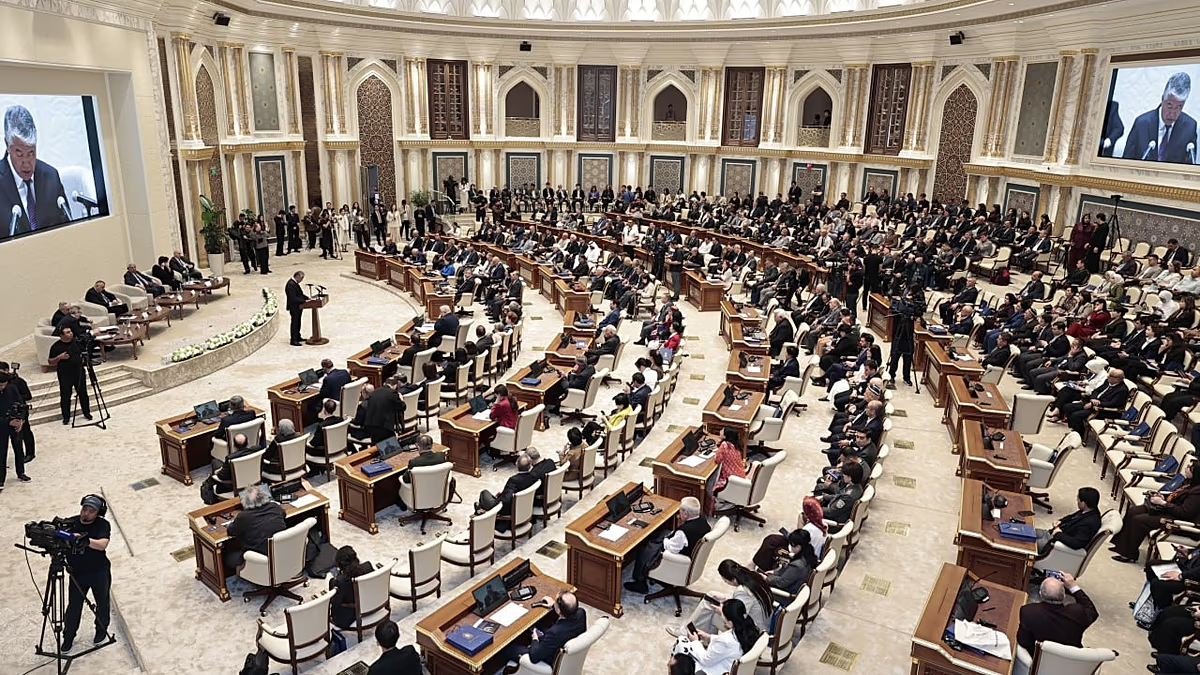
For centuries, the name Amir Temur (Tamerlane) has echoed through history primarily as a synonym for formidable military conquest and empire-building. The narrative surrounding the 14th-century ruler and the vast dynasty he founded has often been dominated by tales of strategic brilliance and fearsome campaigns. However, a significant scholarly shift is now underway, moving the spotlight from the battlefield to the library, the observatory, and the madrassa. International historians are leading a profound re-examination of the Timurid era, increasingly framing it not as a mere interlude of power but as a pivotal period of intellectual, scientific, and cultural flourishing that left a lasting imprint on world civilization. This reframing was the central theme of a major international conference held in Tashkent, Uzbekistan, titled “The Role and Significance of Amir Temur and the Timurid Civilization in World History and Culture,” which brought together over 300 scholars from more than 20 countries to reshape our understanding of this complex legacy.
The conference itself symbolized this new approach, gathering experts from prestigious global institutions like the Oxford Centre for Islamic Studies, ICESCO, and the Al-Furqan Foundation. The collective dialogue moved decisively beyond martial history to explore the sophisticated systems of governance, diplomacy, science, and education that characterized the Timurid state. A powerful consensus emerged among scholars: the 14th and 15th centuries in Central Asia, under Timur and his successors, should be recognized as a transformative intellectual revival, often described as a “Second Renaissance.” This period saw the deliberate establishment of scientific institutions and structured education systems that nurtured sustained cultural development across the Islamic world and beyond. As Uzbekistan’s President Shavkat Mirziyoyev noted in his address, this “Timurid Renaissance” represents one of the nation’s most remarkable historical chapters, urging deeper research and international cooperation to fully uncover its dimensions.
A key driver of this scholarly reassessment is the urgent need to correct a historical imbalance in public perception. As Sali Shahsavari of the Al-Furqan Foundation pointed out, Amir Temur is universally known as a military leader, but few recognize the profound scientific legacy of his era. The Timurid period, scholars argue, was not just an age of political authority but one of systematic knowledge production. It fostered groundbreaking advances in astronomy, mathematics, geography, and medicine, supported by a network of madrassas and organized research hubs. These institutions did not merely generate isolated discoveries; they created a self-perpetuating ecosystem for intellectual development that ensured the transmission and evolution of knowledge across generations, influencing scientific progress for centuries to come and weaving a rich thread into the tapestry of global scientific history.
The enduring impact of this renaissance is visibly and tangibly etched into the very landscape of Central Asia. As Cengiz Tomar of IRCICA emphasized, Timurid architecture possesses a distinct and majestic identity, as recognizable as Ottoman or Seljuk styles, with the regal splendor of Samarkand and Bukhara standing as eternal testaments to this creative zenith. This cultural brilliance extended far beyond stone and tile. Historian Hilola Nazirova’s research challenges the one-dimensional portrayal of Temur as merely a conqueror, a view often perpetuated by selective readings of primary sources like the Zafarnama. By delving into a wider array of Khorezmian and Turkish texts, she uncovers a more nuanced reality, arguing that predominantly destructive depictions are the product of biased historiography rather than a complete reading of the evidence. The challenge for modern scholars, she notes, is not a scarcity of sources but the overwhelming abundance of them, requiring careful, contextual analysis.
The influence of the Timurid era radiated far beyond its Central Asian heartland, shaping statecraft, culture, and civilization across a vast geographical and temporal sphere. TURKSOY Secretary General Sultan Raev described it as a foundational period that taught profound lessons in loving and building upon one’s homeland. This cultural diffusion is perhaps best exemplified in the deep, historical connections with India, as highlighted by Bedar Shayesta of the Khuda Bakhsh Oriental Library. The Timurid contributions—in art, architecture, literature, poetry, philosophy, and mysticism—flowed along the Silk Road, influencing the subcontinent’s own cultural evolution in myriad ways. This shared heritage is meticulously preserved in global repositories of manuscripts, such as those highlighted by Irina Popova, which serve as a common resource for international scholars piecing together this interconnected intellectual world.
The Tashkent conference concluded not as an endpoint, but as a launchpad for a new, collaborative phase of discovery. The path forward, as outlined by participants, focuses on translating research into concrete action: expanding international academic partnerships, initiating joint research projects, and implementing advanced techniques for preserving fragile manuscripts and cultural heritage sites. These concerted efforts aim to forge a systematic and globally coordinated study of the Timurid era. By doing so, scholars seek to finally integrate this pivotal “Second Renaissance” into its rightful place in our shared human story—a story that celebrates not only the power of empires but, more enduringly, the power of the human mind, the beauty of cultural expression, and the timeless pursuit of knowledge that defines civilization itself.