

The Intersection of Art, Politics, and Free Speech: The Controversy Surrounding DJ Haram
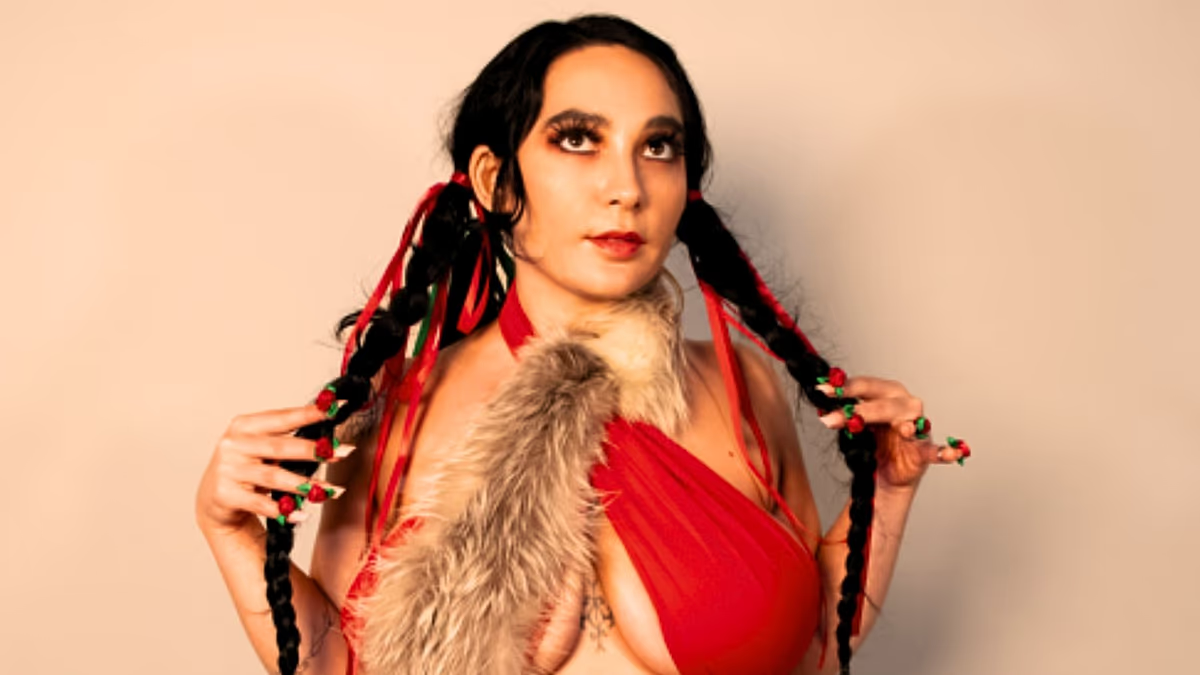
In an era where the lines between artist, activist, and political commentator are increasingly blurred, a recent incident involving US musician DJ Haram has ignited a fierce debate spanning continents. The UK’s Shadow Home Secretary, Chris Philp, has reportedly called for the artist, whose real name is Zubeyda Muzeyyen, to be barred from entering the United Kingdom. This demand stems from remarks she made last month during an opening event at the prestigious Sydney Biennale in Australia. There, Muzeyyen delivered an impassioned speech expressing solidarity with those enduring humanitarian crises in Palestine, Iran, and Lebanon, framing her art within a context of political resistance and a refusal to remain silent.
The catalyst for the controversy was her use of the phrase, “From the river to the sea, Palestine will be free.” This slogan exists in a starkly polarized space of interpretation. For many pro-Palestinian advocates, it is a resonant cry for justice, equality, and liberation from decades of Israeli military occupation and control, envisioning a single state where all inhabitants enjoy equal rights. However, for many in the Jewish community and supporters of Israel, the same phrase is heard as a direct call for the destruction of the State of Israel, evoking deep-seated fears and historical trauma. Muzeyyen compounded the charged atmosphere by stating, “I refuse to comply with artwashing the genocide,” and opposing what she termed the “Zio-Australian-Epstein empire,” concluding that “Until Palestine is free, none of us are free.” Her words thrust the age-old dilemma of artistic expression versus potentially harmful rhetoric into the spotlight.
The immediate fallout occurred in Australia, where local police launched an investigation into whether her comments constituted a criminal offense. However, New South Wales Police Commissioner Mal Lanyon later indicated that her speech was unlikely to meet the high legal threshold for hate speech, emphasizing the valued principle of free speech in a democratic society. This outcome highlighted one nation’s approach to balancing inflammatory rhetoric with the protection of liberty—a balance that is now being tested differently elsewhere. This contrast sets the stage for the UK’s impending decision, demonstrating how the same words can be processed through distinct legal and cultural frameworks.
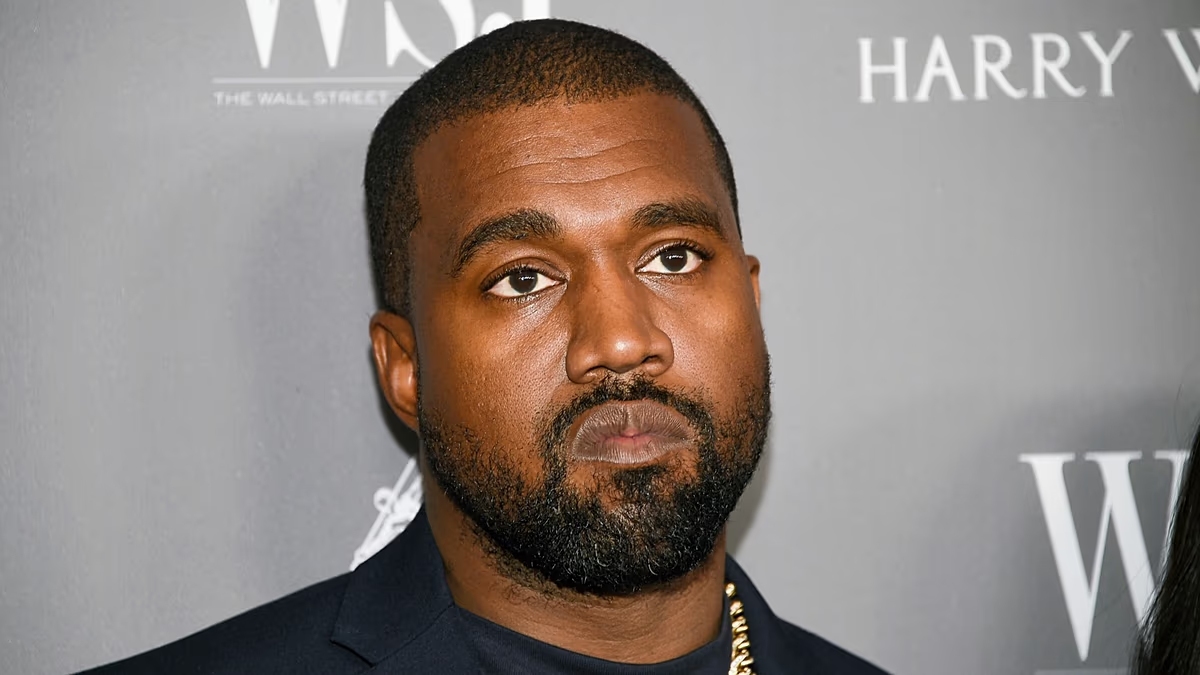
Chris Philp’s intervention marks a significant escalation. In his reported statements to Jewish News, he framed the issue not merely as one of offensive speech, but as a matter of public safety and moral standing, explicitly linking Muzeyyen to allegations of antisemitism and the promotion of terrorism. He drew a direct parallel to the Home Office’s recent ban on Kanye West, arguing, “The last thing this country needs is a visit from yet another international musician embroiled in such allegations.” Philp contends that allowing her to perform is “patently not conducive to the public good,” especially amidst ongoing concerns about antisemitism and extremism in the UK. His demand places the focus squarely on the limits of tolerance in a diverse society and the government’s role in policing ideological boundaries at the border.
Amidst this political storm, the artist at its center continues her professional trajectory. DJ Haram is still scheduled to perform at venues in London, Birmingham, and Manchester this month. Her acclaimed debut album, ‘Beside Myself,’ which fuses club beats with harsh electronics and Middle Eastern samples, was celebrated by Euronews Culture as one of the best of 2025—a “dystopian rave” of restless energy. This artistic identity complicates the narrative, reminding the public that she is not merely a political provocateur but a significant musical voice. The situation poses a poignant question: can, or should, a government separate the art from the artist’s political assertions when considering entry into the country?
Ultimately, the case of DJ Haram transcends a simple travel ban request. It serves as a powerful microcosm of global conflicts over free speech, the responsibilities of artists, and the painful, ongoing tensions surrounding the Israeli-Palestinian conflict. It forces a society to examine where it draws the line between protecting communities from hate and upholding the fundamental freedom of expression, even when that expression is profoundly unsettling to many. Whether she performs in the UK or is turned away, the debate her journey has sparked about art, politics, and the borders we choose to enforce—both physical and ideological—will resonate far longer than any single set.