

Summarized and Humanized Account
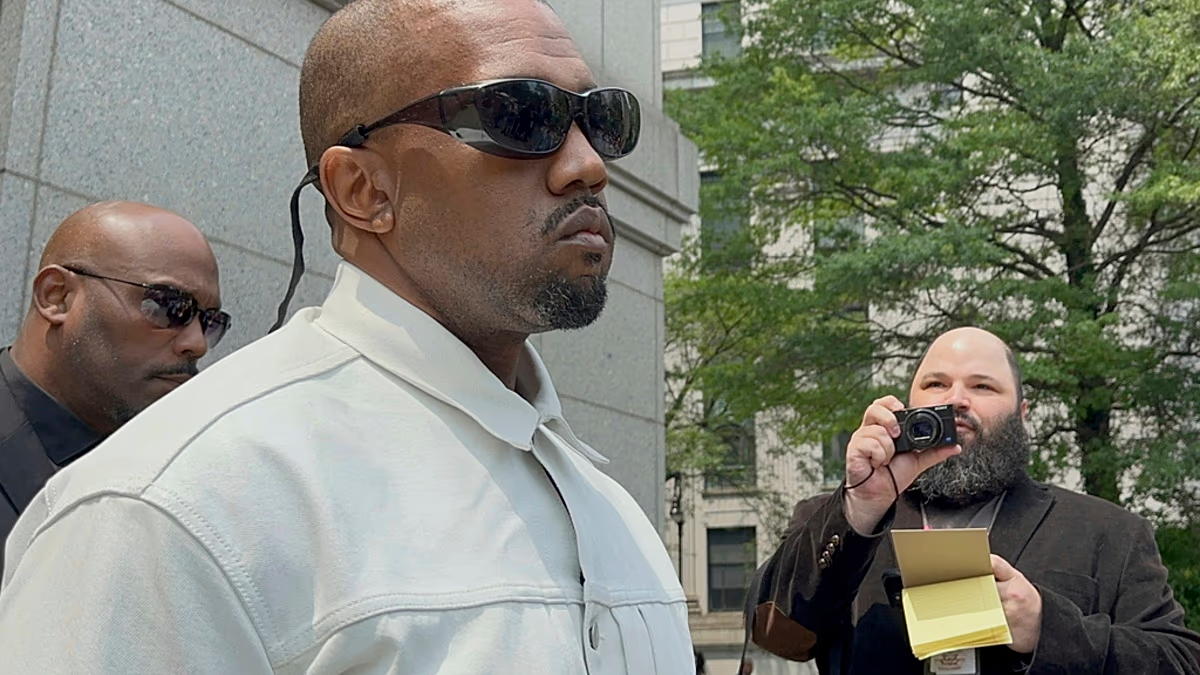
The planned concert of American rapper Kanye ‘Ye’ West at Marseille’s Velodrome stadium on June 11th has been postponed, following a high-profile political controversy in France. The decision came amidst reports that French Interior Minister Laurent Núñez was actively seeking to ban the event, citing the artist’s extensive history of making antisemitic remarks and promoting Nazi imagery. In a statement posted to social media, West addressed the situation, writing, “I know it takes time to understand the sincerity of my commitment to make amends… I take full responsibility for what’s mine but I don’t want to put my fans in the middle of it.” This incident is the latest in a series of international repercussions for the rapper, highlighting the ongoing tension between artistic performance, free expression, and the societal responsibility to combat hate speech.
The controversy in France did not emerge in a vacuum. West’s European tour plans have already faced significant obstacles, most notably a ban from entering the United Kingdom. British authorities and Prime Minister Keir Starmer deemed his potential presence “deeply worrying,” leading to the cancellation of his headline slot at the Wireless Festival. This international context set the stage for the scrutiny in Marseille. The rapper’s actions in recent years have been particularly incendiary, including the release of a song titled ‘Heil Hitler’ in May 2025 and the prior sale of merchandise featuring swastikas. Though West has subsequently expressed regret and attributed some behavior to his publicly disclosed bipolar disorder, the offensive nature of these acts has left a deep and lasting stain on his public standing.
In Marseille, the announcement of the concert on March 4th triggered immediate and forceful condemnation from local and national figures. Mayor Benoît Payan declared West “not welcome” at the Velodrome, a stadium owned by the city, stating firmly, “I refuse to allow Marseille to be a showcase for those who promote hatred and outright Nazism.” This sentiment was powerfully echoed by Fabienne Bendayan, Honorary President of the Representative Council of Jewish Institutions of France (CRIF) in Provence, who emphasized the profound mismatch between the artist’s rhetoric and the city’s identity. “Anyone who openly proclaims his admiration for Hitler and claims to hold Nazi ideas cannot set foot on the stage of a city whose very soul is woven of diversity, memory and fraternity,” she asserted. Their opposition framed the issue as a defense of Marseille’s communal values against imported hatred.
The situation quickly escalated from public criticism to formal governmental action. Regional Prefect Jacques Witkowski initially signaled the state’s concern, noting he was “very interested” in the case alongside the Interior Minister. This bureaucratic language soon translated into a concrete effort by Minister Núñez to legally prevent the concert from proceeding. Faced with this formidable political and administrative pushback, the postponement became virtually inevitable. It represents a clear instance where French authorities exercised their legal and moral authority to draw a line, prioritizing public order and the fight against antisemitism over commercial entertainment interests. The move underscores a broader European pattern of taking a firm stance against hate speech, even when it originates from globally recognized cultural figures.
This episode forces a difficult conversation about accountability, redemption, and the limits of tolerance in the public sphere. While West has apologized and cited his mental health, many argue that the severity and repetitive nature of his actions create a lasting harm that simple statements cannot erase. The question becomes: at what point does an individual’s past behavior rightly preclude their access to massive public platforms? For the French officials and Jewish community leaders involved, the answer was clear in this instance. They viewed the potential concert not merely as a musical event, but as an act of normalization that would insult victims of historical Nazism and contradict France’s foundational principles of liberté, égalité, fraternité.
Ultimately, the postponement in Marseille is more than a scheduling change; it is a cultural and political statement. It reflects a society grappling with how to balance artistic freedom with the imperative to protect its citizens from hateful ideology. For Kanye West, it marks another major setback in his attempt to return to the European stage after a 12-year absence, suggesting that the consequences of his words and actions continue to reverberate powerfully. For the city of Marseille, the decision stands as a defense of its complex, diverse identity against symbols of pure bigotry. The story concludes not with a musical performance, but with a reaffirmation of the boundaries a community sets to safeguard its collective conscience and historical memory.