



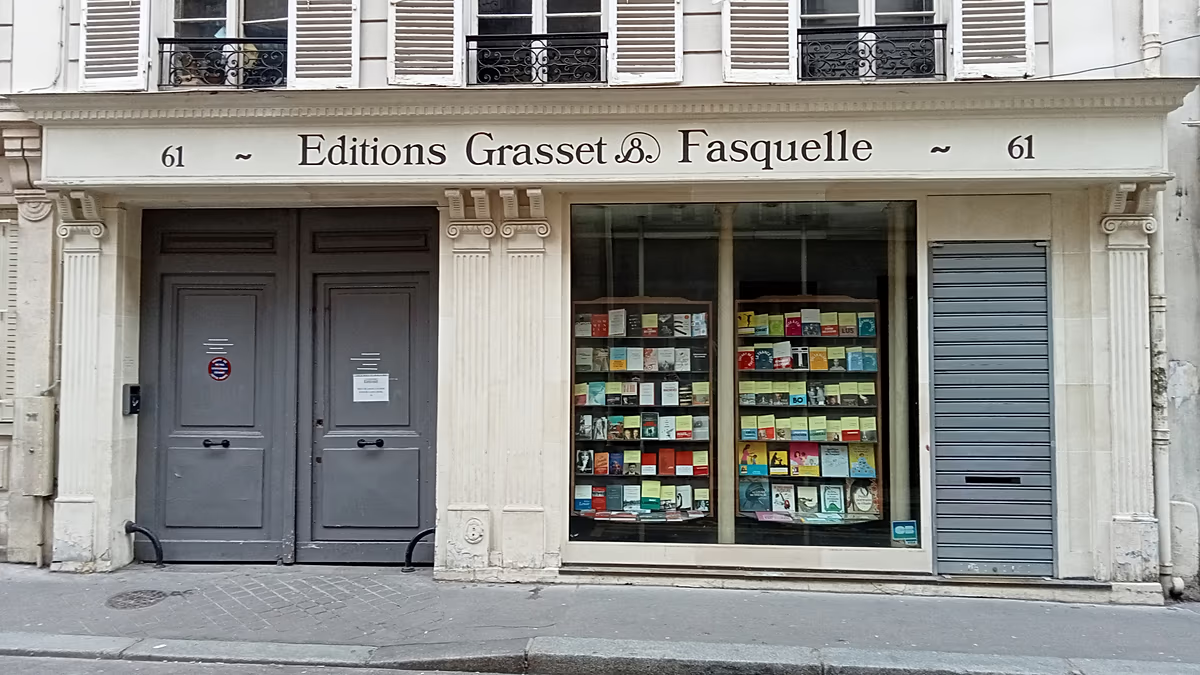
In a remarkable and unified stand, over 115 prominent authors have publicly severed ties with the prestigious French publishing house Grasset. This mass exodus was triggered by the abrupt dismissal of its long-standing chairman, Olivier Nora, after 26 years at the helm. The authors, in a powerful joint letter, framed their departure not as a simple business dispute but as a direct resistance against what they describe as an “ideological war” waged by media billionaire Vincent Bolloré. They accuse the ultraconservative magnate, whose Vivendi group controls the Hachette Livre publishing empire (Grasset’s parent company), of seeking to “impose authoritarianism throughout culture and the media.” Their collective statement, “We will not sign our next book with Grasset,” is a defiant act of protest, rare in its scale within the literary world, underscoring a profound fear that artistic independence is being subsumed by corporate and ideological control.
The immediate catalyst was the surprising and unexplained ousting of Olivier Nora, a figure deeply respected within literary circles. While no official reason was given for his dismissal, the authors’ letter leaves little doubt about whom they hold responsible. They directly implicate Vincent Bolloré, quoting a sentiment they believe drives his actions: “I’m at home and I can do what I want.” For these writers, Nora represented more than a manager; he was “the bulwark and cement” of a house celebrated for its intellectual diversity and quality. His removal is seen not as a neutral executive decision but as a symbolic purge, a move to align the publisher’s ethos with Bolloré’s own conservative vision. The authors explicitly reject the notion that their creative work should become “his property,” framing their exit as a necessary defense of their artistic and ideological autonomy.
Speculation swirled that Nora’s departure was linked to internal tensions over an upcoming book by the renowned Algerian author Boualem Sansal, known for his critical writings. Reports suggested a disagreement over the publication timeline for Sansal’s work about his imprisonment in Algeria. However, Sansal himself quickly disputed this narrative, revealing that Nora had personally written to assure him, “You have nothing to do with this.” This clarification suggests the rift runs deeper than any single title, pointing to fundamental clashes over editorial direction and freedom. The list of departing authors—including literary stars like Virginie Despentes, Vanessa Springora, and Sorj Chalandon—represents a significant brain drain and a powerful vote of no confidence in Grasset’s future under its current ownership.
This crisis at Grasset is not an isolated incident but a vivid symptom of a sweeping transformation within the entire Hachette Livre group since Vincent Bolloré assumed control in 2023. The group, one of the world’s largest publishers, has been undergoing a quiet revolution, with a pattern of high-profile departures signaling internal turmoil. Other senior executives, such as former Hachette Livre CEO Arnaud Nourry and Fayard head Sophie de Closets, have also left their posts amid reported strategic disagreements. These exits paint a picture of a corporate culture in flux, where longstanding publishing philosophies are being challenged and reshaped from the top down, causing unease among those committed to traditional editorial independence.
Concurrently, observers note a perceptible shift in the editorial lines of some Hachette imprints. Publishers like Fayard have increasingly featured works by politicians and figures from the right and far-right of the political spectrum, including former President Nicolas Sarkozy, National Rally president Jordan Bardella, and polemicist Philippe de Villiers. While publishing a range of voices is not inherently controversial, the timing and context—alongside the ousting of editors known for their eclectic, liberal lists—suggest a deliberate strategic pivot. This shift is interpreted by many in the literary community as evidence of Bolloré’s broader project to influence the cultural landscape, extending from his television channels and newspapers into the very heart of France’s publishing industry.
The stand taken by Grasset’s authors is therefore a watershed moment, transcending a single publishing house. It represents a collective, principled stance by creators against the perceived consolidation of cultural power in the hands of a single, ideologically driven billionaire. Their departure is a dramatic attempt to draw a line in the sand, defending the publishing world as a space for pluralism and free debate. The long-term consequences remain uncertain: Will this protest inspire similar actions across the industry, or will it become a cautionary tale? What is clear is that the battle for the soul of French publishing has been openly declared, with writers themselves leading the charge to determine whether their future is written by the dictates of the market and ideology or by the enduring values of artistic freedom and diversity of thought.