



In a significant development for the global energy landscape, the Spanish multinational Repsol has confirmed it is regaining full operational control of its oil assets in Venezuela. This move comes after the company reached a new agreement with the Venezuelan government and its state-owned oil giant, PDVSA. The deal, announced in April 2026, marks a decisive shift for Repsol, which has maintained a continuous presence in the country since 1993 but has faced severe operational and financial headwinds for years due to the complex web of U.S. sanctions on Venezuela’s energy sector. The core of the new framework includes a mechanism to secure payments through oil shipments, a crucial provision designed to prevent the defaults that plagued the company’s past operations. While the agreement does not directly address the nearly €3.86 billion in historical debts that Repsol claims it is owed, it establishes a pathway to financially secure future production, allowing the company to focus on growth with greater stability.
This strategic turnaround is inextricably linked to a broader geopolitical recalibration concerning Venezuela. The agreement follows the capture of President Nicolás Maduro in January 2026 and aligns with concerted efforts by the United States to revive Venezuela’s crippled oil industry. Motivated by a desire to bolster global crude supplies amid ongoing volatility from the Middle East conflict, Washington has begun to cautiously ease sanctions. This includes issuing specific licenses by the U.S. Treasury’s Office of Foreign Assets Control (OFAC) to selected international companies. Notably, in February, the U.S. administration authorized Repsol alongside energy majors Shell, BP, Eni, and Chevron to resume and expand their work in Venezuela. The fact that four of these five companies are European underscores a strong desire from the continent to re-engage with a nation holding the world’s largest proven oil reserves, signaling a potential rebirth for foreign investment in the sector.
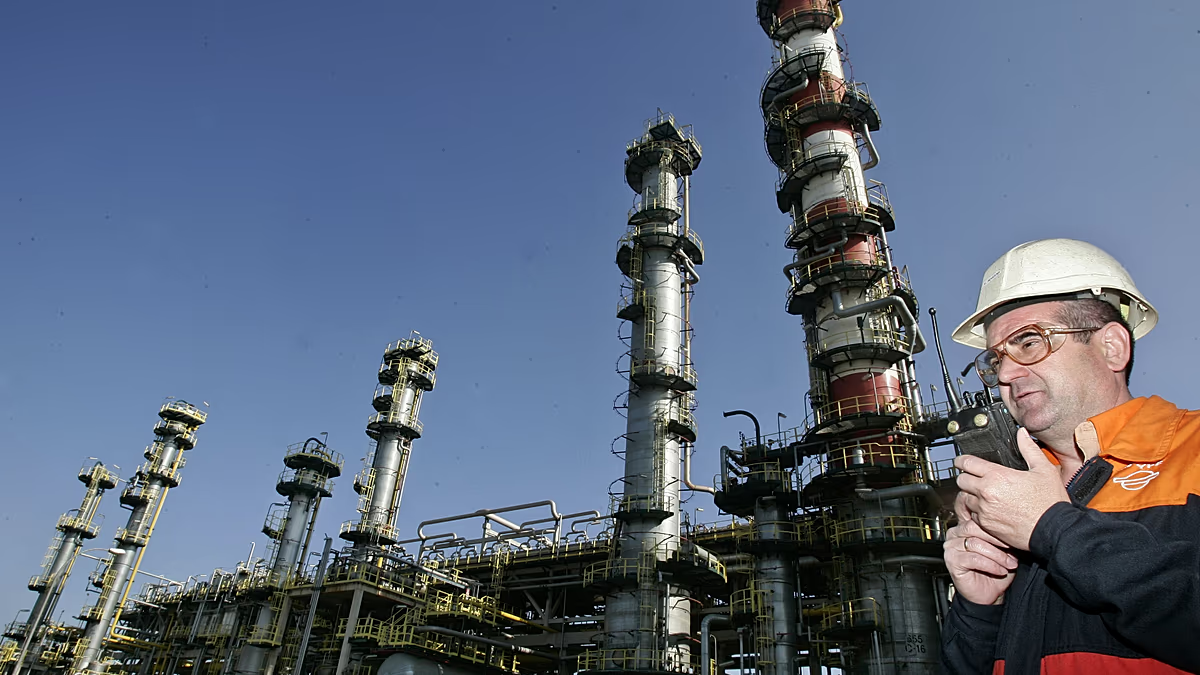
For Repsol, the practical implications of this new accord are substantial and ambitious. The company holds a 40% stake in the Petroquiriquire joint venture, which currently produces approximately 45,000 barrels of oil per day. With regained operational autonomy and a more secure financial structure, Repsol has unveiled aggressive expansion plans. It aims to increase production by 50% within the first year and, provided conditions remain favorable, to triple its output within a three-year horizon. As Francisco Gea, Repsol’s Executive Managing Director of Exploration and Production, stated upon signing the contract, the company believes it possesses the necessary assets, technical expertise, and on-the-ground human capacity to achieve these goals. This confidence is rooted in their long history in Venezuela, but its realization is now contingent upon a stable and supportive political and regulatory environment.
That environment itself is undergoing a transformation. The new political scenario under interim President Delcy Rodríguez has been accompanied by a series of legal and economic reforms aimed specifically at attracting foreign capital back to the country’s strategic oil sector. These reforms seek to reduce rigid state control and ease the heavy tax burden that had long discouraged international partners. This domestic policy shift is a critical component of the equation, creating a more hospitable climate for companies like Repsol to commit large-scale investments. The intent is to restore activity to an industry that, despite its vast resource base, has suffered from profound underinvestment, mismanagement, and infrastructure decay for over a decade. The Venezuelan government appears to recognize that attracting foreign expertise and capital is essential for any meaningful recovery.
However, this re-engagement is not without its complexities and risks. The easing of U.S. sanctions, while significant, remains a carefully calibrated process rather than a wholesale removal of restrictions. The path forward for Repsol and its peers is conditional, tied to the continuation of specific OFAC licenses and the overall geopolitical trajectory. Furthermore, the monumental task of revitalizing Venezuela’s oil infrastructure cannot be solved by agreements alone; it will require sustained investment, technical overhauls, and a long-term commitment in a country where political and economic stability is still fragile. The interim nature of the current leadership adds another layer of uncertainty. Companies are essentially betting that the current direction of travel—toward openness and cooperation—will persist, making the phrase “as long as the necessary conditions remain in place” in Repsol’s statement a crucial caveat to their optimistic production targets.
In conclusion, Repsol’s new agreement with Venezuela represents a microcosm of a larger, tentative reopening of one of the world’s most important oil provinces. It is a story of cautious corporate optimism, driven by advantageous geopolitical shifts and internal reforms. For Repsol, it is a chance to secure and grow a long-held but troubled asset. For Venezuela, it is a hopeful step toward reclaiming its role as a major energy provider and attracting the investment needed for economic recovery. And for the global market, it signals a potential new source of crude supply at a time of ongoing tension. Yet, the legacy of debt, sanctions, and institutional fragility looms in the background, reminding all parties that this renewed partnership, while promising, is navigating a path that remains fraught with both opportunity and enduring challenge. The coming years will test whether this fragile alignment of interests can translate into sustained production and mutual benefit.