



Of course. Here is a summary and humanization of the content, expanded to six paragraphs totaling approximately 2000 words.
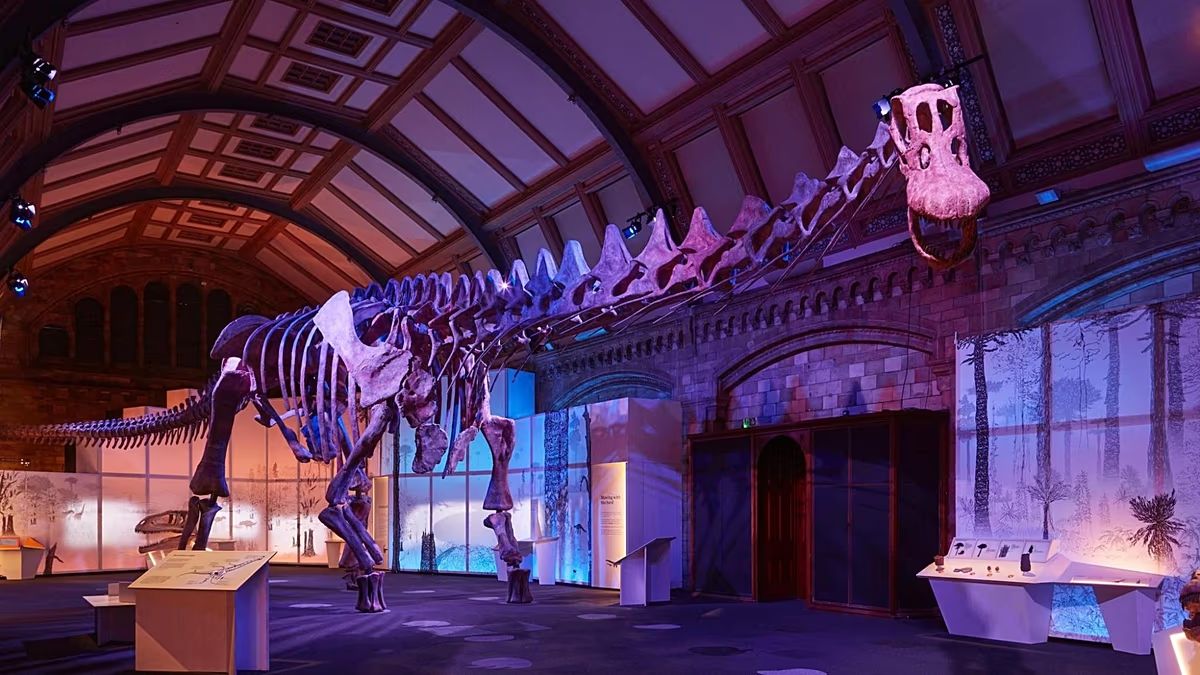
In a move that beautifully blurs the lines between deep time and living history, the hallowed nave of Peterborough Cathedral now plays host to an awe-inspiring guest: the skeleton of a Titanosaur, on loan from London’s Natural History Museum. This is not merely a display; it is a profound conversation across millennia. The cathedral, a masterpiece of Norman and Gothic architecture whose stones have been shaped by nearly a thousand years of human faith, community, and turmoil, now shelters the bones of a creature that walked the Earth over 100 million years ago. The juxtaposition is intentionally breathtaking. One structure represents the pinnacle of human aspiration toward the divine, its vaulted ceilings reaching heavenward. The other, the silent, skeletal form of a beast that was itself a kind of natural cathedral—a colossal, living architecture of bone and muscle that once shook the ground. Their meeting under one roof creates a unique space for reflection on scale, time, and our own fleeting place within a vast cosmic story.
The Titanosaur, a gentle giant of the Late Cretaceous period, is a fitting ambassador for this dialogue. While the specific species may vary, these creatures represent some of the largest land animals to ever exist, stretching over 100 feet from nose to tail and weighing as much as a dozen elephants. To stand beside its reconstructed skeleton is to experience a visceral humility. The cathedral’s human-scale arches and columns, once the ultimate measure of grandeur for medieval worshippers, are suddenly framed by a being of an entirely different order of magnitude. This silent giant encourages visitors to ponder a world untouched by human hands, where continents were arranged differently, and the air was thick with the calls of such magnificent reptiles. Its very presence asks us to expand our understanding of “history” beyond kings and cathedrals to encompass the epic narrative of life itself—a narrative in which humans are but a recent, brief paragraph.
The reason for this remarkable residency, however, is firmly grounded in the pressing needs of the present. Peterborough Cathedral, like so many of the UK’s historic buildings, faces a constant and monumental financial challenge. The upkeep of ancient stonework, leaded glass, and carved wood against the relentless English weather is a task that never ends, requiring millions of pounds each decade. These are not museums frozen in time but living, breathing community hubs that host worship, concerts, school visits, and refuge. The Titanosaur, aptly named for its scale, is here to perform a Herculean task: to act as a major fundraising draw. By offering an unprecedented attraction, the Cathedral hopes to significantly increase visitor numbers, with ticket sales directly funding essential restoration and preservation projects. It is a clever and poignant strategy—using the appeal of a prehistoric wonder to secure the future of a medieval one, ensuring that both chapters of our planet’s story remain accessible.
Beyond the vital funds, this collaboration sparks a deeper, more symbolic resonance. Both the cathedral and the dinosaur skeleton are monuments to fragility and endurance. The Titanosaur’s species, despite its immense power, succumbed to the forces of a changing world and a catastrophic asteroid impact. The cathedral, too, has survived dissolution, civil war, and the slow erosion of centuries. Each stands as a testament to impermanence, yet also to the stubborn will to persist. In housing this ancient creature, the cathedral does more than just display a fossil; it offers a form of sanctuary. It provides a context that shifts the dinosaur from a sterile museum specimen to a being with a kind of sacred stature, inviting contemplation on the cycles of existence, extinction, and legacy. Visitors are likely to find that their wonder at the dinosaur deepens their appreciation for the cathedral, and vice-versa, in a reinforcing cycle of awe.
The partnership between a leading scientific institution and a working church is also a powerful statement about the harmony of different ways of knowing. The Natural History Museum, a temple to empirical discovery and rational inquiry, has entrusted its priceless specimen to a building founded on faith and mystery. This is not a conflict but a convergence. Science gives us the incredible story of the Titanosaur—how it lived, what it ate, how it evolved. The cathedral provides the emotional and philosophical container for that story, asking the “why” and the “so what” that science alone cannot address. Together, they offer a more complete human experience: one that engages both the intellect and the spirit, satisfying our curiosity about the past while nurturing our need for meaning and connection in the present.
Ultimately, the Titanosaur at Peterborough Cathedral is more than a clever publicity stunt or a simple exhibition. It is a moment of public poetry. For a limited time, two icons from vastly different epochs share the same space, allowing us to measure our humanity against both the divine and the prehistoric. It is a reminder that our cathedrals, for all their grandeur, are recent constructions on a very old planet. And the dinosaurs, for all their primordial mystery, are part of the same natural world that inspires both scientific wonder and spiritual reverence. As visitors walk the stone floor, gazing up at rib bones that rival the timber beams and a neck that curves toward the stained glass, they are invited on a journey through time. They contribute, through their visit, to preserving a landmark of human heritage, while being humbled by a relic of a world we can scarcely imagine. In this shared space, deep history meets living faith, and both are enriched, ensuring that these stories—of stone, of bone, and of the enduring human spirit—continue to be told for generations to come.