


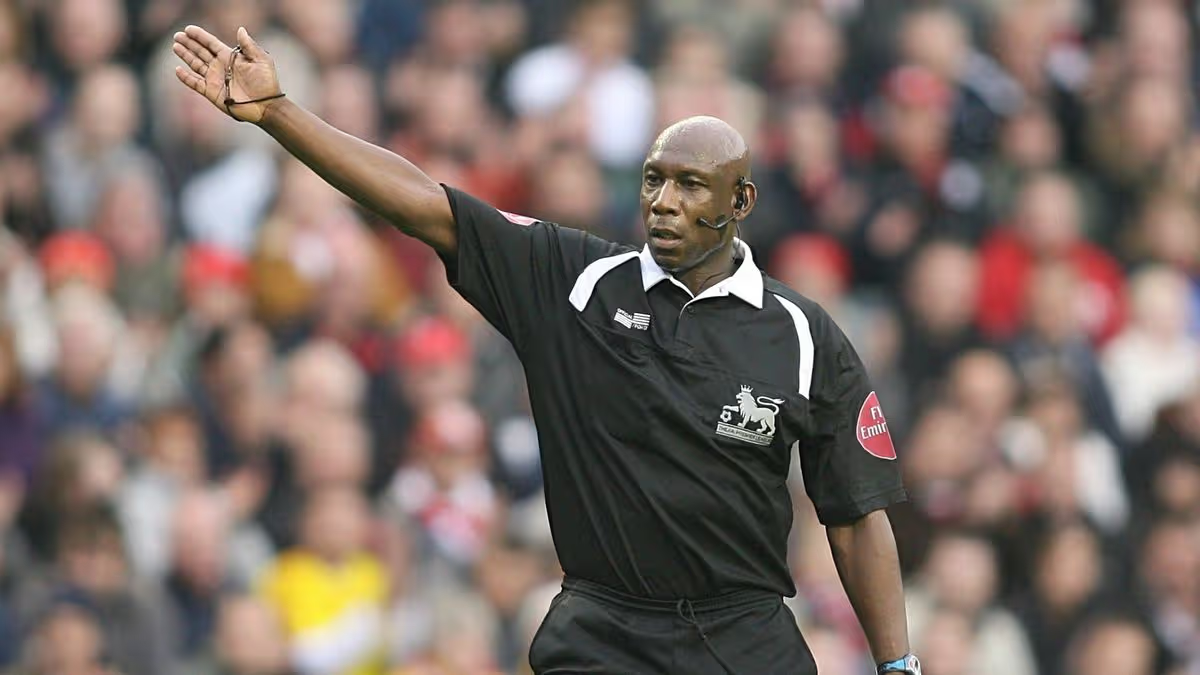
The world of English football recently mourned the loss of a true pioneer, Uriah Rennie, who passed away in June of last year at the age of 65. More than just a statistic in the record books, Rennie was a groundbreaking figure who, in 1997, became the first black referee to officiate a Premier League match, overseeing a clash between Derby County and Wimbledon. His journey to that historic moment began in 1994 when he joined the national list of match officials, embarking on a career that would see him preside over more than 300 games, including 175 in the English top flight. His passing, after a private battle with cancer in a Sheffield hospital, marked the end of a life dedicated not only to the sport but to breaking barriers and serving his community, leaving behind a legacy far greater than the final whistle on any match.
Beyond the pitch, Rennie was a devoted family man, and recent legal documents have revealed the material legacy he left to his loved ones. Having died without a formal will, his estate—valued at a substantial £1.28 million—was automatically passed on to his partner, Jayne, and his two children. This financial security stands as a private testament to the success of his career, a career built on integrity and excellence. In a heartfelt statement released after his death, Jayne and Rennie’s brother, Glenroy, expressed their profound grief and gratitude for the support from medical staff and close friends, simply stating, “Uri will be so very sadly missed.” This personal loss underscores the man behind the iconic figure, a man cherished deeply within his family circle.
Uriah Rennie’s influence extended well beyond his active refereeing years, which concluded in 2005. He channeled his passion and stature into meaningful advocacy, campaigning tirelessly for equality, inclusion in sport, and better mental health support. His commitment to education and community was formally recognized just four months before his death when he was appointed Chancellor of Sheffield Hallam University, a role that reflected his dedication to nurturing future generations. This chapter of his life highlights that his pioneering spirit was not confined to football; he was a leader who used his platform to advocate for a fairer and more supportive society, ensuring his impact was felt in lecture halls and boardrooms as well as on the football field.
The outpouring of tributes following his death painted a clear picture of the respect and admiration he commanded across the footballing world. The Football Association remembered him as “a true trailblazer of the game,” while Sheffield United, a club from the city he called home, noted his popularity and pioneering spirit. The Sheffield FA offered a particularly poignant summary, stating he “broke down barriers, shaped our football community and inspired generations to come.” These institutional acknowledgments were echoed by personal sentiments from those within the sport, such as former striker Stan Collymore, who called him “a pioneer, trailblazer and a bloody good ref.” These collective voices affirm that Rennie’s legacy is one of profound professional respect and human inspiration.
Reflecting on Uriah Rennie’s life and career offers a powerful narrative about visibility and resilience. In an era where diversity among players was growing but remained scarce in officiating, his presence at the highest level was both symbolic and substantive. Every match he officiated was a silent, powerful statement—proof that authority and expertise in the game were not defined by race. For aspiring referees from diverse backgrounds, seeing Rennie in control of high-stakes Premier League fixtures provided an invaluable, tangible example of what was possible. He carried this responsibility with a distinctive and commanding style, becoming one of the most recognizable officials of his time, respected for his fitness, his communication, and his unwavering fairness.
Ultimately, the story of Uriah Rennie is not solely captured in the historic “first” he achieved or the financial estate he left behind. It is a story etched in the respect he earned from a sometimes-unforgiving football community, in the causes he championed after hanging up his whistle, and in the quiet dignity with which he faced his final illness. He navigated the immense pressure of elite sport while carrying the weight of representation, paving a way for others to follow. His life reminds us that true legacy is measured in the barriers removed, the paths cleared, and the lives touched both publicly and privately. Uriah Rennie was more than a referee; he was a landmark figure whose contribution to football and to society continues to resonate, a true pioneer who has left an indelible mark on the beautiful game.