



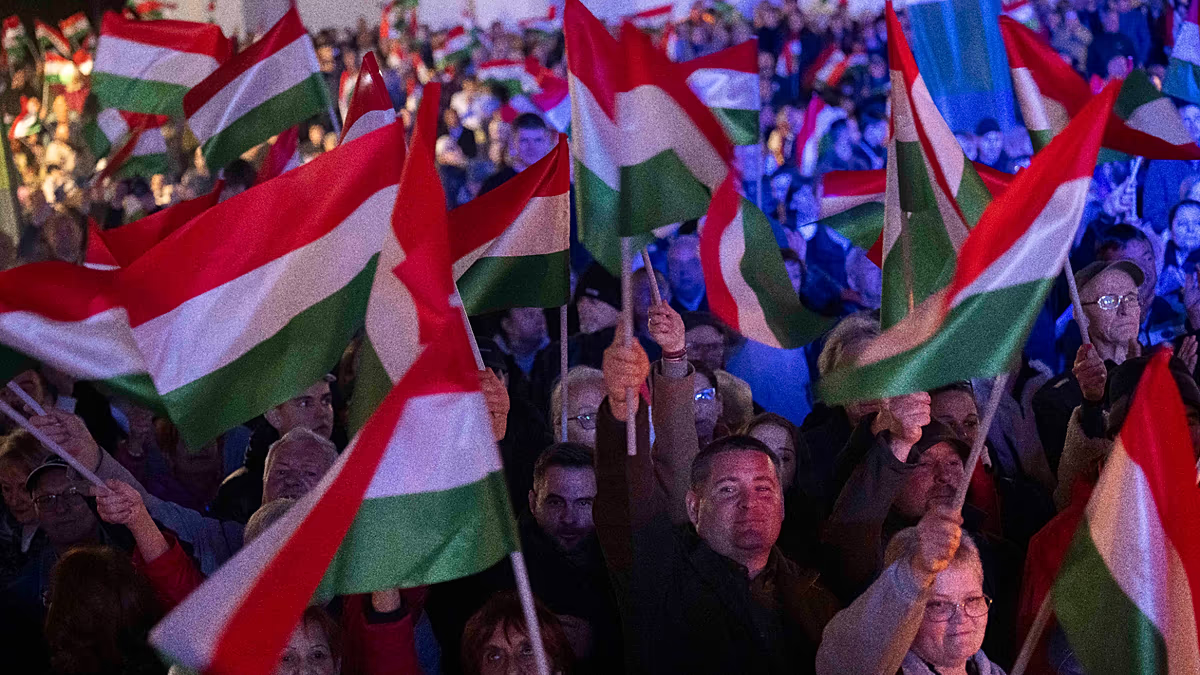
The recent Hungarian parliamentary election, which resulted in a seismic political shift ending Prime Minister Viktor Orbán’s 16-year rule, was not merely a contest of policies but a battleground of information. While the landmark victory of Peter Magyar’s Tisza party, securing a two-thirds majority, captured global headlines, the campaign preceding it was profoundly shaped by a torrent of disinformation. Although international concerns focused on Kremlin-linked interference, analysts on the ground concluded that the overwhelming majority of false narratives—estimated at over 90%—were domestically manufactured. This homegrown effort was spearheaded by Orbán’s Fidesz party and its extensive ecosystem, including influenced media outlets and proxy organizations like the National Resistance Movement and the Megafon influencer network. Their goal was to control the political narrative, and in this election, they deployed more aggressive and inventive tactics than ever before, signaling a desperate and ultimately unsuccessful attempt to cling to power.
The domestic disinformation campaign was marked by a startling escalation from propaganda to outright fabrication. Researchers noted that pro-government actors moved beyond spinning facts to creating their own false realities. A prime example was the fabrication of an entire Tisza party platform, which was leaked to a Hungarian news site. This forged document contained absurd and inflammatory fake policy proposals, such as taxing household pets, and was presented as evidence that the opposition planned massive tax hikes. Fidesz then amplified this complete fiction by featuring the fabricated policies on nationwide campaign posters. As analyst Konrad Bleyer-Simon explained, this move to manufacture “proof” for their propaganda reflected a party genuinely afraid of losing—a fear that proved justified. In response, Tisza’s grassroots, village-to-village campaigning helped build a tangible, human connection with voters that ultimately proved more resilient than the digital smears aimed at undermining their credibility.
While the domestic campaign was dominant, the classic tools of Russian interference were also present, though their impact appears to have been limited. Actors like the “Matryoshka” group, which specializes in fake video news reports, and “Storm-1516,” which creates counterfeit news articles, targeted the Hungarian electorate. Their operations included a fabricated Le Monde video accusing a Ukrainian artist of poisoning Hungarian dogs and elaborate articles claiming Magyar had insulted former U.S. President Donald Trump. Analyst Alice Lee suggested this heightened Russian activity might have been based on an assumption that Orbán’s control was unshakeable, prompting efforts to ensure a friendly government remained in place. However, much of this foreign-originated content was in English and circulated on X (formerly Twitter), a platform less central to Hungarian political discourse than Facebook. Consequently, as fact-checker Szilárd Teczár noted, the actual reach and influence of these overt Russian operations were relatively contained within the noisy information landscape.
The disinformation fight also migrated to new terrain due to platform restrictions. Meta and Google’s bans on political advertising in the EU forced Hungarian parties to find loopholes to reach voters on Facebook, Instagram, and YouTube. While these restrictions did reduce the volume of traditional political ads, Fidesz adeptly circumvented them. The party created large, private Facebook groups like “Fighters Club” and “Digital Civic Circles,” which amassed tens of thousands of members. These groups, described as networks for patriots ready to act for “God, homeland and family,” served as organized brigades to boost the reach of pro-government content through coordinated liking and sharing. Furthermore, seemingly apolitical pages, such as an equestrian group called “Heart of Hungary,” ran paid ads pushing fabricated stories against Tisza politicians. This exploitation of community groups and niche pages created a shadow advertising network that was largely invisible to standard ad transparency tools.
Perhaps the most novel trend was the weaponization of artificial intelligence for personalized fear-mongering. Fidesz candidates deployed AI-generated videos with alarming efficiency, creating synthetic media that depicted Tisza politicians like Romulusz Ruszin-Szendi in military uniforms, forcibly taking young Hungarians to the front lines of the Ukraine war. These videos were a potent form of negative campaigning, designed to stoke social fears and discredit the opposition as warmongers. In turn, Tisza politicians co-opted the technology to push back, sharing AI-generated images of themselves featured as TIME Magazine’s “Person of the Year” to build a narrative of heroic defiance. This arms race in AI content, often posted directly to personal feeds and groups outside ad libraries, created a chaotic layer of synthetic media that was difficult for researchers to track and for voters to critically assess in the heat of the campaign.
In conclusion, Hungary’s election was a case study in modern, multi-front information warfare. The decisive result for Tisza demonstrates that even the most sophisticated dismachine can be overcome by a potent mix of grassroots mobilization and public desire for change. However, the campaign leaves behind a troubling legacy. It showcased a dangerous evolution from misleading rhetoric to the active creation of fraudulent evidence, the exploitation of social media platform loopholes, and the normalization of AI for generating deceptive political content. While overt Russian interference played a secondary role, the domestic playbook proved far more innovative and pervasive. This election underscores that the greatest threats to electoral integrity are increasingly homegrown, leveraging digital tools to create alternative realities. The challenge for Hungary and other democracies is no longer just debunking foreign lies, but defending against a pervasive, domestic ecosystem willing to fabricate the very ground on which political debate stands.