



The Dawn of Independent Robotic Explorers: ANYmal’s Journey Towards a New Era on Mars
In the quest to unravel the mysteries of other worlds, Swiss researchers are pioneering a revolutionary step forward. They are testing a semi-autonomous robot poised to transform planetary exploration by operating without constant human guidance. This advancement promises to significantly accelerate the search for minerals, water, and potential traces of ancient life on planets like Mars or even distant exoplanets.
A New Form of Explorer: The Robotic “Dog”
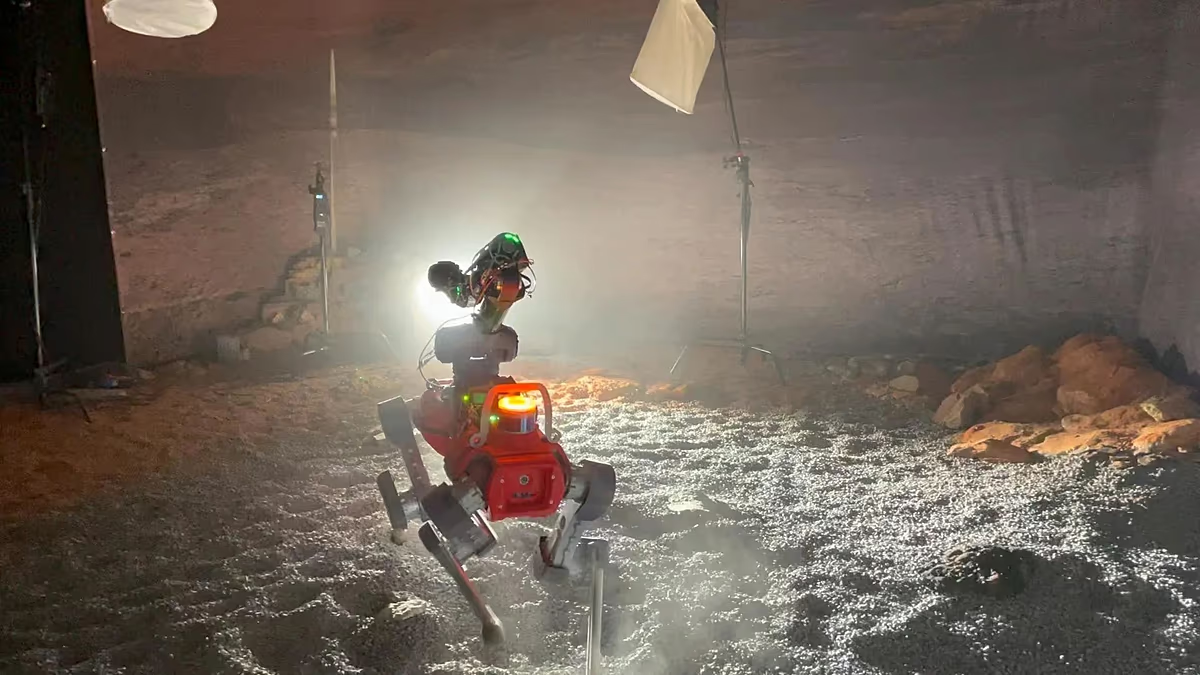
This explorer, named ANYmal, breaks from the traditional image of a wheeled rover. Resembling a sophisticated robotic dog, it is a four-legged machine equipped with a critical tool: a robotic arm carrying a microscopic imager and a Raman spectrometer. This scanner can analyze a rock’s chemical “fingerprint,” allowing for on-site identification of materials. To prepare it for extraterrestrial missions, researchers at the University of Basel have been rigorously testing ANYmal in their specialized “Marslabor”—a simulation facility designed to replicate the dusty, rocky terrains of Mars and the Moon.
The Mission: Autonomous Science in Action
The challenge presented to ANYmal was clear and ambitious: navigate independently, locate rocks with scientific potential, analyze them, and relay the findings—all without direct human control. In recent trials documented in Frontiers in Space Technologies, the robot successfully met this objective. It analyzed a sequence of rocks, correctly identifying substances like gypsum, carbonates, basalts, and lunar-analogue materials such as dunite and anorthosite. Remarkably, ANYmal completed these multi-rock missions autonomously in a mere 12 to 23 minutes, whereas a human operator performing the same task took 41 minutes. While human oversight yielded slightly more detailed and marginally more accurate results, the robot’s speed and independent capability represent a paradigm shift in operational efficiency.
Revolutionizing the Pace of Discovery
Current Mars rovers, while incredible achievements, operate under near-constant supervision from Earth, progressing only a few hundred meters per day. This careful, remote-piloted approach ensures safety but limits the pace of exploration. A robot like ANYmal, capable of making its own informed scientific decisions on the ground, could dramatically accelerate that pace. It could cover more terrain, analyze more samples, and make discoveries faster, compressing years of potential research into shorter, more productive missions.
The Advantage of Legs Over Wheels
The study further highlights a key advantage of ANYmal’s design: its legs. Unlike wheeled rovers, legged robots can step over obstacles and adapt to variable, rugged terrain. This mobility could allow them to access scientifically valuable areas—such as steep gullies, rocky outcrops, or crevices—that are currently unreachable for traditional rovers. By combining autonomous decision-making with superior mobility, these robots could explore the most promising, yet challenging, landscapes on other worlds.
The Future: Robots as Active Scientific Partners
Collectively, this research paints a picture of a transformative future for space exploration. Robots like ANYmal are evolving from being mere tools operated from afar into active, intelligent scientific participants. They could independently roam alien landscapes, hunting for biosignatures—the subtle chemical traces that might indicate past life on distant planets. This shift towards autonomous exploration promises not only to speed up our understanding of the cosmos but also to deepen it, as robots begin to make real-time scientific choices on the frontiers of worlds we seek to understand.