



A Fragile Dialogue: Lebanon and Israel’s First Talks in Three Decades
On a Tuesday in April 2026, a meeting of profound significance, yet fragile as glass, took place. For the first time in thirty years, representatives from Lebanon and Israel sat down at the same table. This was not a grand peace summit, but a tentative, technical discussion, likely centered on the longstanding and volatile border disputes that have frequently ignited conflict. The very occurrence of such dialogue, after three decades of silence and hostility, sends a tremor through the fraught landscape of the Middle East. It represents a crack in a wall once thought impenetrable, a flicker of recognition that the unsustainable status quo of perpetual tension carries a cost too high for both nations to bear indefinitely. This meeting, born not from sudden affection but from exhausting necessity, underscores a shared, if unspoken, understanding that the path of sheer confrontation has led only to cycles of destruction.
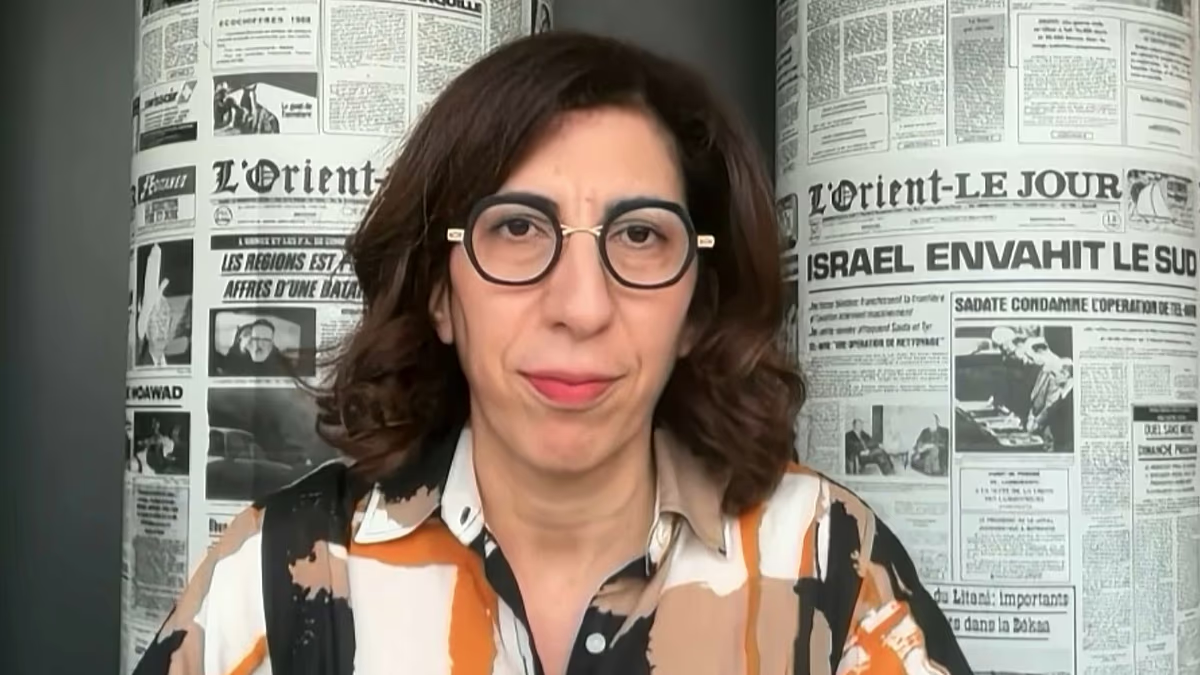
The weight of this moment is powerfully articulated by Rima Abdul Malak, the Lebanese-born former French Minister of Culture. Now serving as the executive director of the prominent Lebanese French-language newspaper L’Orient-Le Jour, she observes the proceedings with a mixture of cautious hope and acute urgency. “This is maybe our last chance to start on a good path,” she states. Her words are not those of naive optimism but of a stark warning. They come from someone who embodies the complex ties between Lebanon and the wider world, and who understands the deep-seated wounds and political fractures within Lebanese society itself. Abdul Malak’s perspective is crucial; she sees a narrow window, one clouded by the smoke of past wars and internal Lebanese paralysis, that might—if the international community acts decisively—allow for a new trajectory to be plotted.
Indeed, the internal context of Lebanon cannot be overstated. The nation is reeling from a concatenation of crises that would overwhelm any state: a financial collapse of historic proportions that has evaporated life savings, a political system mired in deadlock and corruption, and the aftermath of the catastrophic Beirut port explosion that laid bare the failures of its governing class. This domestic turmoil forms the bleak backdrop against which these border talks are occurring. The Lebanese state, in many ways, is fighting for its basic survival and sovereignty. Engaging with Israel, a country with which it is technically still at war, is an astronomically delicate maneuver. It is a step taken not from a position of strength, but from a desperate need to stabilize one front in order to possibly address the many other existential fires raging at home.
Recognizing this fragility, Rima Abdul Malak makes a direct appeal beyond the region. She calls upon the international community to “support” Lebanon in this process. This support is not a vague wish for goodwill; it is a plea for concrete, sustained, and diplomatic engagement. It means providing the guarantees and frameworks that can allow these tentative talks to grow roots. For Lebanon, walking this path alone is politically perilous. International backing can offer a measure of political cover for Lebanese officials, helping to insulate the process from hardline factions who would seek to sabotage any dialogue. For Israel, serious international involvement adds a layer of verification and accountability. This support is the essential scaffolding that might prevent the entire fledgling structure from collapsing at the first strong wind of opposition or provocation.
The challenges ahead are monumental and rooted in a history of profound distrust. Beyond the immediate border demarcation issues, particularly in the disputed Shebaa Farms area and along the Blue Line, lie deeper existential anxieties. For many in Lebanon, any engagement with Israel is viewed through the prism of resistance and the fear of normalization before core Palestinian issues are addressed. In Israel, Lebanon is often seen as a proxy entity, its state authority weakened by the powerful presence of Hezbollah, which operates as a parallel military force. Any agreement, however technical, would need to navigate this labyrinth of proxy conflicts, armed non-state actors, and the overarching shadow of the wider Arab-Israeli conflict. Success is not measured in a comprehensive peace treaty, but in the mere prevention of the next war—in creating a mechanism, however rudimentary, for communication and crisis management that has been absent for a generation.
Therefore, the talks of April 2026 must be seen for what they are: a beginning, not an end. They are the first, hesitant sentence in a story whose following chapters are entirely unwritten. The prognosis is fraught with the risk of failure, but the alternative—a continuation of the silent, tense stalemate that has repeatedly erupted into violence—is arguably worse. As Rima Abdul Malak implores, this may indeed be a final chance to pivot from a trajectory of periodic devastation toward one of managed, if uneasy, coexistence. The responsibility now lies not only with the negotiators in the room but with a watchful world that must decide whether to be a passive witness to the next inevitable flare-up, or an active participant in bolstering this fragile dialogue. The goal is modest but vital: to replace the language of missiles with the language of diplomacy, if only to secure the most basic of human necessities for the people on both sides of the border—the right to live without the constant fear of war.