



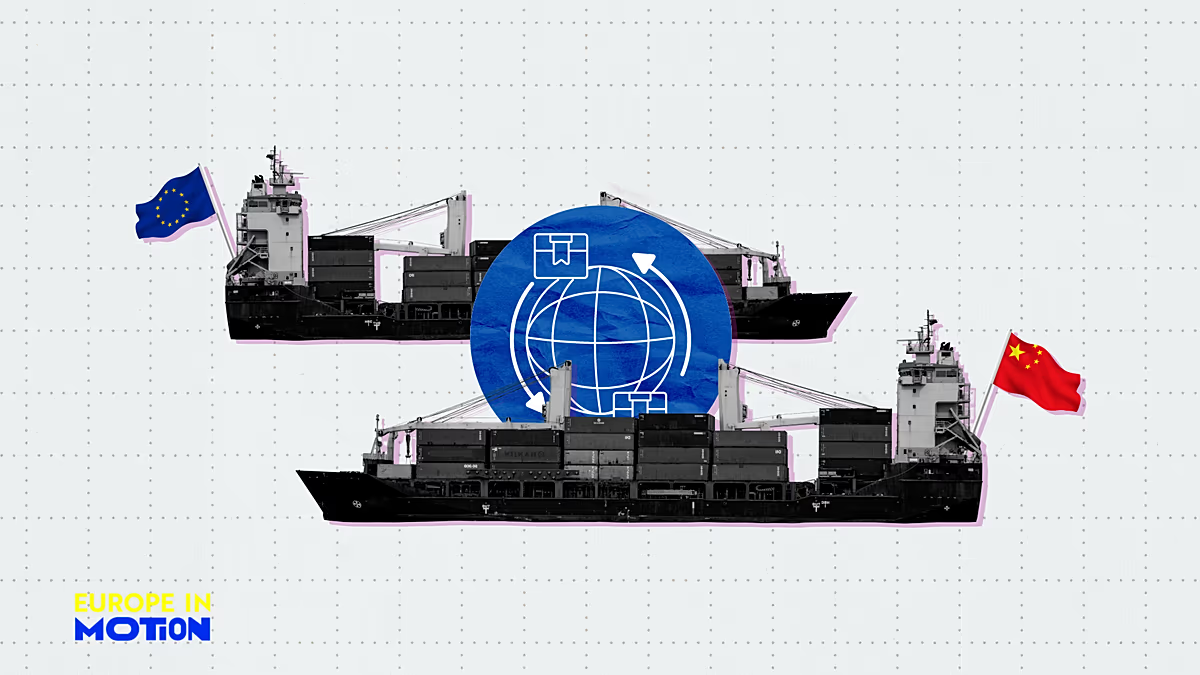
Defying the prevailing winds of geopolitical friction and a significant global trade dispute, economic exchange between the European Union and China demonstrated remarkable resilience over the past year. Even amidst the upheaval of the 2025 Trump tariff war, which saw the imposition of sweeping levies and prompted a global re-evaluation of supply chains, the commercial artery connecting Europe and Asia continued to pulse. The latest data from Eurostat reveals a relationship defined by profound interdependence and a stark numerical imbalance: the EU exported €199.6 billion worth of goods to China, while Chinese imports flooded into Europe to the tune of €559.4 billion. This resulted in a record trade deficit for the EU of €359.8 billion, a figure that looms large over the political landscape in Brussels. While year-on-year comparisons show a 6.5% dip in EU exports coupled with a 6.4% rise in imports from China, the longer-term trend is even more telling. Since 2015, European exports have grown by a respectable 37.1%, but they have been utterly outpaced by the 89% surge in imports from China, illustrating a deepening structural gap that has widened over the past decade.
The composition of this trade reveals the nature of the two economies’ symbiotic, yet unbalanced, relationship. European exports to China are dominated by high-value machinery and manufactured goods, reflecting areas of enduring European industrial strength. Leading the way are complex machinery and mechanical appliances, such as specialized textile fiber preparers and advanced harvesting equipment, which constitute 22.7% of all exports. They are followed by categories like electrical machinery, including items like storage water heaters, and vehicles, which account for 8.2%. In stark contrast, nearly two-thirds of all EU imports from China are concentrated in just five product categories, highlighting a intense reliance on Chinese manufacturing. The largest share, 29.5%, falls under electrical machinery and audio-visual equipment—a broad category encompassing consumer electronics and components. This is closely followed by machinery and mechanical appliances at 19%, signaling direct competition with European makers in areas where the Continent once held uncontested dominance. This import profile underscores how Chinese industry has climbed the value chain, moving from simple assembly to competing directly in sophisticated manufacturing sectors.
The external shock of the 2025 tariff war between the United States and China did force a recalibration of global trade routes, proving the adaptability of modern supply chains. Facing steep new barriers to the American market, Chinese exporters and producers worked diligently to redirect shipments to non-tariffed regions, notably expanding their commercial footprint in Southeast Asia, Europe, and Africa. This strategic pivot helped offset losses in the U.S. and demonstrated the flexibility of China’s export-oriented model. Analysts at the Brussels-based think tank Bruegel have noted that despite these geopolitical tremors, the overall volume of trade between the EU and China continued to grow, a testament to its fundamental resilience. However, this redirection also had the effect of pouring more Chinese goods into the European market, inadvertently exacerbating the EU’s existing trade deficit. Thus, a policy designed to pressure China in one theater had the knock-on effect of intensifying economic pressures in another, placing Europe squarely in the path of redirected Chinese exports.
This burgeoning deficit is not merely a statistic on a balance sheet; it has metastasized into a source of profound political anxiety and industrial unrest across Europe. Policymakers, industry leaders, and workers voice serious concerns that the flood of often subsidized Chinese imports fuels unfair competition, precipitates industrial decline in key sectors, and threatens mass unemployment. For years, Brussels has lodged official complaints against what it views as the distortive effects of Beijing’s state-run economic model, pointing to massive industrial overcapacity and extensive state subsidies that allow Chinese firms to undercut European competitors. The clearest and most contentious example is the electric vehicle sector, where an influx of competitively priced Chinese EVs has sparked panic among traditional European automakers and calls for urgent protective measures. The deficit, therefore, symbolizes a broader clash between economic governance models—Europe’s market-oriented framework versus China’s state-capitalist system—and the very real-world consequences for European communities and livelihoods.
Yet, translating this widespread concern into a unified, effective European response has proven to be an immense challenge. Despite sharing a common currency and a single market, the 27 EU member states possess divergent economic interests and geopolitical outlooks that fracture any consensus on how to confront China. Nations with significant Chinese investment or those reliant on cost-effective Chinese imports for their own industries are often hesitant to support aggressive defensive measures like tariffs or stringent trade investigations. This internal discord was vividly illustrated in the recent landslide election victory of Péter Magyar in Hungary. While signaling a potential shift from his predecessor’s unequivocally China-friendly stance, Magyar’s statement that he would “review” Chinese investments—particularly in EVs—”not with the aim of shutting them down or preventing them from happening,” captures the delicate balancing act many European capitals face. They seek to protect strategic industries without severing a commercial relationship that also provides benefits and opportunities, leaving the EU often appearing hesitant and divided.
Consequently, the EU-China trade relationship exists in a state of tense and paradoxical stability. The sheer scale of mutual economic entanglement ensures a degree of continuity, as businesses on both sides depend on the predictable flow of goods and components. The data confirms that not even a major tariff war could sever these deep connections. However, the political foundation upon which this trade rests is becoming increasingly fragile, eroded by the ever-widening deficit and the systemic tensions it represents. Europe finds itself caught between the undeniable economic logic of engagement with the world’s second-largest economy and the escalating political and social imperative to safeguard its industrial base and economic sovereignty. The path forward is fraught with complexity, requiring a nuanced strategy that goes beyond blunt instruments, one that must reconcile internal European divisions while crafting a response to Chinese economic practices that is both firm and sustainable. The resilience of the trade numbers, therefore, tells only half the story; beneath them lies a growing current of apprehension that will shape European economic policy for years to come.