



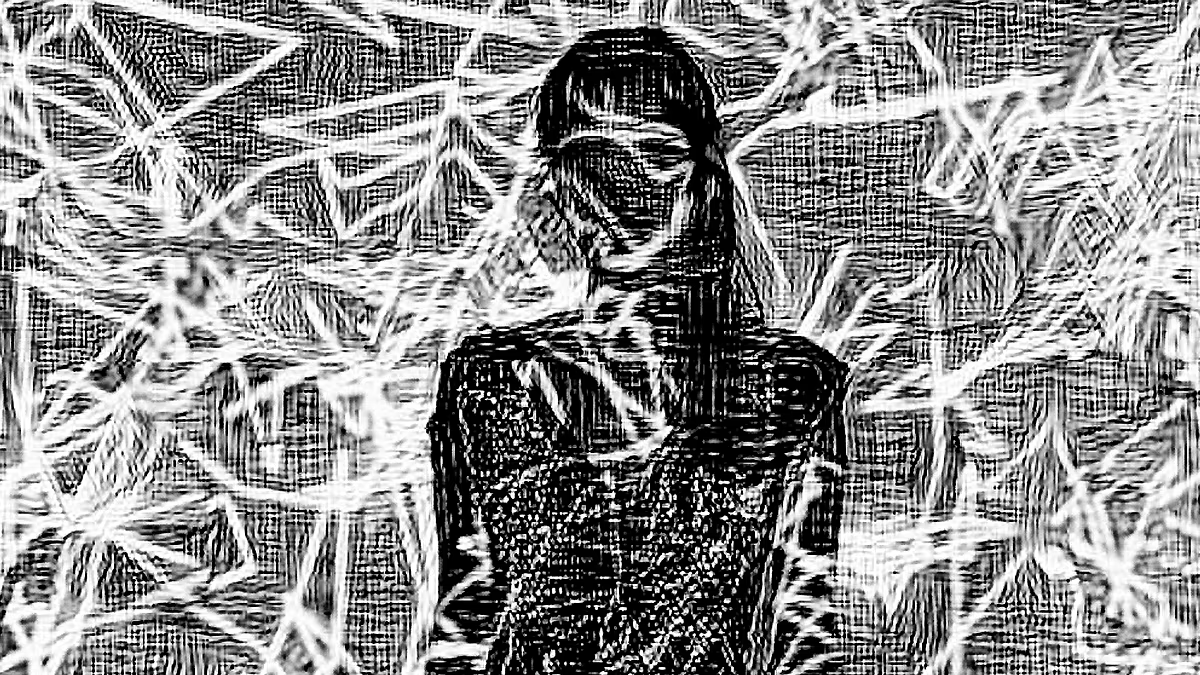
In the vibrant world of digital art, Berlin-based artist and technologist Alida Sun creates a symphony of motion, colour, and sound. When she moves, her body displaces cascading rows of technicolour shapes that shimmer and tinkle, generating geometric patterns and warbling chirps. These glittering artworks are not crafted with traditional tools, but with a self-designed system she calls an audio-visual instrument—a sophisticated technology that detects light and translates her physical gestures into real-time visuals and sounds. This practice is the core of her exhibition, RITES, and represents the culmination of a remarkable discipline: for over 2,500 consecutive days, nearly seven years, Sun has created a new piece of coded art every single day. Recognizing the potentially draining nature of being perpetually glued to a screen, she intentionally designed this process to be restorative. “When I started on this daily coding journey, I knew I was going to have to make the process restorative and fun for me,” she explains. Thus, her software became an extension of her physical self, transforming coding from a purely cerebral task into a daily ritual of bodily awareness and play.
Sun’s journey into this unique fusion of art and technology began with her background in STEM, where she was initially captivated by how light and interactive art could transform physical spaces, from rooms to entire neighbourhoods. Today, however, her focus has turned inward, seeking to make the often-intangible world of code feel intimate and physically resonant. “It’s endlessly fascinating to me how people can connect with an artwork through their phone screens and how it can affect them on a physical level because I am using my physicality to create these code artworks,” she shares. This philosophy directly challenges the prevailing notion of code as a disembodied, purely intellectual medium. With RITES, Sun pushes this investigation further by literally grounding her digital creations in the physical world, translating them into a series of hand-woven and embroidered tapestries. These were created in collaboration with women artisan weavers from the Swami Sivananda Memorial Institute (SSMI) in Delhi, a partnership that bridges continents, technologies, and generations of women’s craft.
The choice of tapestry is profoundly intentional, serving as the perfect vessel to explore the exhibition’s central theme: reclaiming the erased history of women’s pivotal contributions to technology. Sun positions RITES as an alternative narrative to the dominant “Big Tech bro-ligarchy,” highlighting how modern computational programming finds its literal roots in the ancient craft of weaving—a practice historically associated with women’s labour. She points to a powerful example: the women in New England who, using skills honed in textile mills, hand-wove the copper “rope” memory that stored the software for the Apollo moon missions. “Women literally wove the memory that got humanity to the moon,” Sun states, drawing a direct line from the loom to the lunar module. This forgotten kinship between textiles and code fueled her collaboration with the SSMI artisans, creating a dialogue where digital patterns inspired hand-stitched designs, and traditional embroidery motifs, in turn, influenced Sun’s own programming. “I’ve never programmed flowers before,” she notes, “but once I saw what the artisans were doing, I started programming flowers into digital environments.”
This collaborative process also becomes a pointed critique of entrenched artistic hierarchies. Sun challenges the patriarchal and colonial systems that have long relegated forms like weaving, embroidery, and other crafts traditionally practiced by women to a lower status of “craft” or “decorative art,” as opposed to the elevated realm of “fine art.” “All these art forms that are mostly associated or created by women are relegated to craft and not art or fine art,” she explains. By placing intricately threaded, vibrant tapestries at the heart of a contemporary tech-art exhibition, Sun and the SSMI artisans actively dismantle this false dichotomy. Their two-year collaboration, conducted across language and cultural barriers, was built on shared understanding and a simple, guiding principle from Sun: “Just have fun with it.” The resulting works, such as Protect your playful whimsy at all costs, radiate this joy, with colourful squares and embossed floral embroideries that celebrate a shared, subversive creativity.
Indeed, playfulness and a consciously feminine aesthetic are central to Sun’s subversion of the tech world. She describes the existing tech ecosystem as a “padlocked dumpster fire” and has always operated outside its constraints, even building her own software system when she couldn’t afford proprietary tools. Her art, with its joyful palette and rhythmic, graceful forms, is a deliberate departure from the often sterile, male-dominated narratives of technology. “The girliness and the feminine qualities – I think they feel the most subversive,” she says. She sees herself as part of an exciting movement where more women and girls are challenging these boring, exclusionary narratives, a critique she extends through both her art and her substantial social media platform. For Sun, the integration of physical movement and whimsy is not just an artistic choice but a sustainable practice. “It makes the coding process a lot more fun and restorative,” she reflects. “There’s something strangely healing about code for me.”
As Alida Sun continues her daily artistic ritual, she carries forward this powerful synthesis of body and code, history and innovation, individual play and collective heritage. The RITES exhibition, now viewable online following its physical debut in Delhi, stands as a testament to a more inclusive and embodied vision of technology. It is a vision where the rhythmic click of a loom and the silent logic of a programming language are recognized as kin, where flowers can bloom in both thread and pixels, and where the act of creation is always rooted in awareness, joy, and a reclaiming of lost stories. Her upcoming lectures in Vienna and Stockholm will further amplify this message, ensuring that this alternative, deeply human narrative of tech and art continues to resonate and inspire.