


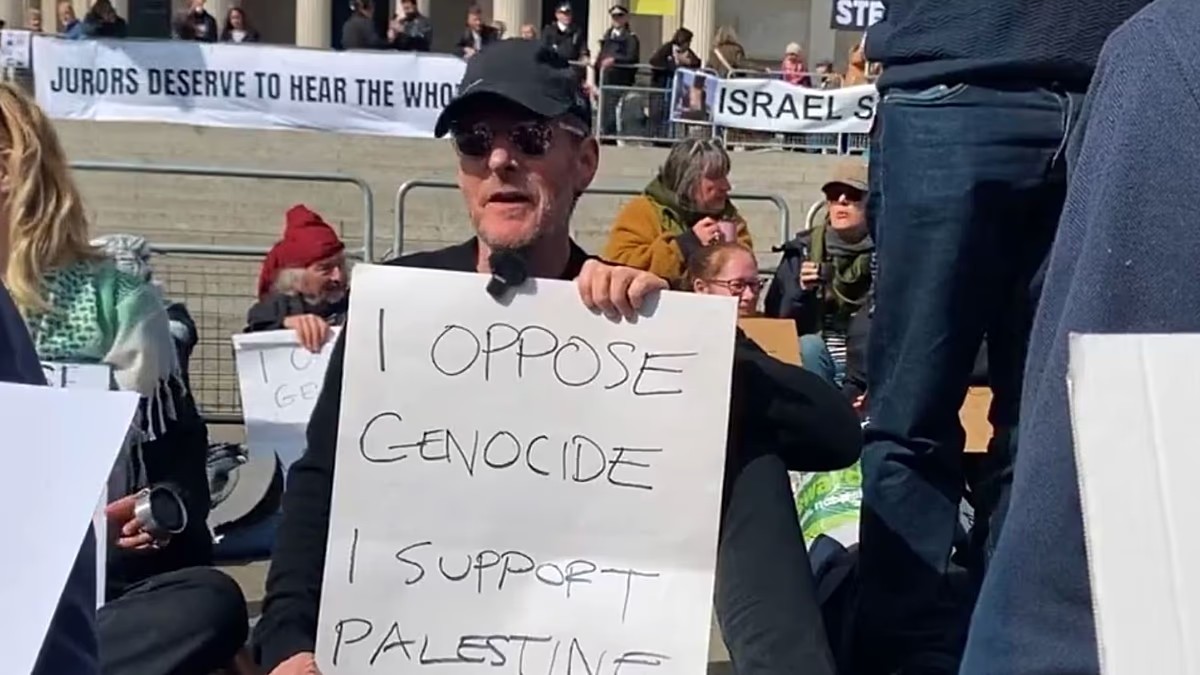
On a brisk Saturday in March, the historic expanse of London’s Trafalgar Square became the stage for a profound act of civil dissent. Among the hundreds gathered was Robert Del Naja, the pioneering musician and visual artist better known as 3D from the iconic trip-hop band Massive Attack. He was there to participate in a mass demonstration against the UK government’s controversial decision to proscribe Palestine Action—a direct action network focused on Palestinian rights—as a terrorist organization. With a simple, hand-held sign stating “I Oppose Genocide, I Support Palestine Action,” Del Naja took a seat in solidarity, a quiet but powerful figure amidst the crowd. His presence was not that of a distant celebrity endorsing a cause from afar, but of an engaged citizen willingly placing himself on the front line, knowing the personal and professional risks involved. This moment crystallized the convergence of art, politics, and conscience, setting the scene for an arrest that would reverberate far beyond the square’s stone paving.
The Metropolitan Police moved through the demonstration, making a total of 523 arrests that day, with detainees spanning generations from 18 to 87 years old. In footage of the event, Del Naja is seen calmly approached by officers who inform him he is under arrest before physically carrying him away from the protest. This image—the artist being removed while holding his unequivocal message—is a potent symbol of the tensions between state authority and the right to protest. For Del Naja, this was not a spontaneous decision born of fleeting passion. In speaking to the Press Association beforehand, he articulated a carefully considered stance, acknowledging the “trepidation” he felt as a musician whose career depends on international travel and visas. He weighed these consequences against a moral imperative he found undeniable, deciding that the police’s “U-turn to arrest people again” was “even more ridiculous” than his own fears. His arrest was thus a deliberate act of principle, a choice to embody his convictions publicly.
Del Naja’s justification for his presence was framed not as rebellion, but as a form of profound patriotism. He argued that the actions of groups like Palestine Action, which seek to disrupt companies they accuse of supplying arms used in violations of international law, are “highly patriotic.” In his view, they are “protecting our country from getting involved in serious war crimes and breaking international law.” This reframing is significant; it challenges the state’s narrative of terrorism and security, positing instead that true loyalty involves holding one’s nation to the highest ethical standards. Del Naja expressed confidence in taking this argument to court, stating his belief that his arrest was unlawful and that he would defend his actions on those grounds. This transforms his protest from a mere demonstration into a potential legal test case, underscoring his commitment to seeing the principle through the entire judicial process.
This event is not an isolated incident in Del Naja’s life or in the history of Massive Attack. The band, formed in Bristol in 1988, has long woven political and social consciousness into its music and public actions. They have been steadfast supporters of Palestinian rights for decades, instituting a boycott of performances in Israel as far back as 1999. Last year, they joined over 400 artists in supporting the ‘No Music For Genocide’ campaign, explicitly linking their artistic platform to the cause of justice. For Del Naja and his bandmate Grant “Daddy G” Marshall, activism is an extension of their artistic expression—a commitment to using their visibility to illuminate injustices they see as urgent and catastrophic. The arrest in Trafalgar Square, therefore, is a consistent chapter in a long-standing story, demonstrating that their advocacy moves beyond statements and into the realm of tangible, personal risk and sacrifice.
The immediate practical repercussions of the arrest now cast a shadow over Massive Attack’s professional commitments. The band is scheduled for a series of European summer performances in cities including Helsinki, Copenhagen, Berlin, Brussels, and Lyon. A criminal record, particularly one related to a group proscribed as terrorist, could severely complicate international travel, potentially leading to denied entry at EU borders and the heartbreaking cancellation of shows for awaiting fans. This looming uncertainty highlights the very real cost of such dissent for artists. The stage may be a platform for protest, but the machinery of borders and legal systems can silence that platform in an instant. It creates a cruel dilemma: speak out for what you believe is right and risk your ability to connect with your global audience through your art.
Ultimately, Robert Del Naja’s arrest transcends the story of one musician on one Saturday. It serves as a microcosm of broader, urgent debates in our society: the shrinking space for legitimate protest, the definition of terrorism versus activism, and the role of the artist in times of crisis. His calm defiance, his framing of dissent as a patriotic duty, and his willingness to bear the consequences invite us all to reflect on the price of conscience. In a world where many express solidarity from a safe distance, Del Naja’s choice to sit on the cold ground with a sign, awaiting arrest, is a powerful testament to the belief that some principles are worth more than convenience, career, or comfort. The fate of his summer tour remains uncertain, but the image of his arrest has already cemented a lasting statement—one of moral courage that resonates louder than any speaker at a concert could.