



The Unbroken Spirit of Angelita: A Journey Through War, Silence, and Belonging
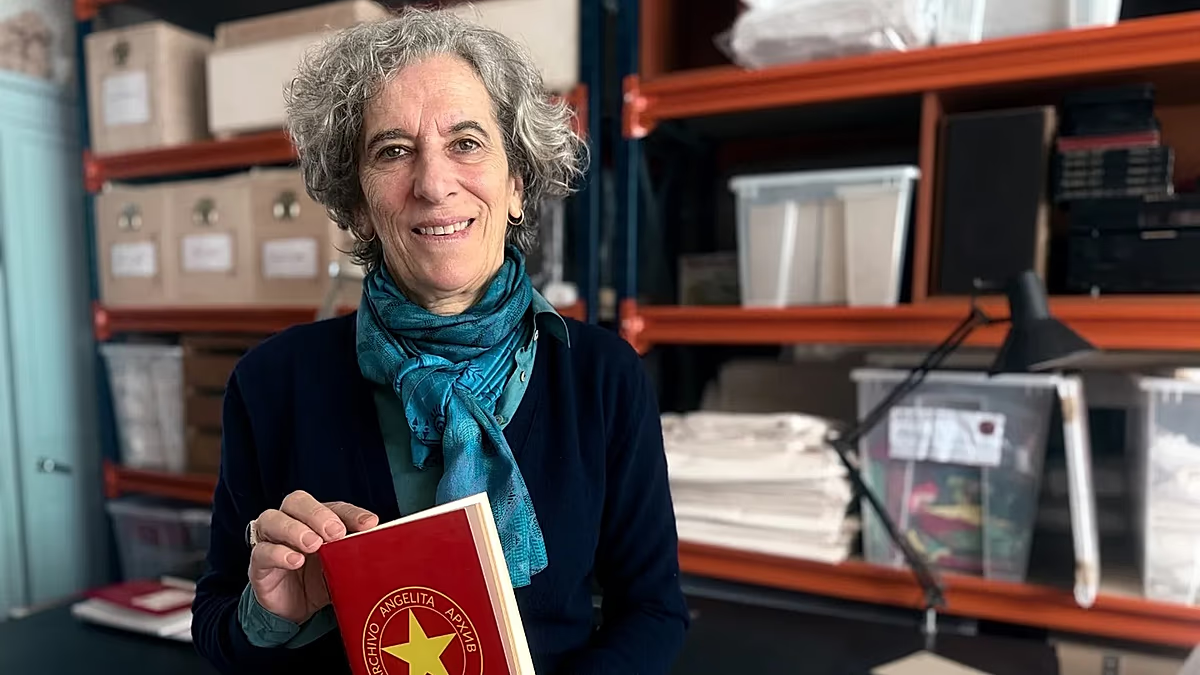
In the poignant documentary “What House Are You From?,” Portuguese-Spanish artist Ana Pérez-Quiroga turns the camera toward a profound and intimate subject: her mother, Angelita. The title’s question—simple yet deeply resonant—guides us into a life story fractured by twentieth-century conflicts, defined by displacement, and ultimately woven together by quiet resilience. Angelita, a child refugee from the Spanish Civil War, was taken from Spain to the Soviet Union, only to find herself caught within the tumult of another world war. Her early life became a relentless journey across borders and ideologies, estranged from her family and homeland, living in closed boarding schools with other Spanish refugee children from ages four to twenty-four. She moved from Kherson (in present-day Ukraine) to Kazakhstan, to a Siberian village, and finally to Moscow for university, maintaining her mother tongue in a Russian-speaking world. This narrative is not just a chronicle of survival; it is an exploration of how a person carries history within them, often in silence, and how that history shapes the questions of identity that echo through generations.
A Trauma Framed as an Adventure: The Power of a Mother’s Narrative
What makes Angelita’s story particularly compelling is not merely the historical upheaval she endured, but the remarkable perspective she cultivated. As Ana Pérez-Quiroga reveals, her mother is a shy and introverted person who speaks little of that period. Yet, when she does, she has never presented it to her children as a trauma. “I’ve always felt that it was (for her) an adventure,” Ana told Euronews. This conscious reframing is a powerful act of emotional protection and strength. Angelita’s choice to shield her children from the weight of her past, to transform a saga of loss and dislocation into a tale of endurance and experience, speaks volumes about her character. It also sets the central thematic tension for the film: how do we process and transmit difficult histories? The passage of time, the evolving relationship between mother and daughter, and the fractured sense of belonging across multiple cultures become the film’s emotional pillars, asking us to consider the distances—both geographical and emotional—that exist within a single family’s story.
Returning to a Changed Homeland: The Threads of Politics and Memory
Angelita and her sister finally returned to Spain in the 1950s, more than two decades after their exile. Their return was to a homeland profoundly altered by Franco’s victory, a nation where their republican parents had somehow survived the repression and wartime executions, though their father endured imprisonment. This return completed one circle but opened another. The Spain they returned to was not the Spain they left; their identity was now layered with Soviet education, Russian language, and the memories of a life built entirely abroad. This segment of the story underscores the political dimensions of personal fate—how ideologies and wars dictate the maps of individual lives. Angelita’s later meeting with her Portuguese husband and move to a vineyard estate in central Portugal added another layer to her complex identity, creating a new home rooted in family and land, yet forever connected to a scattered past.
The Vineyard as a Metaphor: Time, Cycles, and Artistic Vision
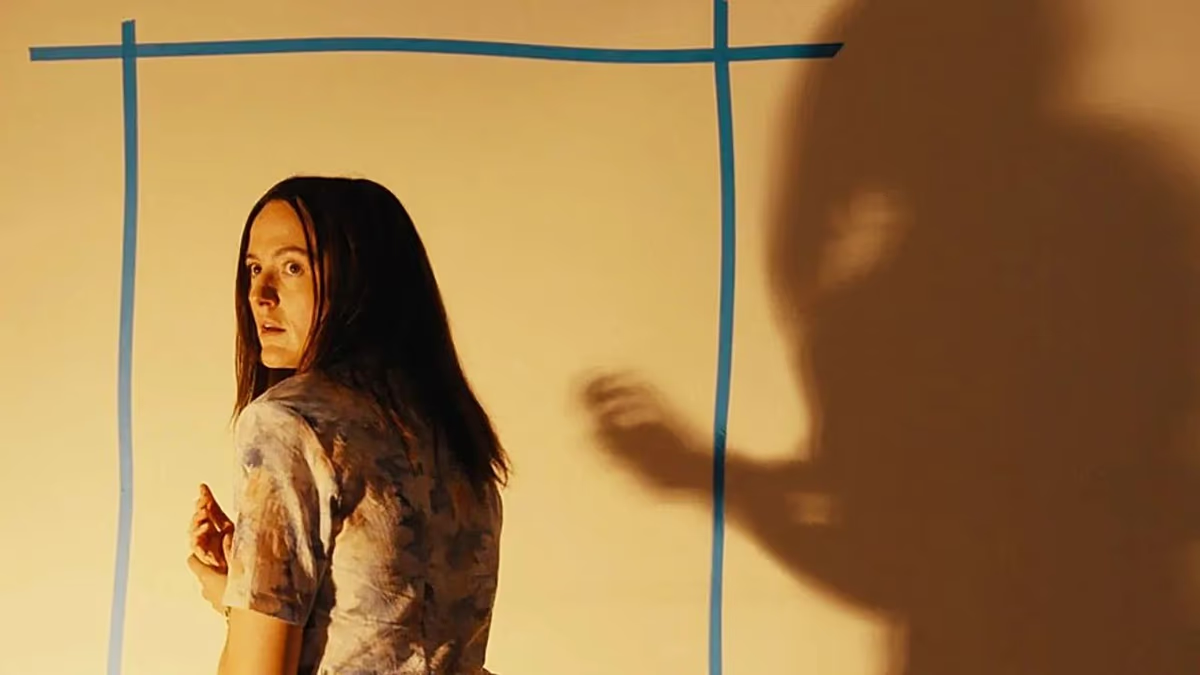
The family vineyard becomes a central metaphor in Ana Pérez-Quiroga’s film. The annual grape harvest, filmed over two consecutive years, serves as a visual and symbolic anchor, mixing past and present. “The film is about time,” Pérez-Quiroga explains. The cyclical, patient nature of the harvest mirrors the long, unfolding process of understanding a life and a history. It represents growth, renewal, and the tangible results of nurtured roots—contrasting beautifully with the earlier rootlessness of Angelita’s life. The artist also hasn’t forgotten her roots in visual arts; the film incorporates installations and performances she created based on her mother’s story. Merging these two facets—the documentary’s linear narrative and the artistic, interpretive expressions—was the biggest challenge during editing. This multidisciplinary approach enriches the film, allowing it to operate on both a factual and a poetic level, contemplating the “fracture” of identity and asking, “Who do we belong to?”
A Project Bridging Peace and Conflict: Filming Before the Storm
The documentary was a multi-year project that took Ana Pérez-Quiroga to various locations in Russia and Ukraine—a journey undertaken before the large-scale invasion and outbreak of the current war in 2022. This timing adds a layer of historical poignancy to the film; it captures landscapes and memories from a region now again engulfed in conflict, making Angelita’s childhood homes in Kherson and elsewhere scenes of doubled tragedy. The film thus becomes not only a personal family archive but also a subtle document of a recent, vanished peace. It connects the historical wounds of the Spanish Civil War and World War II to the ongoing wounds of today, reminding us that the questions of displacement and belonging are timeless and continually urgent.
A Story Reaching Screens: From Festival to Public Reflection
“What House Are You From?” had its world premiere at the Thessaloniki Documentary Festival and is set to reach screens in several Portuguese cities, inviting audiences into this intimate meditation on memory and identity. The film stands as a testament to the quiet strength of individuals like Angelita, who navigate world-historical storms and choose to frame their journeys not as scars, but as stories of human adaptability. It is a daughter’s loving inquiry into her mother’s silent past, a harvesting of memory from the vineyards of time, and a profound reminder that the houses we come from are often many, built across continents and decades, within the resilient human spirit.