

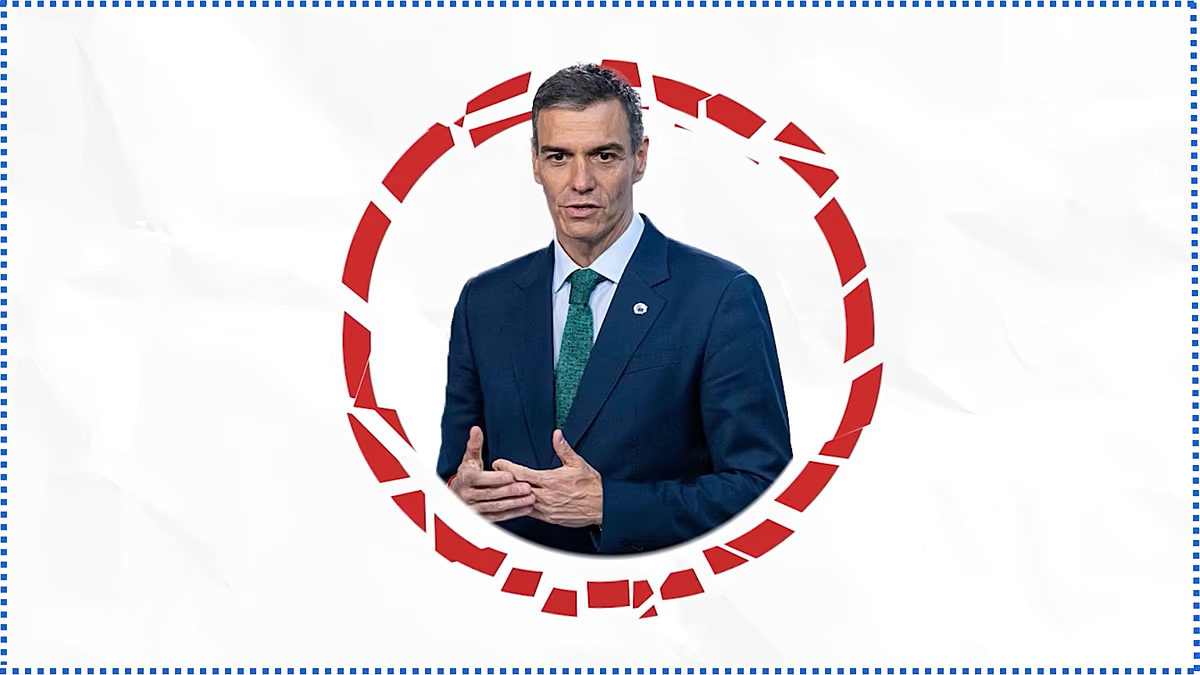
In the heart of Madrid, a political crisis of profound personal and systemic dimensions is unfolding, centering on the family of Spain’s Prime Minister. The judicial system has now formally decided that Begoña Gómez, the wife of Prime Minister Pedro Sánchez, must stand trial. The charges against her are severe: influence peddling and embezzlement. Prosecutors allege she leveraged her proximity to power to improperly secure public funding and support for private initiatives tied to a university foundation she was involved with. This development strikes at the very core of Sánchez’s administration, placing his immediate family under the glaring spotlight of a criminal proceeding and inviting intense public scrutiny over the ethical boundaries of those closest to the seat of power.
The predicament for the Prime Minister deepens considerably when viewed as part of a wider pattern, suggesting a collapse of trust within his most trusted circles. Last summer, Santos Cerdán, a former senior aide and a key architect within Sánchez’s Socialist Party, was placed in pre-trial detention over allegations of bribery. This was followed months later by a scandal that shook the government’s pandemic response narrative. Former Transport Minister José Luis Ábalos and his top aide, Koldo García, were taken into custody in connection with the “Koldo Case.” They stand accused of orchestrating a scheme to accept secret cash payments in exchange for awarding lucrative government contracts for face masks during the COVID-19 emergency. The irony is bitter; officials tasked with procuring protective coverings for the public are alleged to have been utterly transparent in their own corrupt dealings. Further staining the affair are claims that misappropriated public funds were also used to finance personal trips and a home for Ábalos’s secret mistress, adding a layer of tawdry personal misconduct to the grave breach of public trust.
Unsurprisingly, this cascade of judicial actions has provided potent ammunition for the political opposition. The conservative People’s Party (PP) has seized upon the scandals, demanding the immediate resignation of Prime Minister Sánchez. They frame the situation as evidence of a government riddled with corruption at its highest levels, unfit to continue governing. However, the PP’s moral high ground is significantly undermined by its own extensive history of corruption scandals, which tempers the force of its outrage. Most notably, the party is itself entangled in the ongoing “Kitchen Case” trial, where its former officials are accused of orchestrating a covert police operation to spy on and steal compromising materials from a former party treasurer, aiming to destroy evidence related to a vast system of illegal party financing. This historical context creates a cynical political standoff where accusations are hurled across an aisle muddied by mutual suspicion.
The pressing question for Spanish citizens, therefore, transcends the fate of any single politician and points to a deeper, systemic malaise. How endemic is the problem of corruption within Spain’s institutions? According to leading watchdog Transparency International, the country has suffered a notable decline in its perceived cleanliness in recent years. Data from European Union institutions provides a comparative and sobering perspective. Among the 27 member states, Spain consistently finds itself ranked in the lower half of the table concerning corruption perceptions and the robustness of its safeguards. While it still performs better than nations like Italy and Poland, its trajectory is a cause for concern, drifting uncomfortably closer to the bottom-tier nations such as Hungary and Bulgaria. This positioning suggests a problem that is not merely a cyclical outbreak of bad actors but a persistent institutional weakness that allows such scandals to take root and flourish.
Against this tumultuous domestic backdrop, Prime Minister Sánchez’s international stance appears strikingly bold. He has notably positioned Spain as a critical, independent voice within the European Union, at times directly challenging U.S. foreign policy, particularly regarding the war in Gaza, and advocating for a greater global role for the Global South. While these foreign policy maneuvers garner headlines and define a certain political legacy, they now ring somewhat hollow against the drumbeat of scandal at home. The greatest test for Sánchez is no longer on the diplomatic stage in Washington or Brussels, but in the courtrooms and court of public opinion in Madrid. His political survival hinges on his ability to govern through a permanent state of scandal, maintaining coalition stability while his inner circle and family face protracted legal battles.
Ultimately, the series of trials involving his wife, former ministers, and political opponents paints a portrait of a democracy under strain. The coming months will determine not only the legal culpability of the accused but also the resilience of Spain’s institutions and the patience of its populace. The real battle for Pedro Sánchez is a dual one: to prove his government’s innocence and integrity in the face of specific allegations, and to confront the broader, lingering specter of systemic corruption that threatens to erode public faith in democracy itself. His ability to navigate this domestic minefield will ultimately prove more defining than any foreign policy triumph.