



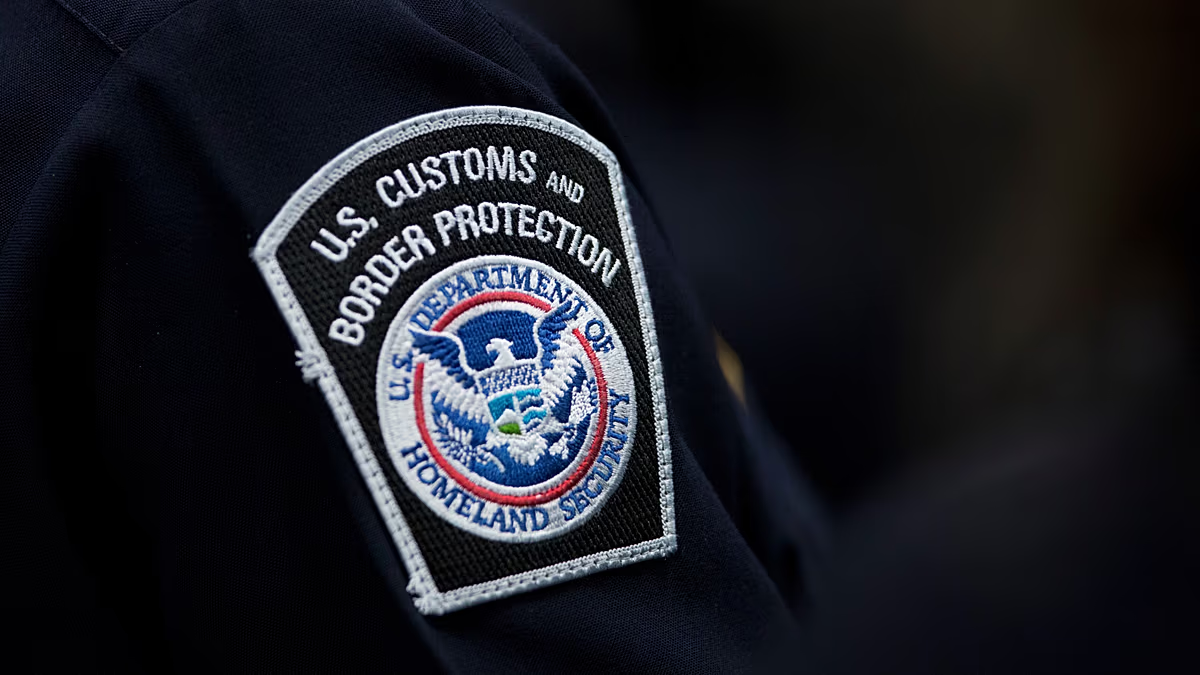
For American businesses, a moment nearly a decade in the making arrived on April 20, 2026. At 8 a.m. EST, a long-awaited digital portal operated by U.S. Customs and Border Protection officially opened, marking the start of a gargantuan effort to return billions of dollars in tariffs unlawfully collected during the Trump administration. This process was triggered by a landmark Supreme Court ruling in February, which determined, in a 6-3 decision, that the former president had overstepped his constitutional authority by imposing sweeping import taxes without the explicit approval of Congress. That ruling tore down the legal foundation of a vast tariff regime, transforming payments once considered a cost of doing business into debts owed by the government. The launch of the refund system is the first practical step in settling that debt, setting in motion a complex administrative and financial reckoning.
The scale of this undertaking is almost incomprehensible. Over the years, more than 330,000 U.S. importers paid a staggering $166 billion across 53 million individual shipments of goods ranging from steel and aluminum to consumer electronics and agricultural products. As of mid-April, tens of thousands of companies had already pre-registered, with claims totaling $127 billion, a figure that includes statutory interest. However, not every business could file immediately. The process is being rolled out in phases, with the first wave limited to tariffs that were in a provisional state or where the final accounting had occurred within the previous 80 days. Even for those who successfully file, patience is required; the government estimates a 60 to 90-day window for processing and payment once a claim is approved. Lawyers are advising extreme caution, warning that a single error on a complex customs entry could jeopardize an entire refund request.
For the small business owners who bore the brunt of these tariffs, this process is not an abstract financial exercise but a deeply personal matter of survival and fairness. Take Brad Jackson, co-founder of After Action Cigars in Minnesota, who spent $34,000 last year—money he chose to absorb rather than pass on to his customers—on tariffs for cigars imported from Nicaragua and the Dominican Republic. For him, the refund portal represents a critical lifeline to recoup capital that was diverted from marketing, hiring, or expansion. Yet, his relief is tempered by a very practical anxiety: a slow reimbursement does little to alleviate the ongoing cash flow crisis that the tariffs created. His story is a microcosm of a national experience, where small and medium-sized enterprises, lacking the vast financial cushions of multinational corporations, were forced to make difficult sacrifices to stay afloat.
While businesses begin the arduous task of filing for restitution, American consumers are left largely on the sidelines, watching a refund process from which they are almost entirely excluded. Companies that receive multimillion-dollar windfalls are under no legal obligation to share the proceeds with the customers who ultimately paid these tariffs through higher prices. Some hope for consumer redress lies in a web of class-action lawsuits working their way through the courts, targeting major retailers like Costco and manufacturers like Ray-Ban’s parent company, EssilorLuxottica. However, legal experts note such cases face significant hurdles and could take years to resolve, making any consumer reimbursement a distant and uncertain prospect. A more immediate hope for some individuals may come from shipping giants like FedEx, which has publicly committed to returning any refunds it receives directly to the customers from whom it collected tariff payments on imported goods.
The corporate landscape of claimants reads like a who’s who of American and global industry. According to analyses by firms like PwC and law firm Clark Hill, the technology, media, and telecommunications sector stands to gain the most, with an estimated $47.6 billion in potential refunds, followed closely by industrial manufacturing. Household names from Toyota and Goodyear to Xerox, Steve Madden, and Bath & Body Works are among the thousands already preparing their claims. Beyond the administrative portal, the legal battle continues in parallel; more than 3,000 individual cases are pending before the U.S. Court of International Trade, covering the full spectrum of affected industries and ensuring judicial oversight of the broader refund process. This dual-track approach underscores the unprecedented complexity of unwinding a trade policy of such magnitude.
Ultimately, the opening of this refund portal is more than a bureaucratic event; it is the closing chapter of a profound constitutional and economic dispute. The Supreme Court’s ruling was a powerful reassertion of Congress’s “power of the purse,” clarifying the limits of executive authority in setting national trade policy. Now, the monumental task of implementation begins. As businesses navigate technical glitches, complex paperwork, and long waits, the process will test the government’s capacity to correct a historic error efficiently and justly. For the thousands of companies that paid what the highest court has now deemed an illegal tax, it is a day of long-overdue accountability, offering a tangible, if belated, correction to a policy that reshaped global trade and strained American pocketbooks for years.