


Paragraph 1
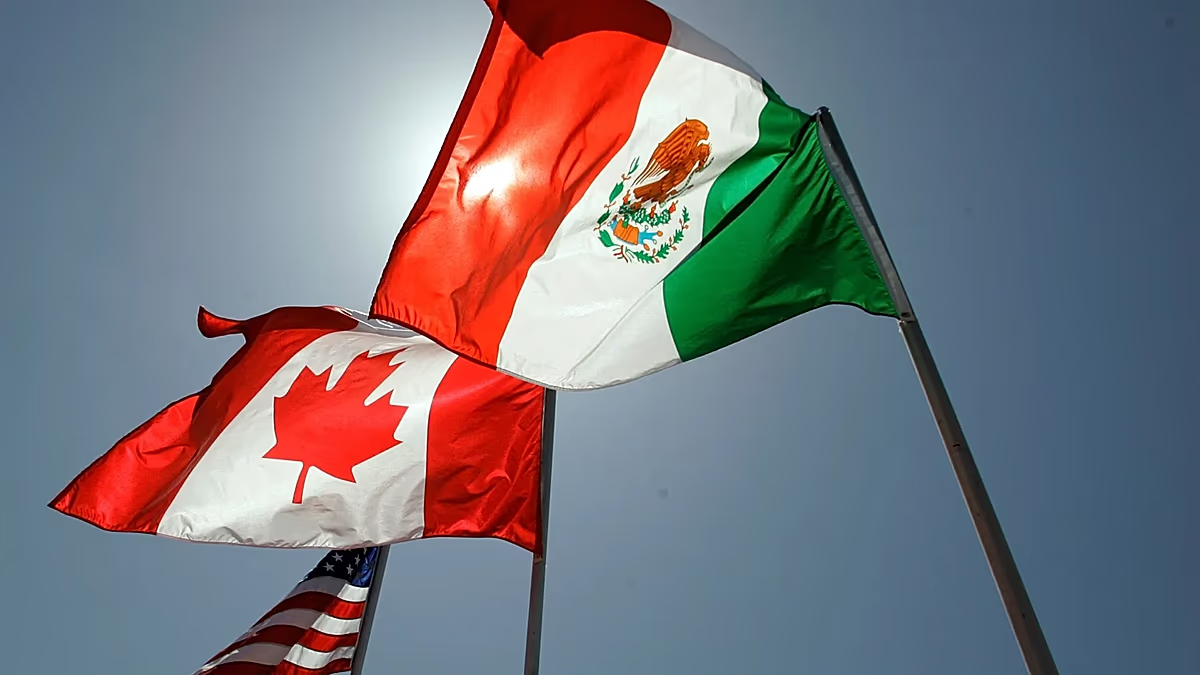
Amidst the complex and often contentious landscape of North American trade, a significant diplomatic maneuver is underway. Canada has formally proposed extending the United States-Mexico-Canada Agreement (USMCA), the cornerstone of continental commerce, for a full 16-year term. This proposal, conveyed in letters to U.S. Trade Representative Jamieson Greer and Mexican Economy Secretary Marcelo Ebrard, comes just ahead of the pact’s scheduled July review. Canada’s Minister for U.S. Trade, Dominic LeBlanc, emphasized the agreement’s profound mutual benefits, stating it is “highly beneficial to each of our countries and to the integrated North American economy.” Mexico has since echoed Canada’s support for the 16-year extension. This push for long-term stability stands in stark contrast to the alternative: leaving the pact subject to potentially disruptive annual reviews after its initial decade.
Paragraphブル2
The Canadian initiative is a proactive attempt to solidify economic certainty for all three nations. The USMCA, which succeeded NAFTA, has governed trillions of dollars in cross-border trade and integrated supply chains for decades. LeBlanc, following a meeting with Ambassador Greer in Washington, indicated that Canada presented suggestions aimed at resolving lingering U.S. concerns. However, the diplomatic calculus is delicate. LeBlanc has noted his belief that the U.S., under the current administration, might prefer the annual review option, potentially using the threat of withdrawal as ongoing leverage. The stakes are clear: without a three-party consensus for the 16-year extension by July 1st, the agreement will continue but under a cloud of annual reassessments, a scenario businesses and policymakers fear could inhibit long-term investment and planning.
Paragraph 3
This trade diplomacy unfolds against a backdrop of renewed, and from a Canadian perspective, highly provocative political rhetoric from south of the border. Former President Donald Trump recently revived a long-standing trope by posting “51st State!” on social media, linking to a report on Canada’s economic challenges. The post was notably amplified by the sitting U.S. Ambassador to Canada, Pete Hoekstra. For Canadians, whose national identity is deeply rooted in sovereignty distinct from their powerful neighbor, such comments are more than mere political theater; they are perceived as a direct affront to national dignity and independence, complicating the already sensitive task of pragmatic governance.
Paragraph 4
The Canadian political response to this rhetoric has been swift and unequivocal, transcending partisan lines. Ontario Premier Doug Ford’s irritated retort—“I can’t believe I have to say this again, but Canada will never be the 51st state. Canada is not for sale”—captured a widespread sentiment. Prime Minister Mark Carney, while adopting a more diplomatic tone, firmly dismissed the premise. He stated there was no question of asking Ambassador Hoekstra to leave, but clarified, “We’re not going to respond to, react to, everything that he posts.” This calibrated response highlights the tightrope Canadian leaders must walk: forcefully defending national pride and sovereignty while meticulously protecting an indispensable economic and security relationship that requires constant engagement, regardless of political provocations.
Paragraph 5
Prime Minister Carney’s approach underscores a hard-nosed realism. He acknowledged the administration as it is, stating, “It’s an administration that we have to work with. It’s our biggest trading relationship. It’s our biggest security relationship.” This pragmatism is grounded in cold economic data; Carney noted that while the U.S. has significant trade disputes with Canada, the number with Mexico is nearly double. Furthermore, the legal framework of the USMCA itself provides a sobering reminder of vulnerability, as Washington retains the right to withdraw with six months’ notice. This reality makes Canada’s push for a 16-year extension not merely a preference, but a strategic effort to lock in predictability and reduce exposure to political volatility.
Paragraph 6
In conclusion, Canada finds itself navigating a dual challenge: advancing a forward-looking, stability-seeking trade agenda while simultaneously batting away backward-looking political jabs about its sovereignty. The proposal to renew the USMCA for 16 years represents a clear-eyed vision for North American economic resilience, seeking to elevate continental commerce above the political fray. Yet, the concurrent revival of “51st state” rhetoric acts as a disruptive undercurrent, inflaming public sentiment and testing diplomatic patience. The coming weeks will reveal whether pragmatic economic interests, championed by both Canada and Mexico, can prevail to secure a long-term foundation for trade, or whether the specter of annual reviews and political uncertainty will become the new normal. The outcome will resonate far beyond government offices, impacting the livelihoods of workers, the strategies of industries, and the very shape of the North American economy for years to come.