


Paragraph 1: Europe’s Strategic Pivot
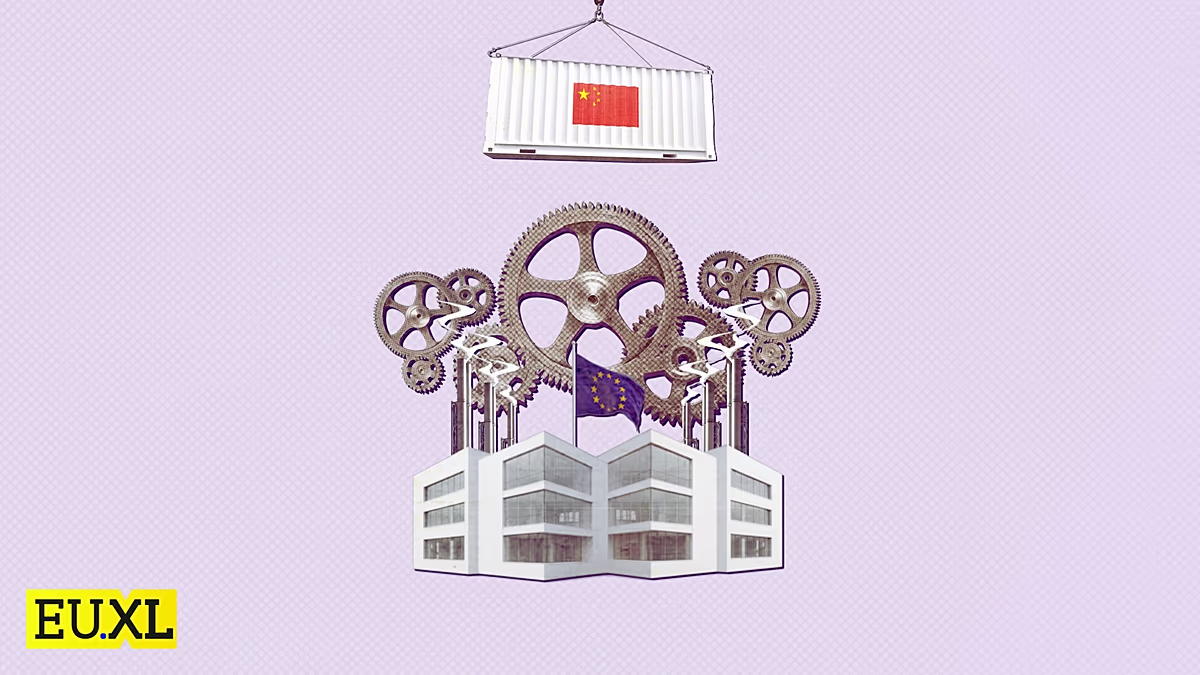
In a bold shift to secure its economic future, the European Commission is preparing to fundamentally reshape how its industries source vital materials. At the heart of this strategy is a proposed rule that would prevent companies from becoming overly dependent on any single supplier for critical components. The Commission aims to cap the share of any such component that a firm can purchase from one source at between 30% and 40%. This means a company would need to cultivate at least two or three different suppliers for its most crucial parts, with an added layer of security: those suppliers cannot all be based within the same country. This is not a minor regulatory tweak, but a conscious and strategic move to weave resilience directly into the fabric of Europe’s industrial supply chains, recognizing that over-reliance can be a critical vulnerability in an unstable world.
Paragraph 2: The Driving Force Behind the Move
The urgency behind this proposal stems from a stark reality laid bare in recent years. Europe’s ambitions in transformative sectors like clean energy, electric vehicles, cutting-edge semiconductors, and defense are currently built on a foundation of profound dependency, particularly on China. From the rare earth magnets essential for wind turbines and EV motors to the raw materials for advanced batteries, Chinese exports dominate these supply chains. This dependence moved from being a theoretical economic concern to a tangible strategic risk when Beijing began using export controls on key materials as a geopolitical lever. These actions left European factories suddenly exposed, highlighting how a disruption on one continent could halt production lines and stall green transitions across another. The European Commission, representing all 27 member states, convened and reached a clear consensus: the current lopsided trade relationship is unsustainable for a bloc that values both prosperity and strategic autonomy.
Paragraph 3: A Coordinated Strategy of “De-risking”
This supply chain proposal is not an isolated measure but a central pillar of a broader, more assertive strategy officially endorsed by the European Commissioners. After a meeting on May 29th, they collectively backed a policy of “de-risking” economic ties with China—a nuanced approach that seeks to reduce critical vulnerabilities without advocating for a full-scale economic decoupling. To turn this strategy from theory into practice, the Commission is simultaneously launching the ReSourceEU plan. Backed by €3 billion, this initiative is designed to actively build and fortify alternative supply sources within Europe itself. The goal is to foster domestic extraction, processing, and manufacturing capabilities, creating a homegrown buffer against external shocks and market manipulations. It represents a significant investment in self-reliance, aiming to ensure that the components powering Europe’s future are not held hostage to distant geopolitical storms.
Paragraph 4: Navigating Legal and Competitive Minefields
Despite its compelling strategic rationale, the Commission’s path forward is fraught with serious challenges and vocal criticism. Industry groups and economic analysts warn that fracturing established, efficient supply chains will inevitably increase costs for European manufacturers. Sourcing from multiple, geographically dispersed suppliers often means higher logistics expenses and the loss of economies of scale. In fiercely competitive global markets for EVs and semiconductors, where margins are tight, these added costs could dent the competitiveness of European champions. Furthermore, the proposal must navigate a complex international legal landscape. Critics argue that such explicit caps and sourcing requirements risk violating the non-discrimination principles of the World Trade Organization (WTO). To survive legal scrutiny, any final legislation will need to be carefully crafted in neutral terms, applying rules equally to all trading partners rather than singling out any one country by name.
Paragraph 5: The Human and Industrial Impact
Beyond the macroeconomic debates, this shift will have a tangible, human impact on businesses across Europe. For procurement managers and company executives, it will mean a fundamental rethink of long-standing partnerships and logistical playbooks. The quest for diversification will send them scouting for new partners, possibly in emerging markets or within fellow European nations, fostering new alliances but also demanding rigorous new quality assurance and coordination efforts. For smaller suppliers within Europe, the ReSourceEU fund could represent a transformative opportunity for growth and investment. However, the transition period may be rocky, potentially leading to short-term shortages or price volatility for key inputs as the market adjusts. The success of the policy will ultimately hinge on this practical, on-the-ground execution and its ability to create a new, stable equilibrium without crippling the industries it seeks to protect.
Paragraph 6: A Defining Moment for European Autonomy
In essence, the European Commission’s proposal marks a defining moment in the bloc’s journey toward greater strategic sovereignty. It acknowledges that true strength in the 21st century lies not just in market access, but in control over the foundational elements of one’s own economy. By legally mandating supply chain diversification and investing in internal alternatives, Europe is attempting to future-proof its core industries against coercion and disruption. The coming debates over cost, competitiveness, and legality will be fierce, reflecting the high stakes of this recalibration. The outcome will determine whether Europe can successfully build an economic model that is both open and resilient, safeguarding its ability to chart its own course in an era of renewed great-power competition. This is more than a trade policy; it is a statement of intent about the kind of independent, secure future Europe intends to build for itself.