



The Electric Surge: Europe’s Automotive Landscape Transforms Amid Geopolitical Storm
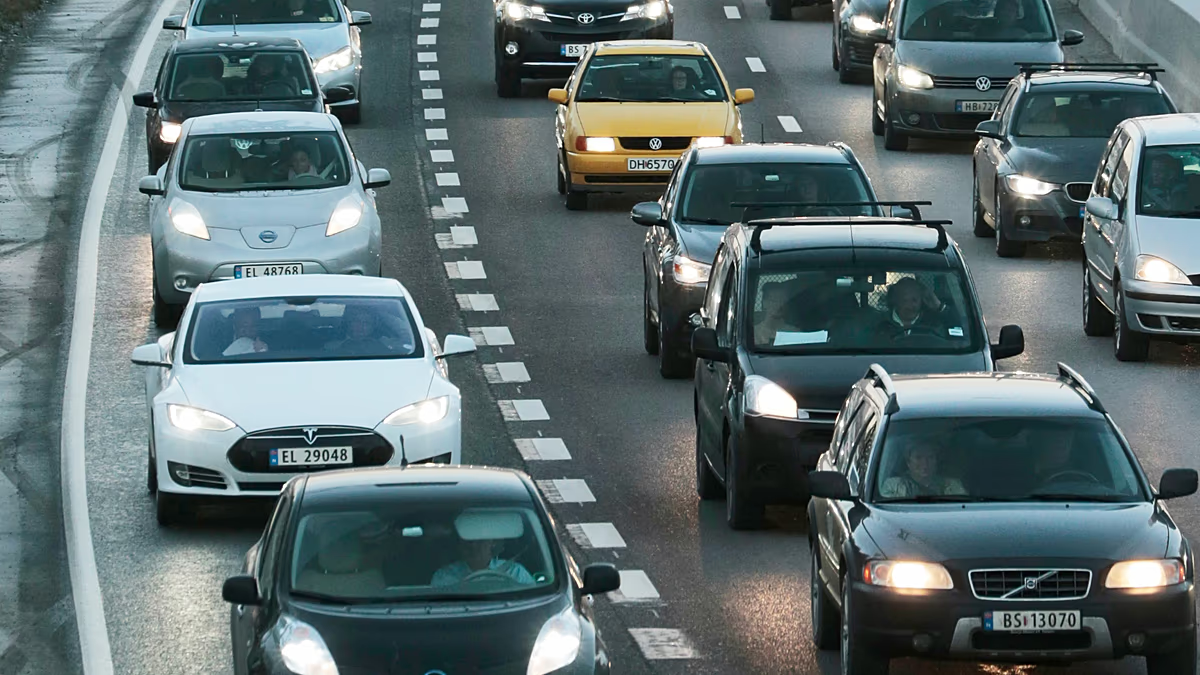
This past March marked a watershed moment for European roads, as recorded by the European Automobile Manufacturers’ Association (ACEA). In a stunning display of accelerating change, registrations for new battery-electric vehicles (BEVs) across the European Union skyrocketed by nearly 49% compared to March of the previous year. This surge is not an isolated spike but part of a profound and rapid reordering of the entire market. For the first quarter of the year, battery-electric cars captured a 19.4% share of all new passenger vehicle registrations, a significant leap from the 15.2% held just a year earlier. Crucially, in the single month of March, their slice of the market even surpassed the symbolic 20% threshold. This explosive growth unfolds even as the overall car market grew by a modest 4%, underscoring that the expansion of electric vehicles is actively reshaping the industry’s foundations, drawing consumers away from traditional options at an unprecedented rate.
This remarkable shift is not merely a product of consumer whim; it has been actively catalyzed by deliberate policy. The ACEA report highlights that revised tax benefits and new incentive schemes across major European nations have significantly bolstered the move to electrification. These government actions have provided critical financial nudges, making the upfront cost of electric vehicles more competitive. However, the transition is multifaceted and reveals a market in a state of complex evolution, not a simple binary swap. While BEVs are the fastest-growing segment, hybrid-electric vehicles (HEVs)—which combine a petrol engine with a battery—still command the largest individual share of the market at 38.6%, with over a million units registered in the first quarter alone. Plug-in hybrids (PHEVs) also grew their share. This diverse landscape supports what industry leaders call a “technology-neutral” approach to decarbonization, allowing for a gradual transition that accommodates varying consumer needs and the still-uneven development of charging infrastructure across the continent.
The dynamics of this transformation are most vividly illustrated in the performance of Western Europe’s “Big Four” automotive markets: Germany, France, Italy, and the United Kingdom. Each showed vigorous but distinct trajectories toward electrification, collectively driving the continental trend. Italy led the charge with the most explosive growth, recording a 65.7% surge in BEV registrations for the first quarter. France followed with a robust 50.4% increase, while Germany, a traditional automotive powerhouse, posted a 41.3% rise. The UK, while showing a slightly more moderate percentage increase of 24.2% in March, demonstrated formidable volume, registering over 86,000 new pure-electric cars in that single month. This bullish growth for electric powertrains came at the direct and severe expense of traditional internal combustion engines. Petrol and diesel car sales plummeted across all four markets, with France witnessing the most dramatic contraction at over 40%, and Italy, Germany, and the UK all reporting steep double-digit declines.
This accelerating consumer shift is occurring against a tense and costly geopolitical backdrop, adding a layer of urgent practicality to the environmental and policy-driven motivations for change. The conflict involving Iran and the consequential disruption to vital global energy passages, like the Strait of Hormuz, have placed sustained pressure on oil markets. This has led to a period of high and volatile petrol and diesel prices across Europe. These external factors are delivering a harsh, real-world penalty to owners of conventional vehicles, directly impacting household budgets. In contrast, the stable and significantly lower running costs of electric vehicles are becoming not just an attractive alternative, but a financially prudent one for a growing number of motorists. If such geopolitical instability persists, it is expected to further alienate consumers from the unpredictability of fossil fuel costs, steadily channeling more new buyers toward the certainty of electric propulsion.
The current data paints a clear picture of momentum, but also of a market in transition, not at its final destination. The sustained strong demand for hybrid vehicles indicates that for many consumers, a complete leap to a fully electric vehicle still presents hurdles, whether related to cost, range anxiety, or charging access. The continued dominance of the hybrid segment acts as a crucial bridge, reducing emissions immediately while familiarizing drivers with electrified technology. This period represents the great unraveling of the internal combustion engine’s century-long dominance. As policy incentives lower financial barriers and geopolitical events highlight economic vulnerabilities, the conventional petrol and diesel car is being displaced from its central position at an accelerating pace.
In conclusion, the first quarter of the year has delivered an unambiguous signal: Europe’s automotive revolution has moved from a speculative future into a forceful present. The near-50% jump in pure-electric car registrations is a landmark, proving that consumer adoption has reached a critical and self-reinforcing mass, propelled by supportive policy and, ironically, by global instability. The dramatic decline in petrol and diesel sales across the continent’s largest markets confirms this is a zero-sum game. While the path forward will include hybrids as an important transitional technology, the direction of travel is now unequivocal. The convergence of environmental policy, economic incentive, and geopolitical pressure has created a perfect storm, one that is swiftly carrying the European automobile away from the fossil-fueled past and toward an electric future.