


In the intricate and often politically charged world of international football, a surprising proposal has emerged from the orbit of former U.S. President Donald Trump. Paolo Zampolli, an Italian-American socialite and businessman who serves as a special envoy, has publicly revealed a personal appeal made to both Trump and FIFA President Gianni Infantino. His request is as straightforward as it is unprecedented: to replace Iran’s national football team with Italy in the upcoming 2026 World Cup, hosted across the United States, Mexico, and Canada. Zampolli’s rationale is rooted in nostalgia and spectacle; as a native Italian, he described it as a “dream” to see the four-time champion Azzurri compete on American soil, despite Italy’s failure to qualify for the tournament after a heartbreaking penalty shootout loss to Bosnia and Herzegovina.
This suggestion, however, collides with the complex realities of international sports governance and geopolitics. Iran earned its place in the World Cup through a rigorous qualification process in the Asian Football Confederation. Their participation has been cast into a shadow of uncertainty due to the ongoing conflict that erupted in late February, prompting discussions about security and logistics. The Iranian football federation itself had previously explored the possibility of moving its matches from the United States to Mexico. Yet, FIFA has remained firm in its public stance. President Infantino, after attending an Iranian friendly match, stated unequivocally that Iran will participate “for sure,” emphasizing that sports should exist outside of politics and that qualified teams deserve to represent their people on the world’s biggest stage.
The procedural feasibility of Zampolli’s “dream” is a mixture of theoretical possibility and practical improbability. Under FIFA’s regulations, the global governing body holds “sole discretion” to select a replacement team should a qualified nation withdraw or be excluded. If a vacancy were to arise, FIFA’s ideal course would be to maintain continental balance, likely by inviting another Asian team. However, the rules do allow for alternative approaches, including selecting the highest-ranked non-qualifier. According to the official standings, that team is indeed Italy, currently ranked 12th globally. So, while a pathway exists in the strictest legal sense, it would require a significant departure from FIFA’s principles of sporting merit and regional representation, making it an extreme long shot.
Beneath the surface of this sporting proposition lies a deeper layer of diplomatic tension. Zampolli’s suggestion was reportedly framed, in part, as a potential gesture to mend a sudden and public rift between Donald Trump and Italian Prime Minister Giorgia Meloni. The two leaders, who had previously cultivated a notably close relationship, found themselves at odds following Trump’s criticism of Pope Francis for his anti-war stance on the Iran conflict. Trump escalated by labeling Meloni “unacceptable” and questioning her courage for not being more supportive, a stark contrast to his past praise of her as a “fantastic” world leader. Meloni firmly defended the Pope’s right to advocate for peace, creating an unexpected transatlantic dispute that this football proposal seemingly sought to soften.
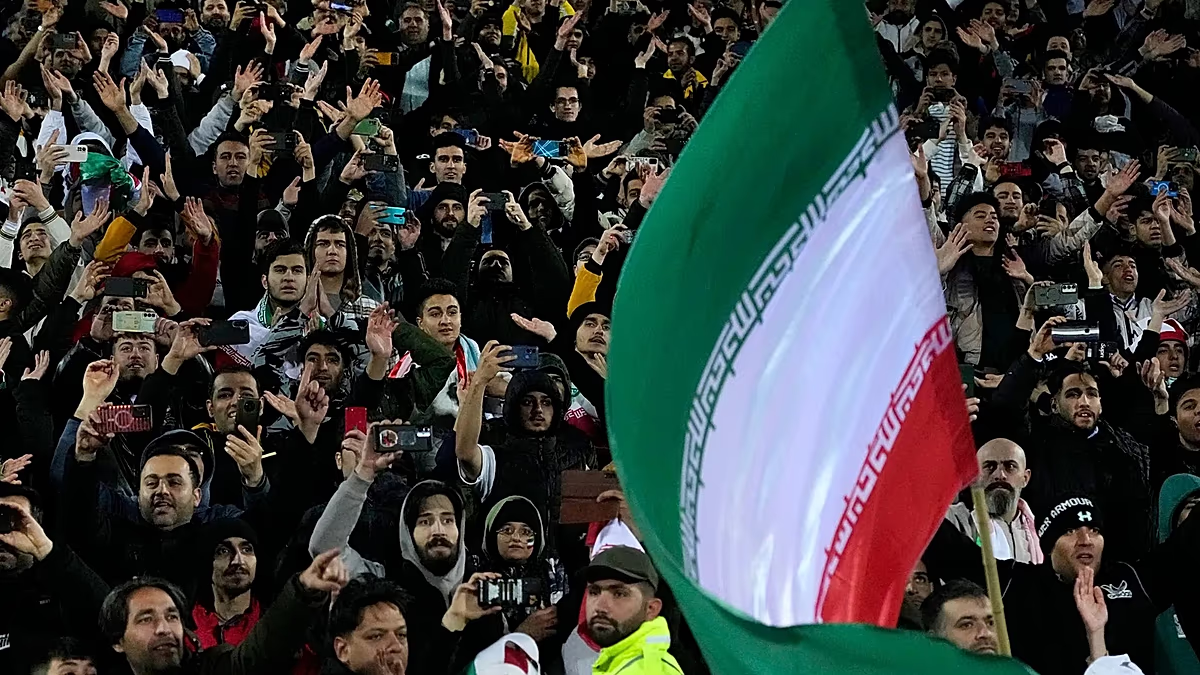
Amidst this geopolitical backdrop, the Iranian government has projected an image of determined normalcy. A government spokesperson recently affirmed the national team’s full preparedness for a “proud and successful participation” in the United States, with plans to arrive at their Arizona training camp well ahead of their first match, in strict adherence to FIFA protocols. This official stance underscores a determination to proceed despite the swirling political currents, presenting the team’s presence as a matter of national pride and sporting principle. It stands in direct contrast to any notion of voluntary withdrawal or replacement, reinforcing the significant hurdles any last-minute substitution would face.
Ultimately, the episode illuminates the perpetual struggle to separate major sporting events from international politics. While Paolo Zampolli’s vision of an Italian renaissance at a U.S.-hosted World Cup taps into powerful emotions for many football fans, it is overshadowed by the foundational rules of qualification and the explicit intentions of both FIFA and the Iranian football authorities. The request, emerging from a context of diplomatic discord, serves more as a political talking point than a viable sporting plan. As it stands, the beautiful game’s biggest tournament is poised to proceed with the teams that earned their place on the pitch, even as the world’s conflicts and disagreements continue to echo in the stadiums.