


Residents and commuters in the peaceful Danish municipality of Gribskov were met with a scene of profound shock and confusion on Thursday morning. Instead of the usual rhythm of a quiet weekday commute, a devastating head-on collision between two passenger trains brought life to a standstill at 6:30 a.m. The crash occurred on a local rail line connecting Hillerød and Kagerup, a route nestled in the countryside about 35 kilometers north of Copenhagen. For the many who depend on this service—residents, employees, and schoolchildren traveling to their daily destinations—this ordinary line suddenly became the site of an extraordinary and traumatic event. The immediate aftermath was one of sirens, flashing lights, and a scramble for survival, marking a grim departure from Denmark’s renowned reputation for safe and efficient public transport.
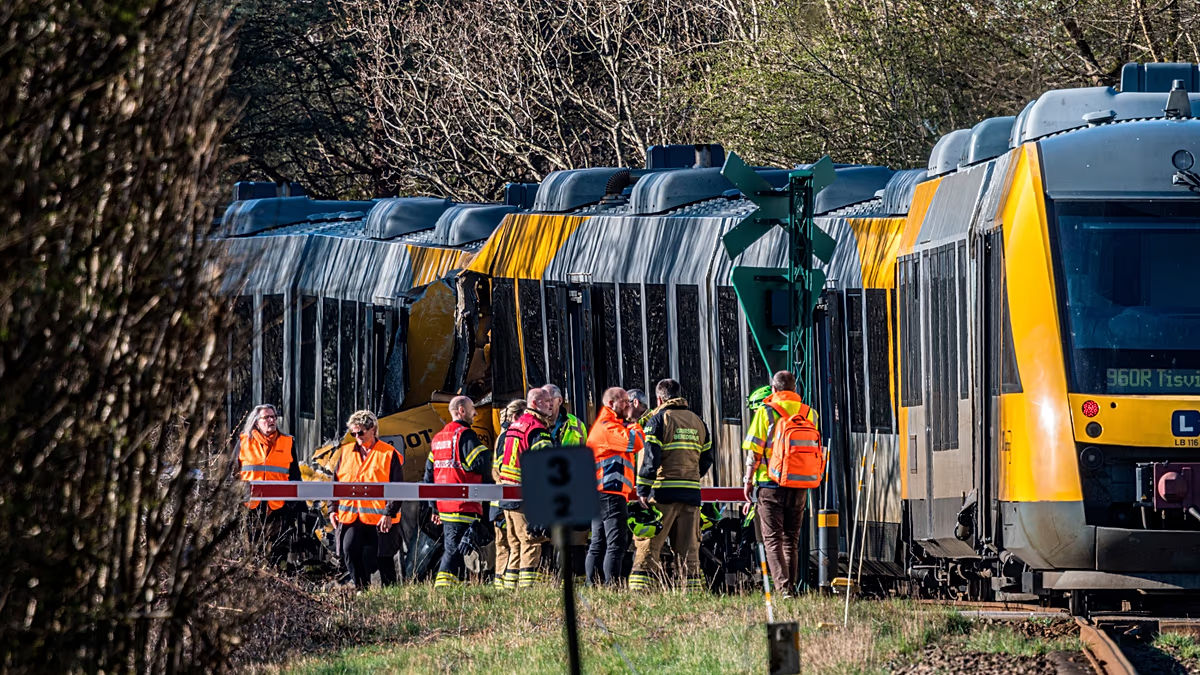
The visual evidence of the impact was stark and unsettling. Photographs from the scene, now circulating in media reports, showed the two trains locked in a mangled embrace, their front ends crumpled and smashed from the force of the collision. Miraculously, both trains remained upright on the tracks, a small mercy that likely prevented an even greater catastrophe. The area was swiftly sealed off by police, transforming the familiar landscape into a secured emergency zone bustling with first responders. In an official statement, authorities described the incident simply but gravely as “a serious accident,” confirming that two trains had collided and that police and emergency services were mobilized in large numbers to manage the crisis and begin the painstaking work of rescue and investigation.
Amid the twisted metal, the human toll began to emerge. Police and media confirmed that at least 17 people were injured in the crash, with five of those victims reported to be in critical condition. The urgency of the situation was underscored by the use of air ambulances, with Gribskov Mayor Trine Egetved noting on Facebook that the critically injured had been flown directly to the National Hospital in Copenhagen for specialized, lifesaving care. Her social media post served as a somber, direct line of communication to a concerned community, emphasizing that this was not an abstract news event but a deeply personal tragedy affecting their neighbors, colleagues, and potentially their own children. The phrase “many injured, some of which are critical” moved the story beyond statistics and into the realm of shared communal anxiety.
In the midst of the chaos, a coordinated and massive rescue operation unfolded. A police spokesman assured the public that all passengers had been successfully evacuated from the wrecked carriages, a testament to the rapid and professional response of emergency crews who worked under extreme pressure. This evacuation was the crucial first step, pulling survivors from the debris and transporting the wounded to hospitals across the region. The large-scale mobilization involved not just medical teams and firefighters, but also specialists who could secure the unstable wreckage and begin the forensic process of determining how such a catastrophic failure could occur on a modern rail system.
As the immediate rescue phase transitioned into one of recovery and inquiry, profound questions began to surface, casting a shadow over a nation proud of its infrastructure. How could two trains on a single track be allowed to meet in such a fatal encounter? The investigation will inevitably focus on signals, possible human error, or technical malfunctions within a system that citizens trust implicitly. For the local community, the psychological impact runs deep; the mundane act of catching a train has been irrevocably altered by this trauma. Mayor Egetved’s acknowledgment that this line is a daily lifeline for her constituents highlights the disruption and fear that will linger long after the tracks are cleared, affecting the sense of security in everyday life.
While the wreckage will eventually be cleared and the trains removed, the journey toward healing for Gribskov and Denmark is just beginning. For the families of the critically injured, their world has narrowed to the walls of a hospital intensive care unit. For the other passengers, even those physically unscathed, the memory of the impact, the screams, and the smell of fear will be a difficult burden to process. The incident serves as a harsh reminder that no system, however efficiently designed, is impervious to failure, and that community resilience is often born from shared tragedy. The coming days will be defined by updates on the condition of the injured, the findings of preliminary investigations, and a collective effort to support all those whose lives were violently derailed on an otherwise quiet Thursday morning.