



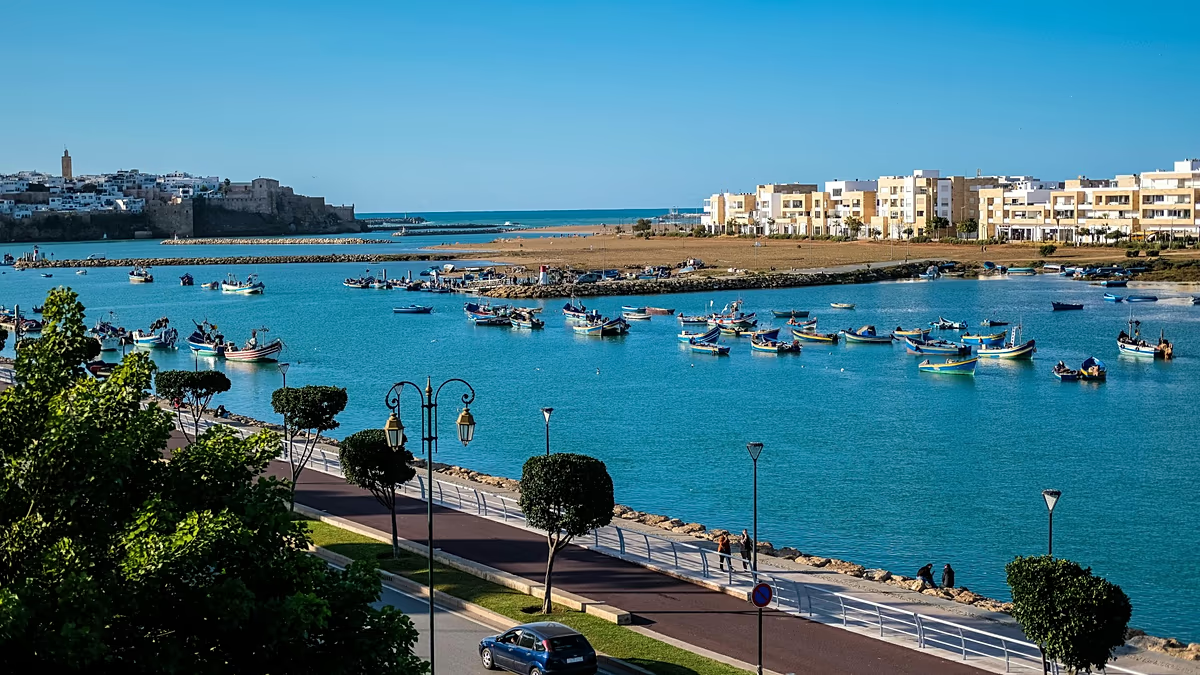
Rabat, Morocco’s sophisticated coastal capital, has long been a nexus of culture and history, yet its vibrant literary soul has often been overshadowed by its political significance. This recognition is set to change profoundly, as UNESCO has designated Rabat as the World Book Capital for 2026. Taking over from Rio de Janeiro and commencing its year-long celebration on April 23, 2026—World Book and Copyright Day—Rabat will embark on a city-wide festival dedicated to the written word. The program is ambitiously designed not just for celebration, but for meaningful impact, with core goals focused on combating illiteracy in underserved communities, specifically encouraging reading among women and children, and strengthening Morocco’s publishing industry. Furthermore, it aims to ingeniously weave literature into the fabric of daily life by promoting reading in public spaces like parks and cafes. UNESCO’s choice was deeply influenced by Rabat’s established role as a cultural crossroads and its thriving literary ecosystem, most notably exemplified by the International Book and Publishing Fair (SIEL), one of Africa’s largest and most dynamic book fairs.
For the literary traveler, Rabat’s designation offers a compelling invitation to explore its rich tapestry of bookish havens. The epicenter of this culture is undoubtedly the SIEL fair, scheduled from April 30 to May 10 this year. It is an electric event, drawing thousands of visitors and over 700 exhibitors from nearly fifty countries. The fair’s atmosphere is one of intellectual excitement and cultural exchange, buzzing with seminars, poetry readings, and panels on topics like Arabic children’s literature. The 2026 edition will carry even greater significance, coinciding with the World Book Capital festivities and featuring France as the guest of honor, with Nobel laureate Annie Ernaux spotlighting a deepened partnership between French and Moroccan literary worlds. It will also serve as a moment to celebrate the legacy of the great Moroccan traveler Ibn Battuta and the contributions of the Moroccan diaspora, ensuring the fair is a bridge connecting past, present, and future.
Beyond the grand spectacle of the fair, Rabat’s literary charm is intimately embedded in its historic quarters. A wander through the ancient Medina and the Rue des Consuls reveals a quieter, more authentic dimension of the city’s book culture. Here, traditional bookshops, Arabic calligraphy stalls, and antique dealers create a labyrinth of discovery. Among them stands a legendary figure: Mohammed Aziz, one of Rabat’s oldest booksellers. His stall, a “living library” overflowing with thousands of secondhand books in Arabic, English, French, and Spanish, is a testament to a lifelong devotion to reading—he has personally read over 4,000 of his volumes. Engaging with Aziz is not merely a transaction; it is a conversation with a curated knowledge, and his recommendations promise to guide visitors to rare, forgotten gems. This environment fosters serendipitous encounters with like-minded locals, students, and travelers, all drawn by the shared love of the printed page.
Rabat’s narrative is not confined to books alone; it is also vividly told through art. The Museum Mohammed VI of Modern Art provides a profound visual companion to the literary journey. It acts as a storyboard of 20th-century Moroccan history, tracing the nation’s journey from colonial-era realism to modern abstraction and contemporary social commentary. For those delving into themes of identity, modernity, and transition—core subjects in much Moroccan literature—the museum’s exhibitions offer deep, reflective context. It provides quiet study spaces and a dedicated bookshop filled with specialized literature on its collections, allowing visitors to extend their understanding beyond the gallery walls. This synergy between visual art and textual narrative enriches the overall exploration of Moroccan culture.
For the ultimate immersion into the nation’s intellectual heritage, the National Library of the Kingdom of Morocco is indispensable. It is a guardian of over a millennium of knowledge, housing more than 200,000 titles and approximately 80,000 rare documents and manuscripts. These collections span the vast realms of Moroccan, Arabic, and Islamic intellectual, legal, and religious history, preserved in rare books, photographs, and maps. Yet, the library is fiercely forward-looking. Through its “Digital 2030” strategy, over half of its contents are already digitized, making this heritage accessible across the country and to the world. It also boasts advanced accessibility features for the visually impaired, a 300-seat auditorium for events, and amenities like a bookstore, cafeteria, and prayer room, designed to accommodate a full day of deep study or casual discovery.
Finally, Rabat understands that reading is not solely an academic pursuit but a pleasure to be savored in moments of tranquility. The city offers idyllic settings for this, most notably within the serene Andalusian Gardens of the Kasbah des Oudayas. Here, cultural cafes like the famed Cafe des Oudayas (historically Cafe Maure) provide a perfect respite. With its stunning views over the Bou Regreg River, authentic Zellige-tiled benches, and shady, calm spaces, it invites visitors to slow down. Sitting with a pot of fragrant Moroccan mint tea, fresh orange juice, and delicate pastries like cornes de gazelle, one can lose oneself in a new favorite book. This harmonious blend of historic ambiance, natural beauty, and literary engagement encapsulates the essence of Rabat’s World Book Capital vision: to make reading an inseparable and joyful part of life’s everyday rhythm.