




Here is a summarized and humanized version of the provided content, structured into six paragraphs as requested.
—
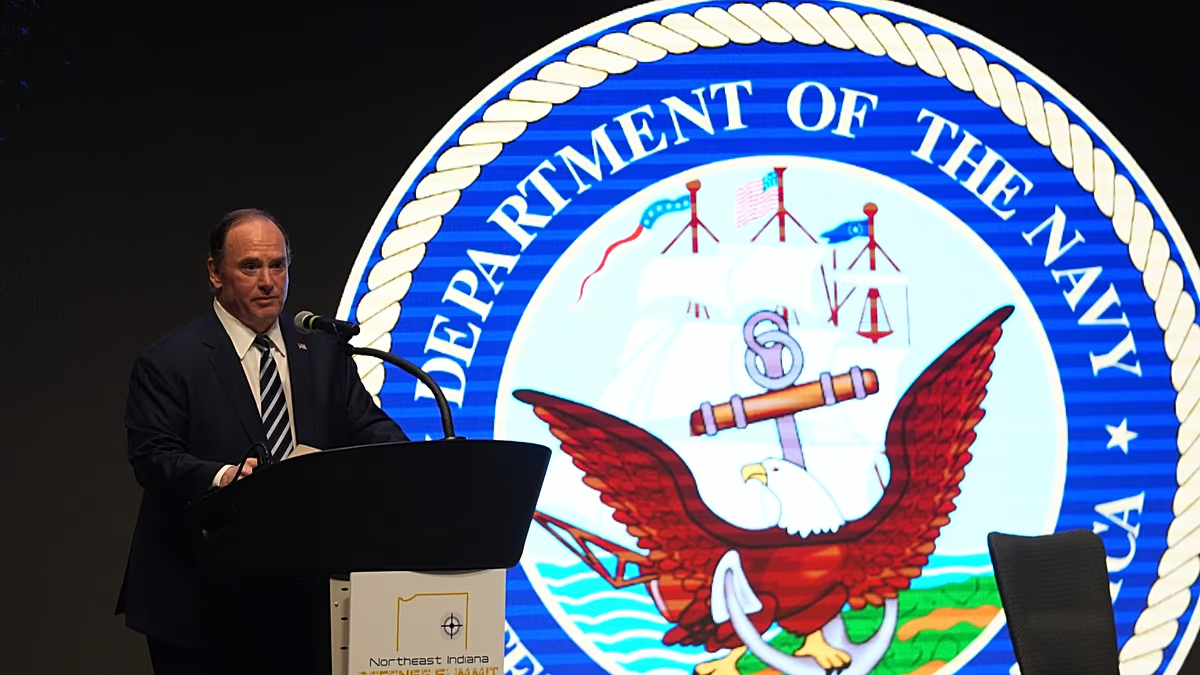
The Pentagon’s revolving door of leadership swung once again this week with the abrupt departure of Navy Secretary John Phelan, the latest high-ranking official to exit the Department of Defense under the current administration. The announcement was made late Wednesday via a curt social media post from Pentagon spokesperson Sean Parnell, who offered little more than a polite farewell, noting that the Department of Defense wished Phelan “well in his future endeavours.” No specific reason was given for this sudden exit, leaving a cloud of speculation over the Navy’s top civilian post. This move is the most recent in a series of dramatic shakeups that have rattled the Pentagon’s leadership structure, following a pattern of high-profile firings and resignations orchestrated by Defense Secretary Pete Hegseth and, ultimately, President Donald Trump. The silence surrounding Phelan’s departure is particularly striking given the high-stakes environment in which the Navy currently operates, including a tense naval blockade of Iranian ports and ongoing interdiction of ships linked to Tehran across global waters, all while a fragile ceasefire hangs in the balance. For those watching the defense department, this feels less like a routine personnel change and more like the continuation of a deliberate, sweeping reorganization of military command.
John Phelan’s tenure as Navy Secretary was notable for its unconventional profile. Unlike many of his predecessors, Phelan came to the role without a background of military service or any previous civilian leadership experience within the Navy. His primary connection to the armed forces came from an advisory role with Spirit of America, a non-profit organization focused on supporting the defense of Ukraine and Taiwan. Before that, he was best known as a major financial donor to Donald Trump’s presidential campaign and as the founder of Rugger Management LLC, a private investment firm. His appointment was seen by many as a reward for loyalty rather than a merit-based selection for one of the most complex logistical and strategic roles in the U.S. government. The suddenness of his dismissal was underscored by the fact that, just a day prior, Phelan was publicly engaged in the full duties of his office. He addressed a large crowd of sailors and defense industry professionals at the U.S. Navy’s annual conference in Washington, speaking with reporters about his vision and priorities. He also hosted key members of the House Armed Services Committee to discuss the Navy’s budget and shipbuilding plans, posting about the meeting on social media. This stark contrast between a normal work day and a sudden termination has left many inside the Pentagon questioning the rationale behind the decision.
To fill the immediate vacuum, Navy Under Secretary Hung Cao has been appointed as the acting Secretary of the Navy. Cao is a figure who brings a very different kind of experience to the role, one steeped in direct military service. A 25-year Navy combat veteran, Cao served with distinction before transitioning into politics, though his campaigns have so far been unsuccessful. He ran for the U.S. Senate in Virginia in 2024, seeking to unseat Democratic Senator Tim Kaine, and previously ran for the House of Representatives in 2022. While he lost both races, he gained significant attention within Republican circles, earning an endorsement from Trump and delivering a speech at the 2024 Republican National Convention. His political platform provides a clear window into his worldview. During his Senate debate, Cao was sharply critical of COVID-19 vaccine mandates for service members and derided the military’s efforts to promote diversity, equity, and inclusion. He also expressed strong opposition to continued aid for Ukraine, arguing that the U.S. was borrowing heavily to fund a foreign war while depleting its own strategic reserves. Since taking on the role of Under Secretary, Cao has already made his mark by championing the return to duty of service members who refused the COVID-19 vaccine mandate under the previous administration.
Phelan’s departure is not an isolated incident but rather the latest domino to fall in a sweeping purge of senior military leadership. Defense Secretary Pete Hegseth, who took office last year, has moved aggressively to reshape the upper echelons of the armed forces. Just weeks before Phelan’s exit, Hegseth fired General Randy George, the Army’s top uniformed officer. This followed a wave of removals that began in February 2025, including Admiral Lisa Franchetti, the Navy’s top uniformed officer, and General Jim Slife, the second-in-command at the Air Force. Perhaps the most significant firing came from President Trump himself, who removed General Charles “CQ” Brown Jr. as Chairman of the Joint Chiefs of Staff. These actions represent a fundamental break from tradition, where continuity at the top of the military chain of command has historically been protected from the political winds of a new administration. The message being sent appears to be clear: loyalty to the current administration’s agenda is paramount, and those who are perceived as being part of the old guard or who disagree with the new direction are being replaced. For the military, an institution that prides itself on being apolitical, these moves have created a deep sense of uncertainty and concern about the politicization of command.
The context of Phelan’s firing adds another layer of gravity to the situation. The Navy is currently operating at an extremely high tempo, with three aircraft carriers deployed or heading to the Middle East. This massive projection of naval power is directly tied to the administration’s aggressive posture toward Iran. The Trump administration has made it clear that all armed forces are prepared to resume combat operations against Iran should the current, tenuous ceasefire expire. The Navy is actively enforcing a blockade of Iranian ports and targeting ships linked to Tehran around the world. In this volatile environment, the sudden removal of the Navy’s top civilian leader—the person responsible for its budget, policy, and overall administration—introduces a degree of instability. It raises difficult questions about accountability and decision-making during a time of potential conflict. While Acting Secretary Cao is a combat veteran, his political background and specific stances, particularly his opposition to NATO-style aid for allies, mark a significant shift in the ideological leanings of the Navy’s leadership. The Navy is now effectively being run by a placeholder who has never held a position of this magnitude, during one of its most operationally demanding periods in recent years.
Ultimately, the story of John Phelan’s departure is less about one man’s career and more about the broader transformation underway within the U.S. military establishment. It reflects an administration that is willing to break norms, remove high-ranking officials with little public explanation, and prioritize political alignment over traditional experience. Phelan, a political donor and businessman with no military background, was brought in as an outsider and then dismissed just as abruptly as he arrived. His replacement, Hung Cao, is a political candidate who has been vocal about his desire to strip away what he sees as the previous administration’s cultural and policy legacies within the armed forces. For the men and women serving in the Navy, this creates a complex and uncertain reality. They are executing dangerous missions around the world while their leadership structure is being rapidly overhauled above them. While the Pentagon wishes Phelan well in his future endeavors, the institution itself is left to wonder what future endeavors are in store for the entire military as it navigates this unprecedented leadership churn. The human cost of this instability is not borne by the politicians and appointees, but by the service members who must remain focused and ready, regardless of who is signing their orders.