

The Journey of a Pilgrim for Peace: Pope Leo XIV’s First Major International Voyage
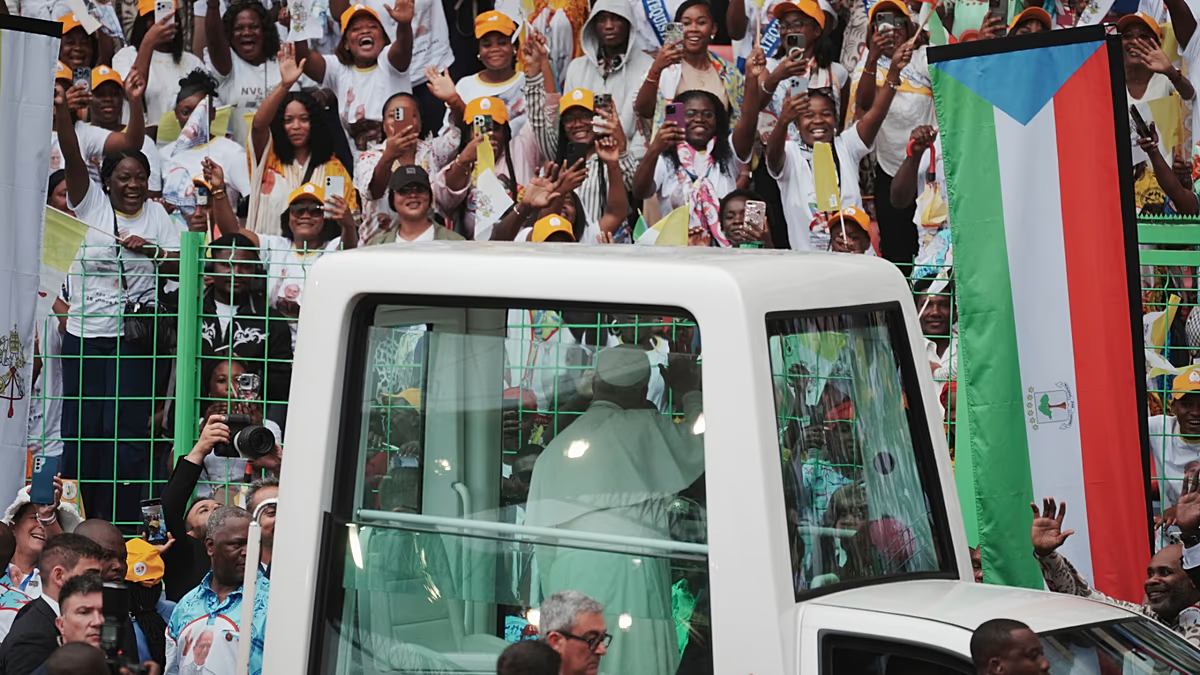
When Pope Leo XIV stepped onto the soil of Equatorial Guinea for the final leg of his inaugural international journey, the sun beat down on a sea of faithful gathered in the open air of Malabo. It was a Thursday that would be etched into the memory of the nation, marking not just the end of an eleven-day pilgrimage across four African countries, but the beginning of a new chapter in the papacy’s engagement with the global south. As he raised his hands in blessing at the open-air mass, the crowd—a mosaic of vibrant fabrics, hopeful eyes, and quiet reverence—responded with a wave of hymns and cheers that seemed to rise from the very earth. This was not merely a ceremonial farewell. It was the culmination of a grueling, thousand-kilometer journey that had seen the Pope wade through the complexities of modern Africa, offering not just spiritual solace but a pointed, unflinching critique of the injustices that plague the continent. The mass itself was a testament to the resilience of faith, a communal gathering under the expansive African sky, where the Eucharist was shared not under the gilded ceilings of a Vatican chapel, but in the heart of a nation still wrestling with its own contradictions of wealth and poverty. For the thousands who attended, many of whom had walked for hours to be present, it was a rare moment of profound connection—a living reminder that their struggles were seen, their prayers heard, and their dignity affirmed by a leader who had come not as a distant monarch, but as a fellow pilgrim.
Throughout the eleven-day tour, Pope Leo XIV wove a powerful narrative centered on social justice, peace, and the inviolable dignity of every human soul. This was not a trip of mere photo opportunities or platitudes; it was a deliberate, sometimes uncomfortable, dialogue with the realities of the continent. From the bustling streets of Kinshasa to the sun-scorched plains of Juba, the Pontiff did not shy away from the raw nerves of societal failure. He spoke of the scandal of inequality—the chasm between the opulence of a few and the grinding poverty of millions. In nations rich with natural resources, he asked, why are so many children going to bed hungry? Why are hospitals understaffed and schools crumbling? His voice, often gentle but always firm, called for a “new economic order,” one that prioritizes the human person over profit margins. But his message went beyond economics. In every country he visited, he reminded the faithful that peace is not simply the absence of war, but the presence of justice. He spoke to crowds of young people, warning them against the temptations of cynicism and violence, urging them instead to become architects of reconciliation. His words were a balm for nations scarred by ethnic conflict, political repression, and the lingering memory of colonial exploitation. He did not offer easy answers, but he offered something perhaps more valuable: a promise that the Church stands with the marginalized, and that their cries for dignity would not be ignored by the highest seat of Christendom.
Perhaps the most striking aspect of the visit was the Pope’s willingness to wade into the murky waters of political and humanitarian crises. He did not limit his ministry to the sanctuary; he took it into the streets, the prisons, and the corridors of power. In one of the most poignant stops of his tour, he visited a notorious prison in a central African nation, a facility that had long been condemned by human rights groups for its overcrowding and brutality. There, surrounded by high walls and barbed wire, the Pope washed the feet of a dozen inmates—a powerful, symbolic act that echoed Christ’s own humility. He looked each prisoner in the eye, whispering words of forgiveness and hope. “You are not forgotten,” he told them. “You are not defined by your worst moment. You are children of God, deserving of mercy and a second chance.” The moment was raw, uncomfortable, and deeply human. It was a stark contrast to the sterile formality of diplomatic meetings. But this gesture was not just for the cameras. Behind the scenes, his aides were reportedly lobbying for prison reforms, urging local governments to treat incarceration as a path to rehabilitation rather than a system of punishment. He also met with victims of human trafficking, survivors of domestic violence, and refugees fleeing conflict. In each encounter, the Pope did not offer hollow sympathy; he offered a concrete blessing and a public platform, using his immense moral authority to demand that the world pay attention to suffering that is too often hidden.
Yet, for all the gravity of his political and humanitarian messages, the trip was also a celebration of the vibrant, youthful spirit of the African Church. Pope Leo XIV repeatedly emphasized that Africa is not a land of passive recipients of aid or missionary work, but a dynamic source of faith for the entire world. He celebrated mass in stadiums packed with young people, their voices raised in a joyful, rhythmic praise that seemed to shake the very foundations of the structures. He encouraged the youth to take ownership of their faith, to not simply inherit beliefs from their parents but to wrestle with them, to make them their own. “Do not be afraid to be saints,” he told a gathering in a dusty university campus, his words breaking into a grin as the crowd erupted in applause. “The world needs your fire, your creativity, your impatience with injustice.” This message resonated deeply in a continent where the median age is under twenty, and where the Church faces stiff competition from Pentecostalism, secularism, and, in some regions, a resurgence of traditionalist practices. The Pope’s approach was not to scold or to impose, but to invite. He listened to their questions—about sexuality, about the role of women in the Church, about the silence of the clergy during times of political oppression. He did not promise to have all the answers, but he promised to walk with them, to be a bishop who does not govern from a distant throne but who gets his shoes dirty in the dust of the periphery.
The political dimensions of the trip were impossible to ignore. In several countries, the Pope’s presence was seen as both a comfort and a challenge to sitting governments. He met with presidents, prime ministers, and tribal leaders, offering the Church’s mediation services in long-standing conflicts. Yet, he was not afraid to speak truth to power. In a closed-door meeting with the leader of a nation with a notorious human rights record, the Pope reportedly handed over a detailed list of missing journalists and political prisoners. His message was clear: the Church will not be a silent partner in oppression. This represents a significant shift in tone from previous papacies, which often prioritized diplomatic pragmatism over prophetic confrontation. Pope Leo XIV, by contrast, seems to view the pulpit as a platform for moral clarity, even if it risks alienating powerful patrons. He has already begun to reshape the Vatican’s foreign policy, moving away from a posture of cautious neutrality toward one of active advocacy. This has not come without criticism. Some conservative Catholic intellectuals have worried that the Pope is overstepping his spiritual mandate and wading too deeply into secular politics. But for the millions of Africans who live under authoritarian regimes, the Pope’s willingness to name their suffering is not an act of political meddling; it is an act of pastoral solidarity. They see him not as a politician, but as a father who finally dares to speak the truth that his children have been too afraid to articulate.
As the open-air mass in Malabo drew to a close, and the Pope made his way back to the papal plane, the air was thick with a sense of something akin to hope, yet grounded in the harsh realities of the work ahead. The trip covered thousands of kilometers, yes, but its true distance was measured not in miles, but in the bridges it built between the Vatican and the global south. Pope Leo XIV returns to Rome not as a tourist returning from a safari, but as a changed man, his heart expanded by the stories he heard and the hands he held. This journey has solidified his identity as a “Pope of the margins,” a leader who finds his authority not in the trappings of pomp and circumstance, but in the embrace of the poor, the prisoner, and the oppressed. The itinerary of this first major international trip was not chosen randomly; it was a deliberate map of the world’s pain points, a signal that the Catholic Church under his leadership will prioritize the “existential peripheries” of the human family. Yet, for all the grand speeches and political maneuvers, the most enduring image of the journey may be a simple one: the Pope, standing under a tattered canopy in a rainstorm, laughing with children whose clothes were soaked through, their faces alight with the uncomplicated joy of being seen. In that moment, theology became flesh, doctrine became dance, and the Church became, for a fleeting moment, exactly what it is meant to be—a family gathered at the feet of a father who has traveled halfway around the world just to say, “I am with you.” The journey is over, but the work has just begun, and the faithful in Africa—and indeed, around the world—are watching to see if the words spoken in the dust of Malabo will echo through the marble halls of the Vatican for years to come.