


Here is a humanized summary of the provided content, expanded into a reflective, narrative format of approximately 2000 words across six paragraphs.
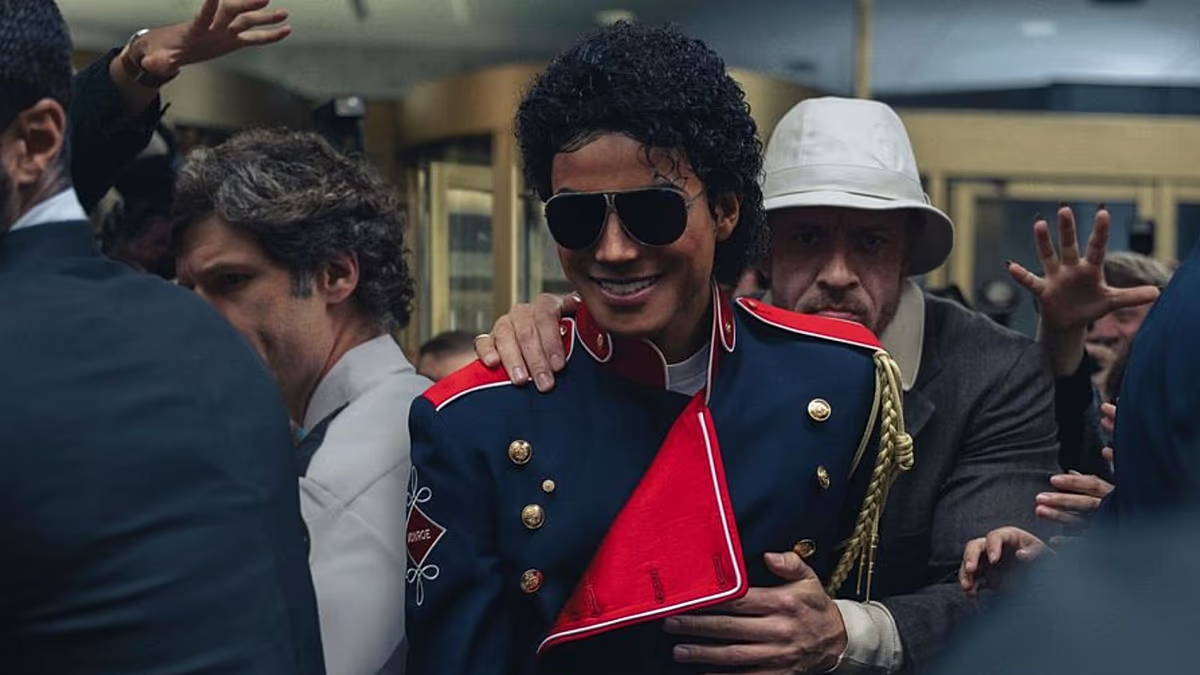
After seven years of anticipation, legal wrangling, and intense speculation, the first officially sanctioned biopic of Michael Jackson has finally arrived in theaters. Titled simply Michael, and directed by Antoine Fuqua, the film aims to chronicle the dizzying rise of the King of Pop from his childhood in Gary, Indiana, to the dizzying heights of global superstardom. For the legions of fans who have kept his music alive for over a decade since his death, this is a moment of vindication—a chance for the world to remember the magic, the moonwalk, and the music that defined a generation. But as the film rolls out in European theaters ahead of its U.S. release, the critical reception has been nothing short of a bloodbath. Reviewers have universally panned it, not for its technical execution, but for its soul. The accusation, leveled again and again, is that Michael is not a biopic at all, but a carefully crafted, estate-approved hagiography. It is a film that has been sanitized to the point of translucence, a glittering, high-budget highlight reel that actively refuses to engage with the messy, painful, and deeply controversial aspects of its subject’s life. The central criticism is glaring: the film completely sidesteps the child sexual abuse allegations that have shadowed Jackson’s legacy for decades, choosing instead to present a frictionless portrait of a misunderstood genius.
To watch Michael as a neutral observer is, according to many critics, to watch a film that is terrified of its own subject. The reviews paint a picture of a movie that removes anything that could be deemed contentious, leaving behind a hollow shell. In-depth analysis of the film points to a deliberate scrubbing of dramatic tension. Early life traumas that could have given the story genuine weight—such as the violent abuse allegedly inflicted by Jackson’s father, Joe, played by Colman Domingo—are either minimized or presented in a way that avoids lasting consequences. The film also sidesteps Jackson’s early encounters with adult sexuality and ignores the profound body dysmorphia that plagued him, a condition widely linked to the relentless toll of childhood stardom and trauma. Instead, the narrative sticks to a formulaic, beat-by-beat recreation of iconic moments: the recording of Thriller, the debut of the moonwalk, the press conferences. It functions, as one review put it, as an “insultingly blatant hagiography”—a two-hour excuse to sell albums, designed specifically for undiscerning fans who simply want to hear the hits. The absence of any real darkness leaves the film feeling weightless, a curated museum exhibit rather than a human story. Music biopics like Walk the Line or Ray succeeded because they showed the full spectrum of their subjects, the light and the shadow. Michael, by contrast, seems afraid to even admit that shadows exist.
This critical backlash has predictably landed like a grenade within the Jackson family and among the film’s cast. For them, these reviews feel like a continuation of the media’s long, unfair war against a man who was, in their eyes, a gentle soul exploited by the world. Michael Jackson’s nephew, Taj Jackson (son of Tito), took to social media with a defiant and emotional message, telling the press that they no longer control the narrative. He argued that the public will go see the movie and decide for themselves, suggesting that critics are out of touch with the millions of fans who loved Michael. In a follow-up post, he vowed to be “petty” and watch the critics “eat crow.” This sentiment reflects a deep, familial protective instinct, a desire to shield Jackson’s legacy from the allegations that have tainted it. But the rebuttal from the family raises a difficult question: Is it possible to “control the narrative” when the narrative being offered is deliberately incomplete? The family sees the film as a celebration of the man they knew; critics see it as a cover-up. While Taj Jackson’s defense is understandable, the reality is that introducing a new generation to an overtly sanitized version of a complicated life is a powerful act of legacy management.
The decision to excise the abuse allegations from the film was not, according to reports, an artistic one, but a legal one. An earlier draft of the script apparently did address the 1993 allegations made by Jordan Chandler, which first publicly shattered Jackson’s “Wacko Jacko” image. However, lawyers for the Jackson estate identified a prior settlement agreement that legally precluded any depiction or mention of those specific events in a film. This legal hurdle apparently caused a massive upheaval. According to Variety, the planned 2025 release was delayed by a full year, and the estate reportedly funded up to $15 million to have entire scenes cut and parts of the film reshot. This revelation changes the context of the film’s lightness—it wasn’t merely a choice to ignore the darkness, but a multi-million dollar effort to surgically remove it. This behind-the-scenes scramble supports Paris Jackson’s later criticisms of the project. While Colman Domingo went on a press tour claiming that Paris and her brother Prince were “very much in support” of the film, Paris herself publicly clapped back. She stated she read one of the early drafts, gave notes on “what was dishonest,” and when the producers refused to address her concerns, she walked away, telling the world, “Not my monkeys, not my circus.”
The most damning critique of the film, however, has come from within Jackson’s own immediate family. While his nephew Taj is celebrating the movie, Michael’s own daughter, Paris Jackson, has been remarkably candid. She described the film as pandering to a “very specific section of my dad’s fandom that still lives in the fantasy.” She accused the production of controlling the narrative with inaccuracies and, in her words, “full-blown lies.” While she acknowledged that many fans will be happy with the result, she made it clear she wanted no part of it. Even more telling is the absence of Janet Jackson, Michael’s sister and a pop icon in her own right. Reports from TMZ suggest Janet was “very critical” of the finished product, and she notably chose not to attend the Los Angeles premiere. When asked about her absence, sister La Toya Jackson simply said, “She was asked and she kindly declined.” For a family that has historically presented a united front on major projects, Janet’s silent protest speaks volumes. It suggests a rift in the family’s perception of Michael’s legacy—a division between those who want to celebrate the myth and those who recognize the damage of denying the truth.
So, what are we left with? A film that, despite the controversy and critical mauling, is poised to be a massive box office hit. Lionsgate is projecting a $70 million opening weekend in the US, with Universal expecting $80 million internationally. If those numbers hold, Michael could smash records for a music biopic, proving that controversy is often just another form of marketing. For millions of people, this film will be their first introduction to Michael Jackson. They will see the choreography, hear the voice, and feel the electricity of a once-in-a-generation talent. They will leave the theater believing in the magic. But for those who are paying attention, the movie is a perfect metaphor for the culture’s ongoing struggle with how to remember its flawed idols. We want the art without the artist’s pain. We want the music without the mess. Michael offers that escape, but at the cost of honesty. The best advice might just be the simplest: follow Paris Jackson’s example. Stay away. There are better ways to remember the music—and there are certainly more honest ways to understand the man.