



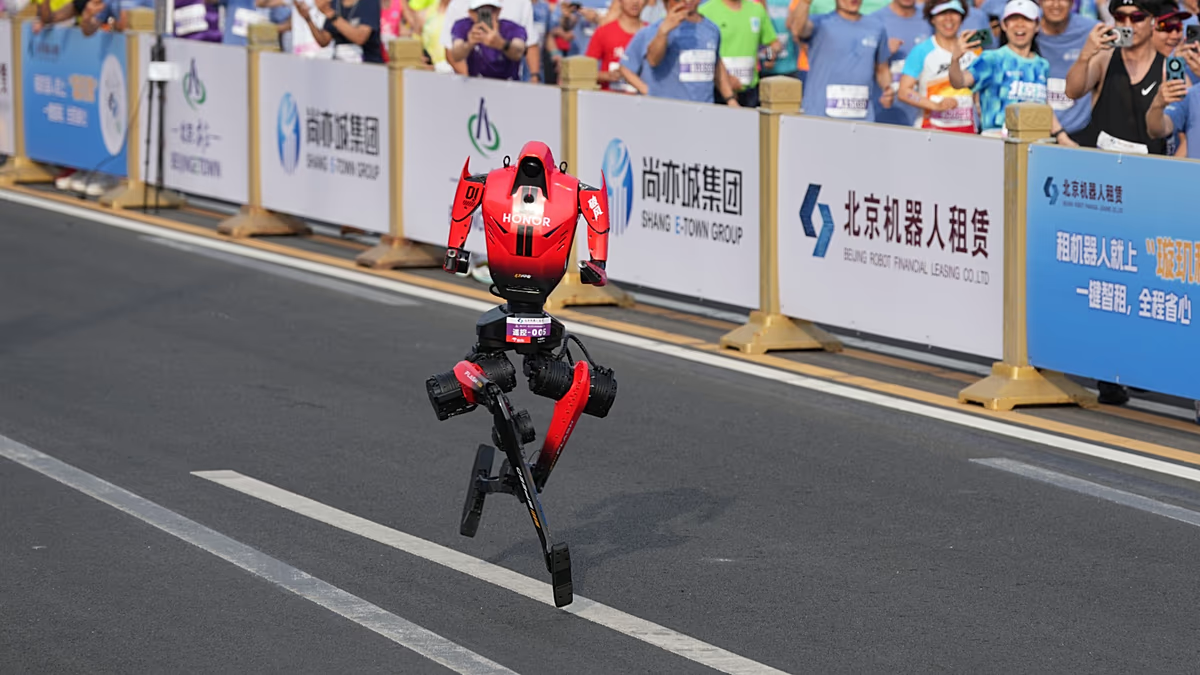
In a stunning display of technological advancement that blurs the line between science fiction and reality, a humanoid robot has officially outrun humanity’s best. At the Beijing E-Town Humanoid Robot Half-Marathon, an autonomous machine developed by the Chinese tech company Honor shattered the human world record for the 21-kilometer distance. Completing the course in just 50 minutes and 26 seconds, the robot surpassed the remarkable human benchmark of approximately 57 minutes, set by Ugandan athlete Jacob Kiplimo earlier in the year. This event was far more than a simple race; it was a meticulously designed proving ground, created to push robotic systems to their absolute limits within the unpredictable and demanding conditions of the real world. The victory marks a landmark moment, signaling not just a incremental step, but a giant leap in robotics, mobility, and autonomous navigation.
The engineering philosophy behind this record-breaking machine was rooted in biomimicry, drawing direct inspiration from nature’s most efficient endurance runners: humans. According to Honor engineer Du Xiaodi, the robot was modeled from its inception on the physiology of elite human athletes. This approach resulted in a design featuring characteristically long legs, measuring about 0.95 meters, to maximize stride length and efficiency. Perhaps even more critical than its skeletal structure was its internal cooling system. The immense physical exertion required for a half-marathon generates significant heat, which can cripple electronic components. To solve this, engineers equipped the robot with a powerful, largely in-house developed liquid-cooling system. This innovation was paramount, acting as the machine’s equivalent of a human sweat response, allowing it to maintain peak performance without succumbing to thermal shutdown over the grueling distance.
The event itself was a spectacular and chaotic symphony of clanking metal and whirring motors, featuring over 100 robotic participants. This followed extensive overnight trials involving more than 70 teams on the full course in Beijing’s E-Town development zone. In a vivid illustration of a new human-machine partnership, the robots ran on parallel tracks alongside 12,000 human participants, a necessary separation to prevent collisions. A key, deliberate challenge set by the organizers was autonomous navigation, with roughly 40% of the robots attempting the course using only their own sensors and AI, without remote control. This year’s race demonstrated dramatic progress from the inaugural event just one year prior, where only six out of 21 robots managed to finish. Despite the improvements, the competition laid bare the ongoing technical hurdles: robots stumbled and fell at the starting line, others veered into barriers, and teams grappled with persistent issues of overheating motors and limited battery life, reminding everyone that this frontier is still being actively conquered.
In a fascinating nuance to the race results, a separate, remote-controlled robot from Honor actually crossed the finish line first with a time of 48 minutes and 19 seconds. However, under the event’s scoring system, which prioritized the greater challenge of full autonomy, the self-navigating model was awarded the overall victory. The podium was swept by Honor, with two other autonomous robots from the company securing second and third place. This distinction highlights the core mission of the event: it is less about raw speed under direct human guidance and more about developing machines capable of intelligent, independent operation in complex environments. The remote-controlled result shows the potential of the hardware, while the autonomous victory celebrates the maturity of the software and AI—the robot’s “mind.”
Looking beyond the finish line and the podium ceremony, engineers like Du Xiaodi see a future where the lessons learned on the race track translate into broad societal utility. He draws a direct parallel to the early days of the automotive industry, which was radically advanced through the pressures of competition. The technologies honed in this robotic marathon—particularly in structural reliability and the sophisticated liquid-cooling systems—have promising applications in future industrial scenarios. Imagine humanoid robots performing prolonged, physically demanding tasks in factories, warehouses, or disaster zones, where endurance and thermal management are critical. The race, therefore, is not an end in itself, but a powerful accelerator for practical innovation, pushing components and software to failure points in a public forum, thereby rapidly identifying and solving problems that would take much longer to uncover in a lab.
This historic race in Beijing is a compelling snapshot of a world in transition. A machine has outperformed the pinnacle of human biological evolution in a fundamental test of endurance and speed. Yet, the stumbling robots and the heated engineering battles on the sidelines keep the achievement in perspective, framing it not as an endpoint, but as a vibrant beginning. The event underscores a future where humanoid robots could become commonplace partners, their capabilities forged in competitive crucibles like this one. The half-marathon record is more than a trophy; it is a testament to human ingenuity, a benchmark of progress, and a promise of a new era of automation, defined not by stationary arms, but by machines that can walk, run, and eventually, work alongside us in the dynamic tapestry of everyday life.