


Cyprus, the European Union’s southeasternmost member, is quietly strengthening its unique humanitarian role on the geopolitical map. With US financial support, the island nation is preparing to upgrade two key military installations: the Andreas Papandreou Air Base in Paphos and the Evangelos Florakis Naval Base in Mari. These expansions are not for building offensive might, but for amplifying Cyprus’s capacity to serve as a strategic safe haven and transit point for civilians fleeing conflicts in the neighboring Middle East. This initiative underscores a deliberate national strategy to leverage Cyprus’s geographic position as a stable EU outpost just miles from turmoil, transforming its bases into hubs of mercy rather than jumping-off points for war.
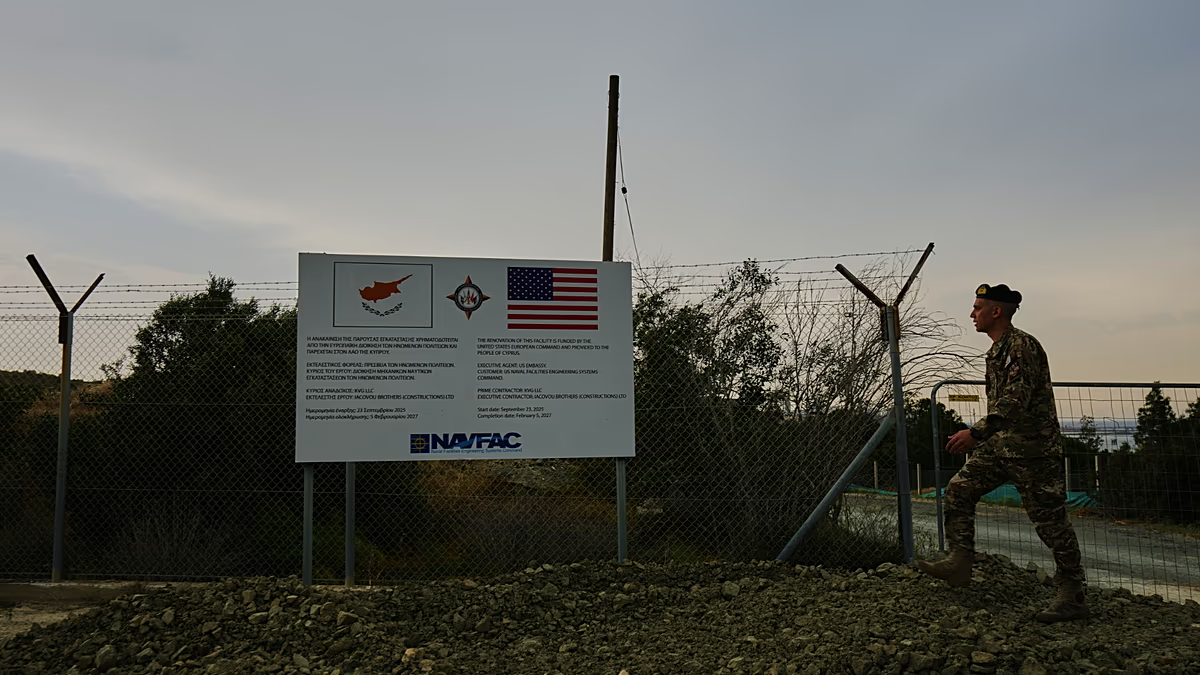
The planned upgrades are highly practical, designed to overcome logistical bottlenecks during large-scale evacuations. At Paphos Air Base, a new parking apron will be constructed to accommodate dozens of heavy-lift military transport aircraft simultaneously. This expansion will allow for faster refuelling, maintenance, and processing, turning what is currently a capable facility into a high-throughput humanitarian airport. Meanwhile, at the naval base near Mari—which lies a mere 229 kilometres from the coast of Lebanon—a new heliport funded by US European Command will be built to handle large Chinook transport helicopters. This addition is crucial for airlifting evacuees directly from conflict zones or ships at sea to safety on Cypriot soil. While final costs are still being assessed, estimates suggest the air base project will cost around €14 million, with the naval base upgrade potentially exceeding €200 million, for which Cyprus is also seeking additional EU funding.
This development is a direct response to hard-earned experience. Cyprus has repeatedly proven its value as a humanitarian linchpin over the past two decades. It orchestrated the evacuation of roughly 30,000 people from Lebanon during the 2006 Israel-Hezbollah war. More recently, in April 2023, it became a critical transit point for third-country nationals fleeing the civil war in Sudan. Its role evolved again in 2024 with the establishment of the Amalthea maritime corridor, which shipped thousands of tonnes of aid to Gaza. The cycle continued in June 2025, following strikes on Iran’s nuclear facilities, when Cyprus once more served as a waystation for people leaving Israel and for stranded Israelis to return home. Each crisis has underscored the need for enhanced, permanent infrastructure to manage these complex operations efficiently.
The deepening partnership with the United States is a cornerstone of this enhanced capability. The US has already provided initial funding for planning and, in 2024, deployed a Marine contingent with V-22 Osprey aircraft to Paphos specifically to assist with potential evacuations from Lebanon. In January 2025, US military experts conducted detailed infrastructure assessments at the air base. As US Army Colonel Kenneth Evans, the senior defence attaché in Nicosia, affirmed, recent events have “demonstrated the criticality of the Republic of Cyprus as a security partner in the eastern Mediterranean.” This cooperation, however, operates within clear boundaries set by Cyprus. President Nikos Christodoulides has been unequivocal: these installations are for humanitarian and emergency response purposes only and will not be used for offensive military action, a vital assurance for regional stability.
To realize these ambitious projects, Cyprus is strategically navigating multiple funding avenues. Beyond direct US support, the nation is actively tapping into European Union mechanisms designed to bolster collective security and resilience. Cyprus has sought funding through the EU’s SAFE (Strategic Adaptation of the European Defence Industry) programme, which offers substantial, long-term financing for defence readiness infrastructure across member states. This multi-source approach—combining US bilateral support with EU strategic funds—not only shares the financial burden but also solidifies Cyprus’s role as a trusted, interconnected node within Western humanitarian and security networks, fully aligned with EU values and crisis response objectives.
Ultimately, the expansion of the Paphos and Mari bases is a forward-looking investment in regional stability and human security. By systematically upgrading its capacity, Cyprus is institutionalizing its ad-hoc humanitarian successes into a permanent, reliable capability. The projects, slated to begin in 2027, represent more than concrete and tarmac; they symbolize a national commitment to providing a beacon of safety amidst the frequent storms of the Eastern Mediterranean. In a region often fractured by conflict, Cyprus is consciously crafting an identity as a neutral ground for rescue and relief, a mission that serves both its moral imperative and its strategic interests as a respected EU partner.