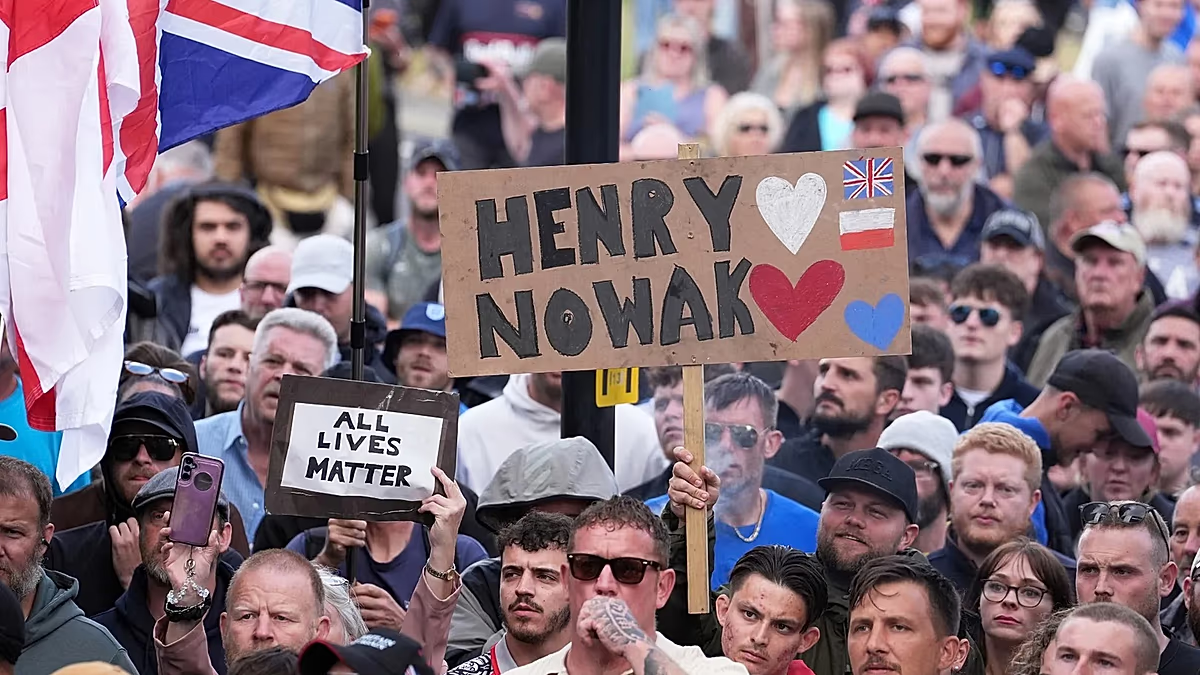


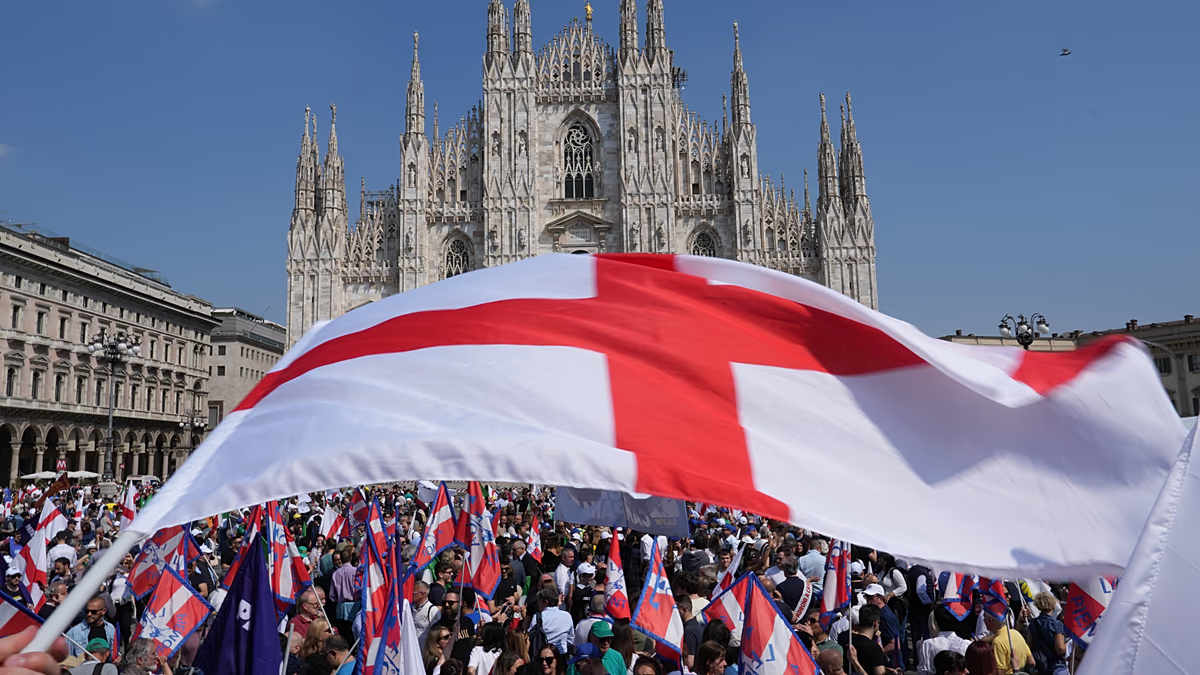
On a brisk Saturday in Milan, the historic Piazza Duomo became the stage for a potent display of political sentiment, as thousands gathered under the banner of “Masters in Our Own Home.” The demonstration, a joint effort by Italy’s League party and the nascent “Patriots for Europe” alliance, framed itself as a defence of national identity and sovereignty. The visual symbolism was stark: a tractor leading the march in support of “Made in Italy,” followed by League mayors adorned in the tricolour sash, painting a picture of agrarian and municipal tradition meeting populist politics. The event, however, transcended national issues, serving as a continental rallying cry for a coalition of right-wing and nationalist parties seeking to reshape the European Union from within, starting with the upcoming European Parliament elections. The atmosphere was one of defiant celebration, yet it was underscored by references to recent tragedies and a palpable sense of cultural confrontation.
The emotional core of the rally was established early by League leader and Deputy Prime Minister Matteo Salvini. He opened not with policy, but with a solemn apology to the family of Giacomo Bongiorni, a man recently beaten to death in Massa after reportedly asking two young men to behave properly. This framing positioned the League as the defender of public order and shared values against perceived decay. Salvini seamlessly linked this domestic grievance to broader European politics, paying tribute to Viktor Orbán, whose party had recently suffered a rare electoral setback in Hungary. Salvini’s praise for Orbán’s border defence and fight against “traffickers” solidified the thematic throughline: a Europe under threat, requiring strong, unapologetic leadership to restore security and law. The speech set a tone of us-versus-them, blending local sorrow with a continent-wide political mission.
Central to Salvini’s address, and to the ideological platform of the gathering, was a radical reimagining of migration policy. He articulated a vision based on “remigration” and a points-based residence permit system, akin to a driving licence. Framing citizenship as “an act of trust,” Salvini argued that the state’s provision of benefits and healthcare must be met with good conduct; repeated “mistakes” would result in deportation. This transactional view was coupled with a preference for migrants from culturally and religiously aligned nations, which he presented as a path to “genuine integration.” In stark terms, he contrasted this with the “chaos” he accused the “globalist left” of fostering to suppress wages. This portion of the speech crystalized the rally’s underpinning philosophy: that the nation is a home to be protected, with membership granted conditionally and sovereignty over borders presented as the ultimate form of democratic self-determination.
Salvini then turned his critique toward the European Union’s economic governance, which he depicted as an alien and malevolent force. He vehemently rejected any notion of “energy lockdowns” and called for the suspension of EU fiscal rules, specifically the Stability Pact, to free up resources for Italian citizens. In a pointed geopolitical stance, he urged for an end to sanctions on Russian gas, citing the United States’ continued trade as a hypocritical precedent. “If they do it in Washington, they must do it in Brussels,” he declared, painting the European Commission and the International Monetary Fund as a detached “duo” of “Martians.” This rhetoric served to externalize economic pressures, positioning Brussels and international finance as antagonists against which a coalition of patriotic nations must rebel. He concluded this segment by dismissing the recent defeat of a justice referendum as a minor setback, insisting the governing majority was “more united” and determined to push through reforms.
The international dimension of the event was amplified as leaders from the “Patriots for Europe” took the stage, transforming the Milanese square into a mini-parliament of European nationalism. Czech Prime Minister Andrej Babiš emphasized border protection as the alliance’s cornerstone. The most incendiary comments came from Dutch MP Geert Wilders, who directly linked the rally to a violent assault in Milan the previous night, allegedly by migrants. “We must stop immigration from Islamic countries… they are criminals who want to follow sharia law,” he stated, drawing a direct line between migration, crime, and cultural threat. French National Rally president Jordan Bardella framed the upcoming French elections as a pivotal battle for all of Europe, while Spain’s Santiago Abascal and Austria’s Udo Landbauer warned of cultural erosion and praised Salvini’s border policies. Their unified message was clear: national sovereignty is not outdated but is the essential building block for a reformed, patriot-led Europe.
However, the narrative of patriotic unity in the piazza was fiercely contested in the streets surrounding it. In a stark illustration of Italy’s deep political fractures, approximately five thousand antagonists, including members of social centres and anti-fascist groups, marched under the banner “fascists out of Milan.” Their attempt to breach police cordons and reach Piazza Duomo resulted in violent clashes. Officers deployed water cannon to repel volleys of firecrackers, smoke bombs, and bottles. This parallel demonstration, and the tense confrontation that ensued, served as a powerful counterpoint to the rally. It highlighted that the vision of Europe promoted by Salvini and the Patriots is not merely a political alternative but a profoundly polarizing force, seen by its opponents as a direct threat to the pluralistic and inclusive values of the modern city and the continent itself. Thus, Milan’s Saturday presented two irreconcilable Europes, each claiming to speak for the people, separated by barricades and a vast ideological divide.