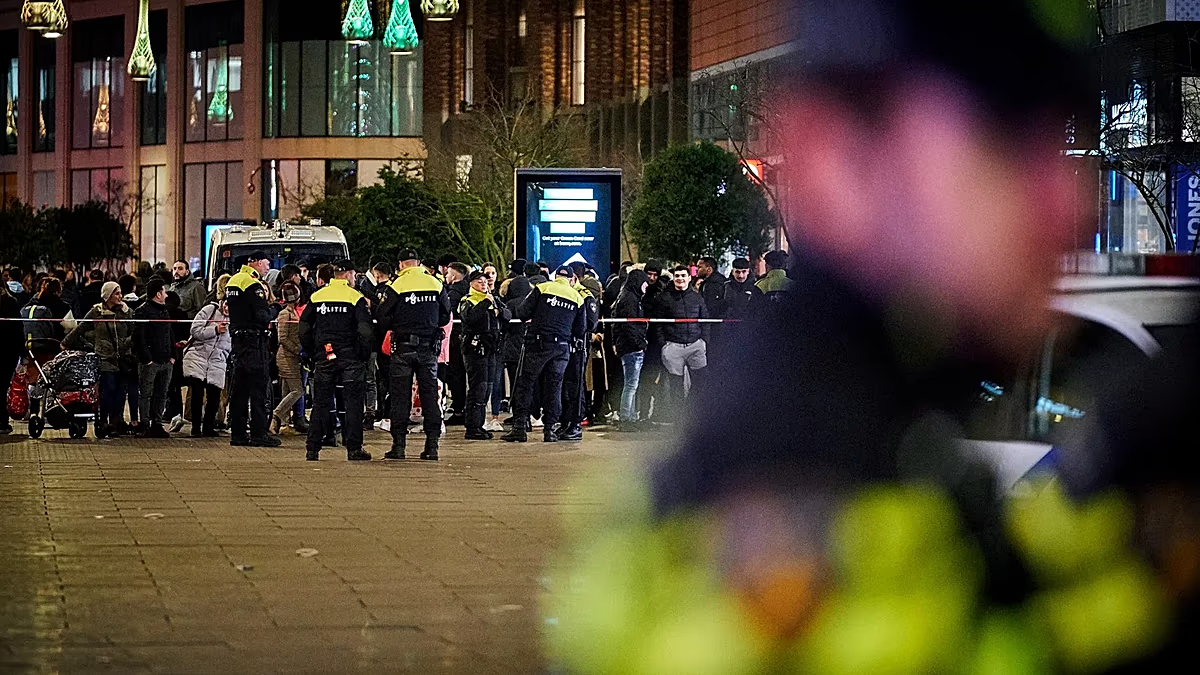



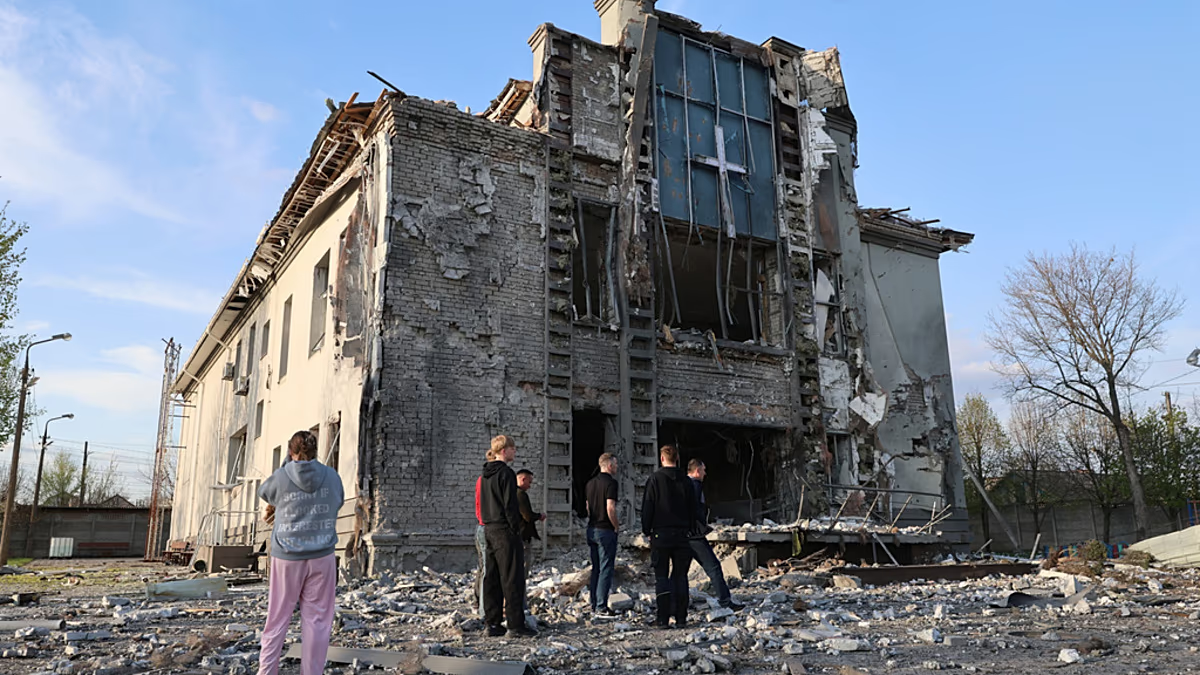
The human cost of war is measured not only in territory gained or lost, but in the shattered quiet of a night and the future stolen from a child. In the early hours of a Sunday in April 2026, the northern Ukrainian city of Chernihiv was rocked by a Russian strike. When the dust settled, the community was left to mourn a 16-year-old boy, killed in the attack. Four other civilians were wounded, their homes, along with administrative and school buildings, left damaged. This tragic incident was part of a massive, coordinated aerial assault. On that Saturday night alone, Russian forces launched 236 drones against Ukrainian cities. While Ukrainian air defences performed heroically, intercepting 203 of them, the sheer volume meant 18 sites were directly hit, with falling debris causing damage at eight more locations. The violence continued into the daylight hours, with drone strikes in Kherson claiming another life and targeting railway infrastructure in the Poltava region, underscoring the relentless, nationwide nature of the threat.
In response to this barrage, Ukrainian forces demonstrated their own growing capacity to strike back at strategic targets deep behind enemy lines. On the same night, they launched a series of precision attacks against Russian military assets, both in occupied Ukrainian territories and within Russia itself. A key success was a strike on the Atlant Aero facility in Taganrog, within Russia’s Rostov region. This enterprise is a crucial node in Russia’s military-industrial complex, responsible for the design, production, and testing of reconnaissance and strike drones like the Molniya and components for the heavier Orion drone, which can carry a significant payload of bombs and missiles. The attack caused a major fire, with the regional governor confirming three people required medical treatment and that commercial warehouses were also damaged. This was not the first time the facility had been hit, indicating its importance to Ukraine’s targeting strategy. Beyond Russia’s borders, Ukrainian forces successfully struck an ammunition depot in the occupied Zaporizhzhia region and hit several equipment and supply depots in the Donetsk region. In a notable tactical evolution, Ukraine’s military also reported a novel achievement: for the first time, a Russian Shahed drone was shot down by an interceptor missile launched from an unmanned surface vessel, showcasing innovative asymmetric warfare at sea.
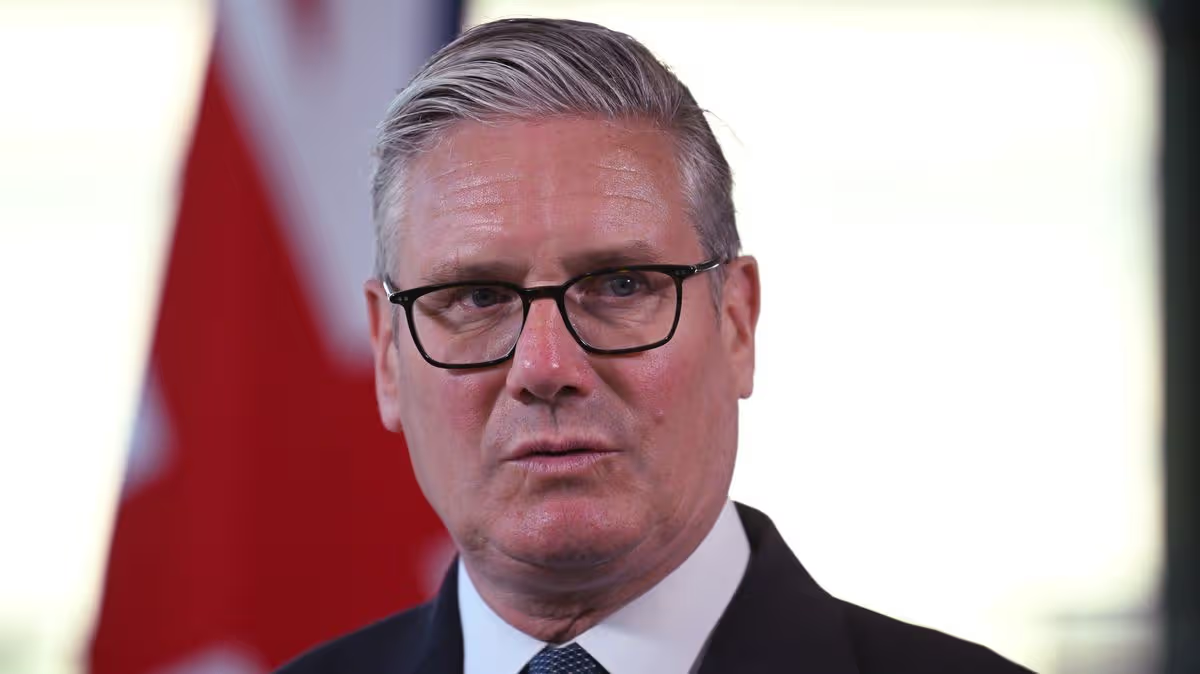
However, Ukraine’s leadership argues that its military efforts are being undermined by economic decisions made thousands of miles away. President Volodymyr Zelenskyy issued a stern condemnation on Sunday, directly linking the flow of money to the flow of missiles. His target was the recent decision by the administration of U.S. President Donald Trump to extend, for another month, a waiver suspending sanctions on Russian oil and petroleum products already loaded on tankers at sea. Zelenskyy did not mention the U.S. by name, but his meaning was unmistakable. He stated that over 110 tankers were currently at sea carrying more than 12 million tonnes of Russian crude in violation of international sanctions, a cargo he valued at $10 billion. “Every dollar paid for Russian oil,” he declared, “is money for Moscow’s war.” He directly connected this revenue stream to the violence raining down on his people, noting that in just one week, Russia had launched over 2,360 drone strikes, 1,320 guided aerial bombs, and nearly 60 missiles.
The Ukrainian president framed the issue as one of fundamental accountability and global security. He called for concrete actions to physically block these “shadow” tankers, urging that they be denied port access to prevent the delivery of their cargo. For Zelenskyy, the logic is straightforward: reducing the aggressor’s oil exports directly reduces its capacity to wage war. He views sustained, enforced sanctions not as an abstract economic tool, but as a vital lifeline for Ukraine’s survival and a necessary step to prevent further global destabilization. This sentiment was powerfully echoed by Ukraine’s Ambassador to the United States, Olha Stefanishyna, who made a direct public appeal on social media. She called on the U.S. administration to reinstate the full sanctions, warning that allowing Russia to profit from oil sales amidst its aggression would only incentivize further conflict. Her warning was underscored by the chilling report that a Russian representative had cynically referred to the U.S. waiver as a form of “cooperation.”
This series of events from a single day in April 2026 paints a stark picture of a conflict that has settled into a brutal rhythm of escalation and interconnected fronts. On the ground, the war manifests in the most visceral way possible: in the loss of a teenager in Chernihiv and a civilian in Kherson. In the air and in distant warehouses, it is a high-tech duel of drones versus air defences, and precision strikes against logistical chains. Yet, in the corridors of international finance and diplomacy, the battle is fought over tariffs, waivers, and tanker routes. Ukraine demonstrates remarkable resilience and tactical ingenuity, finding ways to hit Russian production facilities and even pioneer new methods of drone interception. But its leadership passionately argues that these military efforts are part of a larger struggle, one that can only be won if the economic fuel feeding the Russian war machine is finally cut off.
The tragedy in Chernihiv and the strike on Taganrog are two sides of the same coin—one reflecting the human suffering, the other the industrial-scale machinery of war. The passionate appeals from Kyiv highlight the frustrating reality that in a globalized world, the frontline is everywhere: it is in a Ukrainian neighborhood, a Russian factory, a boardroom, and on the high seas. The conflict has evolved into a total struggle, where every weaponized drone shot down is a victory, every sanction enforced is a shield, and every tanker turned away is a step toward peace. The people of Ukraine fight not only with artillery and drones but with diplomacy and data, striving to show the world that the cost of inaction is measured in lives, like that of the 16-year-old boy whose future ended on a Sunday in Chernihiv.