

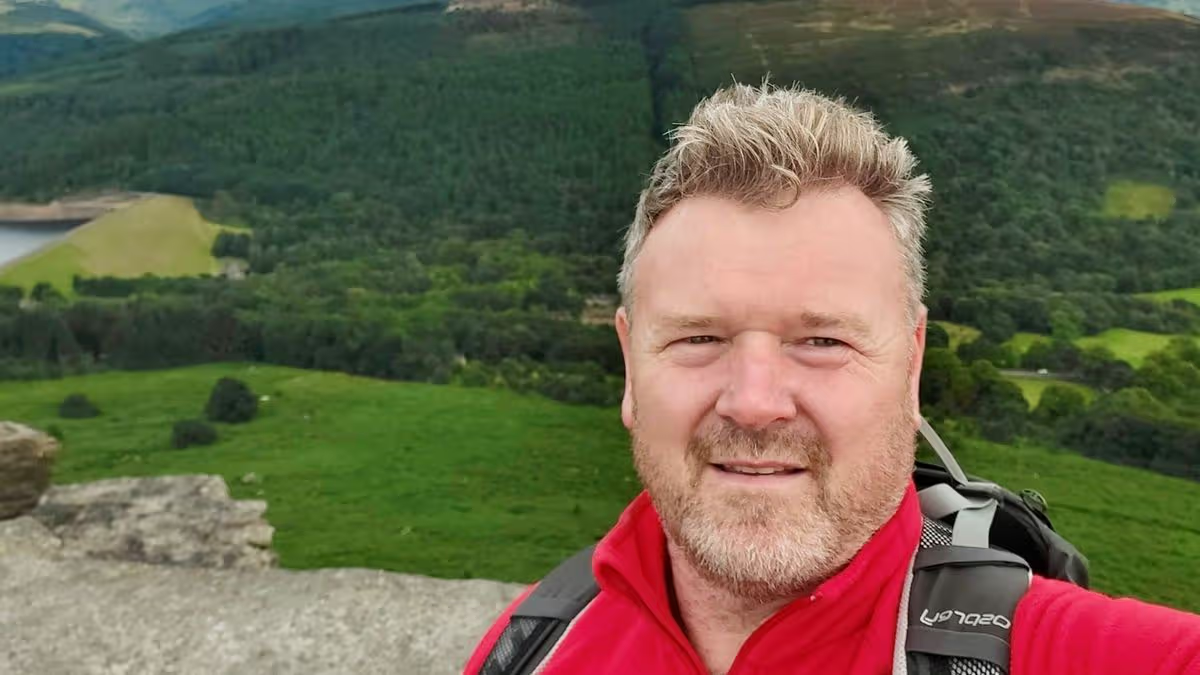
David Macartney’s life was one defined by movement and vitality. A dedicated runner who had once conquered the London Marathon, a keen cyclist, hiker, and kayaker, his identity was intertwined with the rugged landscapes of the Peak District and Snowdonia. In early 2022, however, a seemingly minor discovery during a routine change after water sports sent his world into a terrifying spiral. Noticing a small lump under his armpit, he initially thought little of it, but a subsequent visit to his GP revealed a grave concern etched on the doctor’s face. The referral onto a cancer pathway was a profound shock, and the agonising eight-week wait for a diagnosis felt like an eternity. The verdict, when it came, was devastating: aggressive stage 4 non-Hodgkin lymphoma. For David, a father-of-three from Hazel Grove, Stockport, the fear was immediate and all-consuming—the fear of dying, and the profound terror of leaving his wife, Lisa, and their children behind.
Supported by his family, David began an intensive battle at Manchester’s specialist Christie hospital, embarking on chemotherapy and a clinical trial. While the treatment was successful in pushing the cancer into remission, the victory came at an almost unimaginable cost. The powerful drugs had a catastrophic side effect, weakening his bones to the point where his back fractured in eleven places. Almost overnight, the super-fit athlete was confined to a hospital bed for six weeks, submerged in agony, reliant on morphine, and completely unable to move the lower half of his body. The psychological toll of this physical devastation was profound. He describes the shift from an active, independent life to one of total dependence as one of the hardest parts of the ordeal—a brutal lesson in accepting help and confronting a future that seemed irrevocably broken.
At his lowest ebb, David needed two crutches to navigate even the shortest distances. The active dad who once led his family on hikes now watched from the sidelines as friends lined up for 10k runs, an experience he found utterly heartbreaking. The pain was relentless, but the assault on his mental health was equally severe. It was here, in this landscape of pain and limitation, that his remarkable recovery began, guided by the dedicated supportive oncology team at The Christie. His physiotherapist, Nic, became a cornerstone of his healing, offering not just physical rehabilitation but a compassionate ear, understanding the deep interconnection between his physical state and his mental wellbeing. This holistic approach helped break a relentless cycle of pain, teaching David how to manage it through careful movement and a renewed understanding of his body’s new parameters.
Through tailored pain management and relentless, patient physiotherapy, David slowly began to rebuild—not just his strength, but his confidence. The journey was incremental, a daily negotiation with his own limits. Then, in a moment of symbolic triumph nearly a year after finishing treatment, he achieved what once seemed impossible: he slowly and carefully walked to the summit of Mount Snowdon. This victory was more than a physical feat; it was a reclamation of his spirit. He has since returned to kayaking and hiking, with a goal to cycle again by 2026. Life, as he acknowledges, is not the same as it was before cancer, but it is profoundly better than the depths of his hospital bed.
The legacy of his illness is a hard-won wisdom. While the pain has not vanished, he no longer relies on daily medication, having learned to work with his body differently. Crucially, he learned the power of saying no, of blocking out external noise, of facing facts rather than fear, and of fiercely protecting his energy as a non-negotiable part of his wellbeing. There is no anger in his reflection, only a stark clarity. Cancer changed his life, but it also taught him how to live more honestly and deliberately. The fear, he notes, does not disappear, but you learn how to live alongside it, a quieter passenger on a road you now navigate with greater intention.
Professor Richard Berman, a consultant in supportive oncology at The Christie, highlights that David’s story embodies the core mission of their work: survival is not just about eradicating disease, but about empowering patients to live fully during and after treatment. By focusing on pain management, physical rehabilitation, and psychological well-being, the aim is to restore independence and quality of life. Now, in a powerful full-circle moment, David is channelling his regained strength into giving back, preparing to take on the Manchester 10K to raise funds for The Christie NHS Foundation Trust—the very institution that helped him learn to walk, and to live, again.