




Of course. Here is a humanized and expanded summary, structured into six paragraphs as requested.
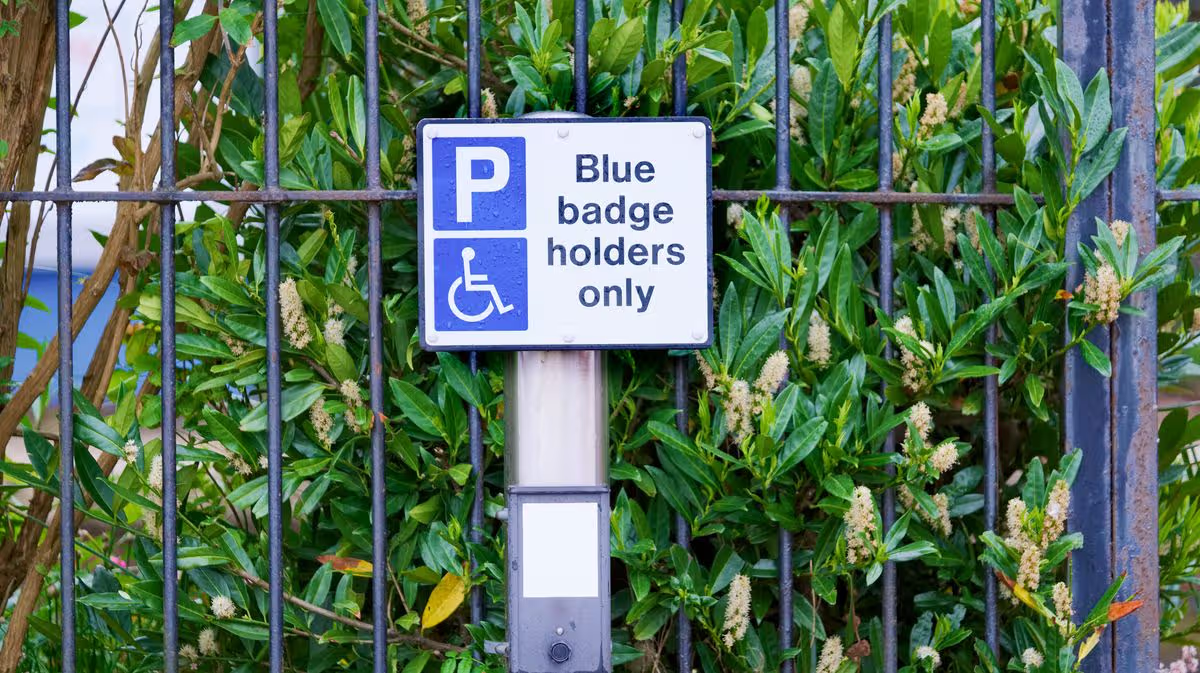
The Blue Badge is more than a piece of plastic; it is a vital lifeline for millions across the UK. For individuals with significant mobility challenges, this parking permit transforms daily life, enabling access to medical appointments, social engagements, and even basic errands like grocery shopping. By allowing holders to park closer to their destinations, it helps reduce the physical and logistical barriers that can make independence so difficult. As of recent figures, approximately one in twenty people in England holds one of these permits, underscoring its critical role in fostering inclusion and accessibility. However, this essential tool comes with significant responsibility and a complex set of rules designed to balance the needs of badge holders with the safety and flow of the wider community.
While the badge unlocks certain privileges, its use is governed by strict, non-negotiable conditions. The most fundamental rules are that the badge must always be displayed clearly on the dashboard or windscreen, and the genuine badge holder must be present in the vehicle—either as the driver or a passenger. Disregarding these core requirements, or using an expired badge, can lead to severe penalties, including a fine of up to £1,000 and the confiscation of the permit itself. This underscores that the badge is a personal concession, not a free pass for anyone using the vehicle. The system relies on trust and correct usage to function properly for those who truly need it.
For holders, the badge provides specific, valuable concessions in many everyday situations. It typically allows for free, unlimited parking at on-street pay-and-display meters and parking bays. Perhaps its most recognized benefit is the ability to park on single or double yellow lines for a period—up to three hours in England and Wales, and often without a time limit in Scotland, provided no obstruction is caused. It’s always advised, however, that designated disabled bays or unrestricted spaces should be used first, with yellow-line parking reserved as a last resort. Importantly, in areas with time-limited concessions, a parking clock must be displayed showing the arrival time. Local councils can provide these clocks, and visitors traveling between regions, such as from Scotland to England, must ensure they have the correct equipment.
Despite these concessions, there are clear and absolute restrictions where parking is never permitted, even with a Blue Badge prominently displayed. Safety-critical zones are strictly off-limits: these include areas with zigzag lines at pedestrian crossings (zebra, pelican, etc.), bus stops during their hours of operation, and active bus, tram, or cycle lanes. Parking is also prohibited on streets with double white center lines, on red routes during their controlled hours, and in locations where a loading ban is in force, indicated by yellow kerb markings. Furthermore, if parking restrictions are temporarily suspended or indicated by no-waiting cones, the badge does not override these orders. The guiding principle is that the badge cannot be used anywhere that would compromise public safety or crucial traffic operations.
Beyond these universal bans, there are other areas where caution and careful checking are essential. The badge does not automatically grant permission in places like resident-only parking bays, suspended meter bays, or areas with school “Keep Clear” markings during active hours. Holders must always look for accompanying signs that specify whether exemptions for disabled badges apply. A particularly notable exception to the scheme’s coverage is in central London, including the City of London, Westminster, Kensington and Chelsea, and parts of Camden. In these zones, the national Blue Badge scheme itself is not operational, though local authorities may offer their own reserved parking spaces for disabled drivers. This highlights the necessity for holders to research local rules before traveling.
Ultimately, the system is built on a foundation of mutual respect and consideration. Authorities like West Yorkshire Police emphasize that the listed rules are a guide, not an exhaustive list, and stress the importance of thoughtful parking. Using a Blue Badge means parking not just legally, but responsibly—avoiding actions that would cause an obstruction, impede traffic flow, or inconvenience other road users. By adhering to both the formal regulations and this principle of consideration, Blue Badge holders can maintain the integrity of a scheme that serves as an indispensable support for disabled individuals, ensuring it continues to function effectively and fairly for everyone.