


In the pre-dawn darkness of a North Yorkshire morning, a routine journey turned into a scene of sheer terror, culminating in a crash so violent it defied belief. The incident began when an alert member of the public, witnessing dangerously erratic driving along Garrowby Hill, made a critical 999 call. This set in motion a police response that would soon escalate into a breathtaking high-speed pursuit. Officers, identifying the vehicle as a white BMW 3 Series registered to an address in Leeds, anticipated its route and strategically positioned themselves. When Traffic Constable Nick Simpson spotted the car, its immediate and obvious instability on the road forced a swift decision: this driver had to be stopped before he killed someone. What followed was a chase that pushed speeds to an almost incomprehensible 142 miles per hour, transforming public roads into a deadly racetrack.
The pursuit, captured in harrowing police dashcam footage, unfolded with a sickening inevitability. After initially slowing in response to the police lights, the driver, 35-year-old Ashley Parr of Guiseley, Leeds, made a sudden, desperate evasion. He accelerated ferociously along the A64, reaching 130 mph, before joining the A1(M) southbound where his speedometer climbed to 140 mph. The raw velocity of the BMW was alarming enough, but combined with Parr’s clearly impaired control, it created a missile weaving through early morning traffic. Other unsuspecting motorists became unwitting participants in a life-or-death scenario, their normal commutes intersecting with a vehicle being operated with blatant disregard for all human safety. This was not merely speeding; it was an act of wanton endangerment playing out in real-time.
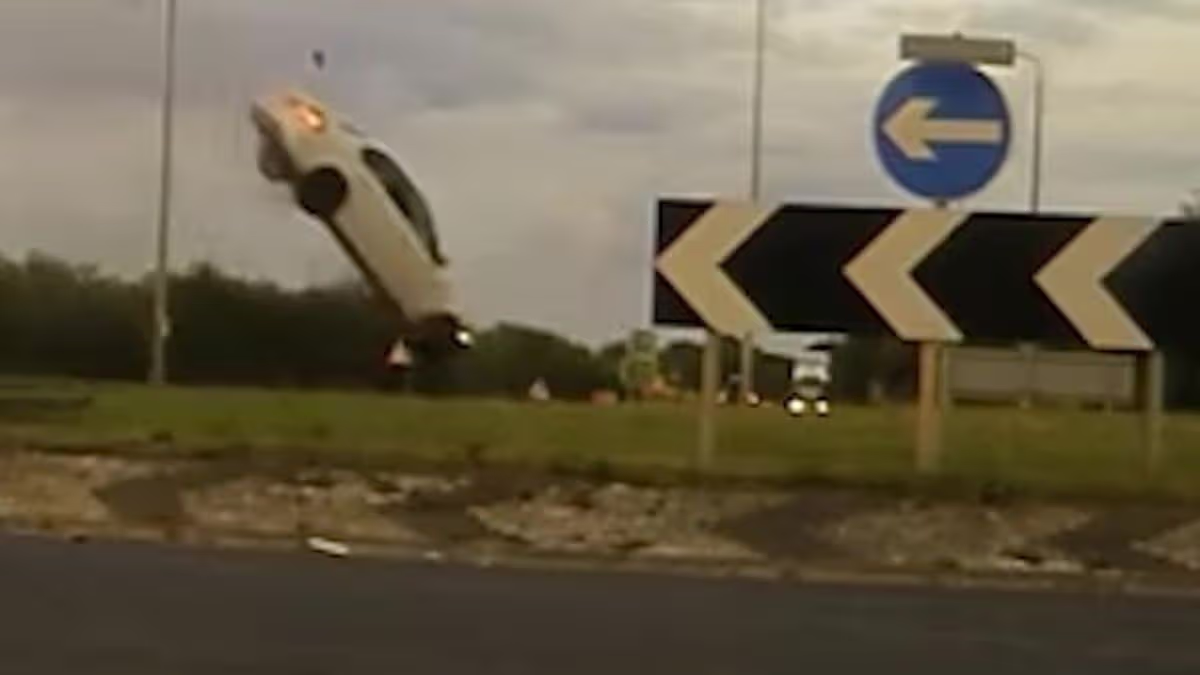
The catastrophic finale was as dramatic as it was predictable. Exiting the motorway at junction 42, Parr approached a roundabout at a speed utterly incompatible with the geometry of the road. In a violent instant, the laws of physics took over. The white BMW struck the roundabout curb at such force that it was launched violently into the air. The dashcam video shows the car spinning chaotically like a toy before crashing down on the far side, clearing the entire roundabout. It then slammed onto its bonnet and somersaulted at least three times in a terrifying display of destruction, finally coming to rest crumpled in a hedge. That Parr walked away from this wreckage was nothing short of a miracle, a twist of fate that spared his life but underscored the immense peril he had imposed on every other person sharing the road that morning.
Subsequent investigation revealed the appalling reasons behind Parr’s lethal behaviour. He was not simply a reckless driver; he was an impaired one. When tested, he was found to be under the influence of both drugs and alcohol, a cocktail of substances that annihilated his judgment, reaction times, and basic motor skills. His decision to get behind the wheel in that state was the original, profound failure that made the ensuing chaos inevitable. At York Crown Court, Ashley Parr pleaded guilty to charges of dangerous driving, drug driving, and drink driving. The court sentenced him to 16 months in prison and imposed a driving ban of three years and eight months, a penalty reflecting the severe gravity of his actions.
Reflecting on the incident, TC Nick Simpson highlighted the narrow escape from tragedy. “This was extremely dangerous driving that could easily have resulted in the death of other road users, as well as the driver himself,” he stated. His words are a chilling understatement. Each swerve at 140 mph, each near miss, was a potential fatality waiting to happen. The outcome—a wrecked car and a prison sentence—was, in a grim sense, the best-case scenario. What could have been a multi-vehicle pileup with unimaginable casualties ended with one man facing the consequences of his own choices. Simpson’s commendation of the vigilant member of the public who first reported Parr serves as a crucial public reminder: community vigilance is a first line of defense in keeping roads safe.
This case stands as a stark, sobering lesson in the consequences of impaired and dangerous driving. The police pursuit, while dramatic, was a symptom of a deeper crime: the conscious choice to operate a vehicle while intoxicated. The shattered BMW, tumbling through the air, is a powerful metaphor for a life thrown into chaos by poor decisions. Parr’s journey to prison began long before he hit the roundabout; it began the moment he decided to drive while impaired. His story is a forceful reminder that a vehicle is not a private sanctuary but a shared responsibility, and that the social contract of the road demands sobriety, attention, and care for the lives of others. The roads are safer with him off them, but the memory of that flying car serves as a lasting warning.