

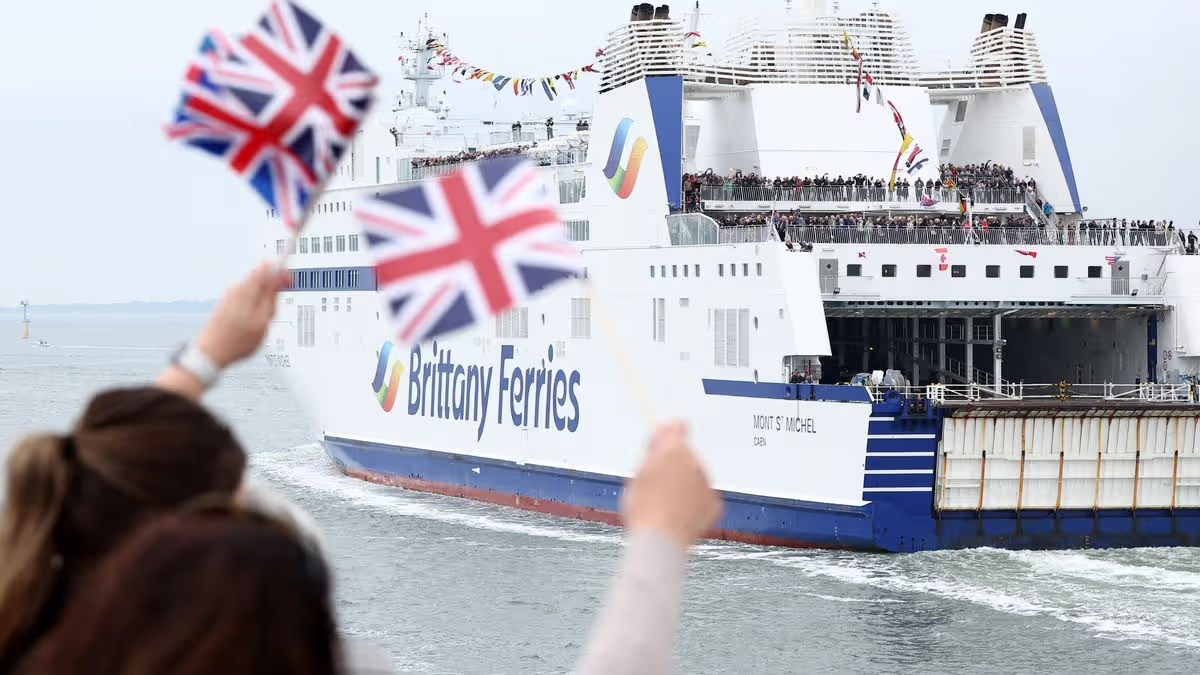
In a bold and principled stand against what he deems predatory business practices, Christophe Mathieu, the CEO of Brittany Ferries, has publicly condemned the exploitation of global crises for corporate gain. Speaking against a backdrop of rising oil prices and regional conflict, Mathieu labeled such behavior by some transport providers as “profiteering” and “absolutely the unacceptable face of capitalism.” His declaration comes as a direct assurance to travelers: Brittany Ferries will not raise its prices in the coming months, nor will its services be disrupted by potential fuel shortages. The company’s commitment is rooted in prudent financial planning, having secured the vast majority of its fuel at a fixed cost through hedging strategies. Mathieu sharply contrasted this approach with that of other operators, whom he likened to “bad gamblers” now “looking to others to cover their losses.” For families dreaming of a summer getaway, this promise of stability and fairness is a welcome beacon of reliability in an often volatile travel industry.
The operational confidence stems from a dual strategy of financial foresight and secured supply chains. Brittany Ferries has not only locked in fuel prices to shield itself from market spikes but has also received guarantees from its suppliers for the uninterrupted flow of all maritime fuels. This preparation positions the company uniquely amid widespread industry anxiety. For instance, rival ferry operator DFDS has acknowledged that while it will attempt to absorb higher costs, it will ultimately have to share that financial pain with customers. Meanwhile, the aviation sector is showing significant strain, with airlines like Virgin Atlantic imposing new fuel surcharges on passengers and others, such as KLM, cancelling flights due to fuel shortage concerns. In this climate, Brittany Ferries’ message is unequivocal: “If you have booked with us, or are considering doing so, we will get you to a beautiful and safe holiday destination this year. Period.” This isn’t merely a corporate policy; it’s a crafted ethos of customer care and ethical operation.
Mathieu’s critique extends beyond operational logistics into a moral commentary on contemporary capitalism. He insists that global conflict and uncertainty should never be leveraged as a pretext for inflating prices, a practice he finds fundamentally exploitative. The company’s pricing, he notes, increased only in line with general inflation earlier in the year, with a firm pledge against any further hikes. This ethical stance appears to be resonating powerfully with the public. Brittany Ferries reports a striking 37% increase in reservations over a recent two-week period for summer sailings, suggesting a notable shift in consumer behavior. Many families, it seems, are opting for the perceived stability and transparency of ferry travel, “abandoning the volatility of travel by air.” This trend underscores a growing public appetite for businesses that prioritize long-term customer trust over short-term windfall profits during crises.
Interestingly, the broader travel market is presenting a complex picture, with some segments offering unexpected bargains. Travel firm On the Beach reports that package holiday prices for the upcoming three months are, on average, 10% cheaper than they were at the same time last year, equating to a typical saving of around £110. According to holiday expert Caspar Nelson, this presents a “rare, sunny spot for consumers,” and his advice is to book now to lock in these favorable prices. This downward pressure is particularly noted for destinations geographically closer to the ongoing Middle East conflict, such as Cyprus, Turkey, and Egypt, as some travelers reconsider their plans. However, industry sources caution that this window may be brief, with prices expected to climb again as the peak summer demand period approaches, highlighting the transient nature of such opportunities.
The economic implications of rising fuel costs extend far beyond holiday budgets, touching the very core of national economies. The increased price of oil is a key driver of inflation, with a consensus of experts predicting it pushed the UK’s Consumer Prices Index (CPI) inflation to 3.3% for March. This official data, to be confirmed by the Office for National Statistics, quantifies the real-world impact of geopolitical strife on household finances. In this context, the actions of companies take on greater significance. Those that pass on costs immediately contribute to the inflationary cycle, while those, like Brittany Ferries, that have planned ahead and absorbed volatility provide temporary shelter for consumers. Their strategy demonstrates how corporate responsibility can have a tangible, dampening effect on the economic pressures faced by ordinary people.
Ultimately, the narrative emerging from the travel sector is one of stark contrast between different business philosophies. On one side are companies compelled to react to market shocks with surcharges, cancellations, and price hikes. On the other is Brittany Ferries, championing a model built on stability, transparency, and a fierce critique of profiteering. Christophe Mathieu’s forthright comments have framed a critical choice for the industry: to act as a stabilizing force or as an amplifier of uncertainty. For consumers navigating these challenging times, such principles translate into priceless peace of mind. The promise of a guaranteed price and a secured passage to a holiday represents more than just a service—it is a statement of values in an unpredictable world, reminding us that commerce and conscience need not be mutually exclusive.