



Amid a transformed global landscape following the closure of the Strait of Hormuz—a vital maritime chokepoint for oil—a strategic proposal has surfaced to fundamentally reshape energy transit routes. Central to this plan, reportedly outlined by US envoy Tom Barrack, is the ambitious repositioning of Syria as a critical land-based corridor, or “land bridge,” for global energy flows. The vision moves beyond simple road transport, focusing instead on reviving and massively expanding a network of pipelines to link Gulf and Iraqi energy fields directly to Mediterranean ports and European consumers. This concept aligns with recent statements by Syria’s President Ahmed al-Sharaa, who at the Antalya diplomacy forum expressed his country’s desire to become an alternative route for energy and goods, leveraging its strategic location to connect the East and West. The underlying rationale is stark: as sea routes become “weaponized,” secure land-based supply chains are deemed a strategic necessity “whatever the cost,” transcending mere market economics.
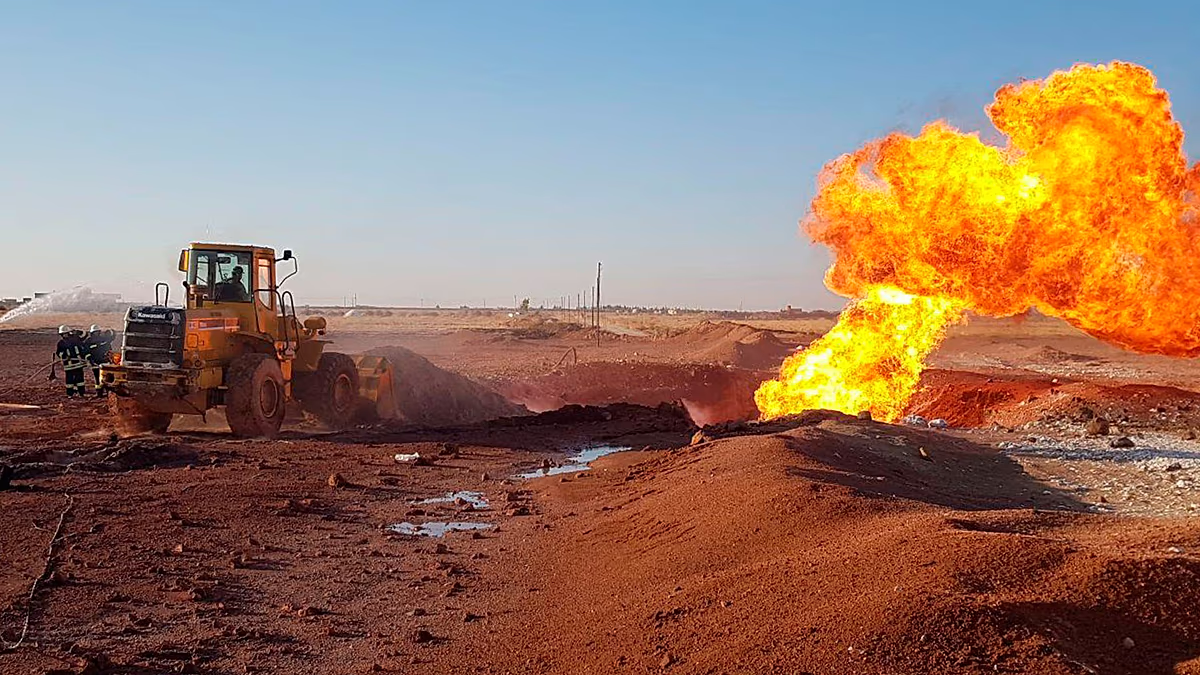
The proposed infrastructure network is both extensive and complex. It pivots on resurrecting major cross-border projects, such as the dormant Kirkuk–Baniyas oil pipeline from Iraq to Syria’s Mediterranean coast, estimated to require $4.5 billion. Equally strategic is the envisioned Qatar–Turkey gas pipeline, designed to carry gas from Qatar through Jordan and Syria northward. This plan also includes expanding newer infrastructure like the operational Azerbaijan–Kilis–Aleppo gas line and extending the existing Arab Gas Pipeline from Egypt through Syria to Turkey. Complementing these international links are efforts to rehabilitate over 1,000 kilometers of domestic pipeline network within northeast Syria and to build new export routes. Collectively, these projects aim to create redundant, secure underground corridors intended to mitigate the risks now concentrated at vulnerable maritime chokepoints.
However, significant skepticism exists regarding the feasibility of this grand vision. Analyst Sarkis Kassarjian dismisses the proposal as a repackaging of decades-old ideas, arguing that Syria lacks the requisite infrastructure, stability, and inherent geographic advantage compared to more viable alternatives. He points to established hubs like Saudi Arabia’s Red Sea ports, Israeli Mediterranean ports, and Turkish energy corridors, all of which possess developed infrastructure and harbors. Kassarjian further questions the fundamental security and governance conditions needed to sustain such a network, describing them as monumental obstacles within the region’s volatile geography. He suggests that more realistic projects, such as the existing Kirkuk-Ceyhan pipeline between Iraq and Turkey, already receive regional support and face fewer hurdles.
The security and governance dilemmas are perhaps the most formidable barriers. Kassarjian emphasizes that establishing, maintaining, repairing, and guarding a cross-border pipeline network is an immensely complex undertaking, requiring long-term stability, robust governance capacity, and reliable security guarantees—all currently uncertain in Syria. He links this directly to the stalled broader reconstruction process within the country, noting that over a year and a half after the formation of the government, little progress has been made. True economic recovery and development, he argues, are fundamentally tied to political stability, internal security, judicial reform, and transparent institutional management. Until these core “internal Syrian issues” are addressed, large-scale infrastructure projects remain precarious, with the economy still reliant on limited direct financial support from external allies.
From a technical perspective, the project is not implausible. Syrian petroleum engineer Ghassan al-Rai notes that much of the basic pipeline infrastructure—including old pumping stations and sections of export routes—still exists. Pipelines are typically buried and can be repaired or expanded using established engineering methods; multiple lines and additional stations could significantly boost capacity. He explains that a single pipeline can carry around one million barrels per day, though this is a fraction of the Gulf’s total exports. The primary constraints, al-Rai clarifies, are not technical but practical: financing, security, and political agreements. A critical acute challenge is a severe shortage of skilled technical labor, as an estimated eighty percent of young professionals who once worked in Syria’s energy sector have left the country during the long conflict, many now residing in Abu Dhabi and Saudi Arabia.
Ultimately, the proposal to transform Syria into a global energy “land bridge” presents a paradoxical mix of clear geopolitical impetus and profound on-ground challenges. The closure of the Strait of Hormuz has undeniably heightened the urgency for secure overland alternatives, giving the plan renewed strategic weight. Yet, its execution hinges on overcoming a cascading series of obstacles: securing billions in financing amidst uncertainty, fostering political agreements between multiple regional and international actors, guaranteeing long-term security in a historically unstable corridor, and reversing a brain drain to rebuild technical capacity. While technically possible, the plan stands at the intersection of high geopolitics and local reality, its future dependent on resolving Syria’s deeper crises of governance, stability, and reconstruction—a task that remains, for now, largely unmet.