




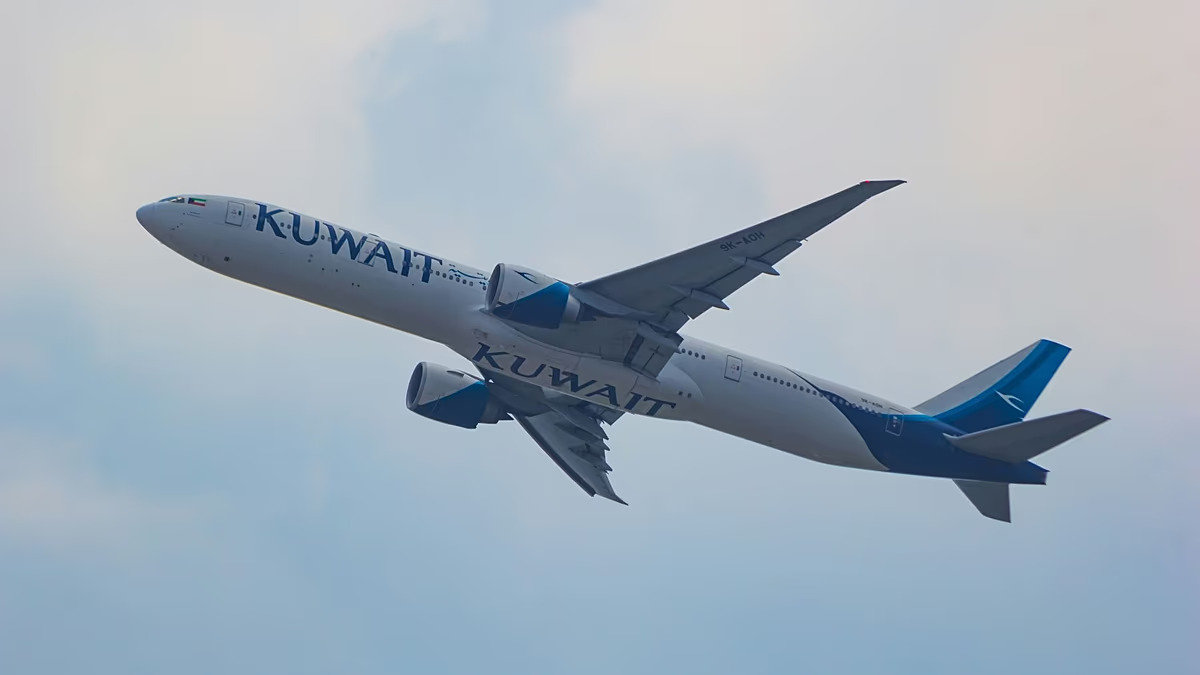
After nearly two months of suspended operations, a palpable sense of cautious optimism returns to Kuwait’s skies this Sunday, 26 April. The long-awaited reopening of Kuwait International Airport marks a significant, if tentative, step toward normalcy following the outbreak of conflict triggered by a US-Israel strike on Iran. While the nation’s airspace technically reopened on Thursday night, the resumption of commercial flights was deliberately delayed. According to a statement from Kuwait’s civil aviation authority, published by the Kuwait News Agency, this phased plan allows for the careful restoration of air traffic, aiming for the airport’s full operation in the coming period. This staged approach is not merely bureaucratic caution; it is a necessary response to the physical scars borne by the airport itself, which endured several drone strikes in recent weeks, targeting Terminal 1, the under-construction Terminal 2, and vital fuel storage tanks. The gradual timeline provides a crucial window for maintenance and repair works, ensuring passenger safety and infrastructure integrity as operations rebuild from the ground up.
The path to this resumption has been arduous for Kuwait’s aviation sector. During the closure, the country’s national carrier, Kuwait Airways, and its prominent low-cost competitor, Jazeera Airways, ingeniously sustained a semblance of service by operating flights out of Dammam in Saudi Arabia—a hub located approximately four to five hours’ drive from Kuwait. This extraordinary measure provided a vital lifeline for stranded passengers and maintained a minimal operational framework. Now, as the home hub prepares to welcome flights again, both airlines have wisely announced a hybrid strategy. They will continue to operate some services from Dammam while progressively ramping up operations at Kuwait International, ensuring continuity and flexibility during the transition. Kuwait Airways plans to resume services to a substantial list of 17 destinations, including key cities like London, Istanbul, Mumbai, Cairo, and Manila. Jazeera Airways will begin with a more focused reopening of nine routes: Istanbul, Beirut, Damascus, Dubai, Cairo, Amman, Kochi, Mumbai, and Delhi. Notably, as of now, no other international airlines have announced their return to Kuwait, highlighting that the recovery will be spearheaded by local carriers.
Kuwait’s reopening is part of a broader, gradual thaw in regional aviation, a sector profoundly disrupted by the conflict. The announcement follows a similar move by Hamad International Airport in Doha, which earlier this week permitted foreign airlines to resume operations. There, a sequenced return has unfolded: Flydubai resumed on 21 April, AirArabia on 22 April, followed by Oman Air, Royal Jordanian, Tarco Aviation, and US-Bangla Airlines on 23 April. Further services by Middle East Airlines and Himalaya Airlines are slated to begin on 26 and 28 April respectively. Qatar Airways, the flag carrier, has been maintaining limited flights since early March. In the United Arab Emirates, flights restarted on 2 March. While many European carriers like Air France, Lufthansa, KLM, and British Airways remain temporarily suspended, Emirates has demonstrated a robust recovery, resuming nearly 80% of its operations from Dubai, according to Flightradar24 data.
The regional picture, however, remains a mosaic of varying operational statuses and challenges. Saudi Arabia’s airspace, a critical corridor, remained open throughout the crisis, yet it witnessed widespread delays and cancellations that underscored the pervasive instability. The disruption was severe enough that Virgin Atlantic recently announced the cancellation of its London-to-Riyadh route merely a year after its launch, a commercial decision likely influenced by the ongoing uncertainty. Oman’s airspace also remains open, albeit with persistent reports of cancellations and delays. Following the announcement of a ceasefire, several nations took decisive steps: Bahrain, Iraq, and Israel reopened their airspace on 8 April, while Iran began a partial reopening of its airspace on 18 April. This collective, staggered effort illustrates the region’s concerted push to restore connectivity, albeit with each nation carefully assessing its own security and operational readiness.
The human dimension of this aviation recovery is profound. For two months, families separated by the conflict, students stranded abroad, business connections severed, and medical travel halted have awaited this news. The phased reopening, beginning with key regional and international destinations, will slowly mend these fractures. The continuation of some Dammam operations by Kuwaiti airlines is a thoughtful acknowledgement that the return to full capacity will not be instantaneous; it provides a safety net for travelers. Each rescheduled flight represents a reunification, a resumed business deal, or a long-delayed return home. The airport’s repairs are not just about concrete and steel; they are about restoring a vital portal for human stories, economic life, and cultural exchange that Kuwait, a nation deeply connected to the global community, depends upon.
In conclusion, the resumption of flights from Kuwait International Airport is a landmark event, symbolizing a cautious but determined move from crisis management toward recovery. It is a process characterized by pragmatism—evident in the phased plan, the ongoing use of alternate hubs, and the prioritization of infrastructure repair. While the journey back to full, pre-conflict operational levels will take time, Sunday’s first flights represent a crucial and hopeful departure. As Kuwait’s carriers lead the way and the broader region continues its own uneven but progressive reopening, the skies over the Middle East are slowly clearing. This restoration of aviation links is a foundational step in rebuilding not just travel schedules, but the broader economic and social confidence of a region seeking to navigate its way back to stability and peace.