

Of all the remarkable and often tumultuous journeys documented over 27 years of Grand Designs, few have resonated with the public—and haunted the host—quite like the story of Chesil Cliff House in North Devon. Commonly known as the “Lighthouse,” this ambitious project, led by owner Edward Short, first appeared in an episode aired in 2019. It began as a dream with a £1.8 million budget and an 18-month timeline, but spiralled into a 12-year ordeal costing roughly £7 million. The televised chapters witnessed not only soaring financial costs but profound personal strain, including the breakdown of Edward’s 20-year marriage and his daughters attempting to raise funds through car boot sales. Ultimately, Edward never lived in the finished house, selling the project in late 2025 to settle debts, after its asking price was slashed from an original £10 million to approximately £5.25 million. The narrative was branded by the press as the “saddest ever” Grand Designs, a label that speaks to its deep emotional toll.
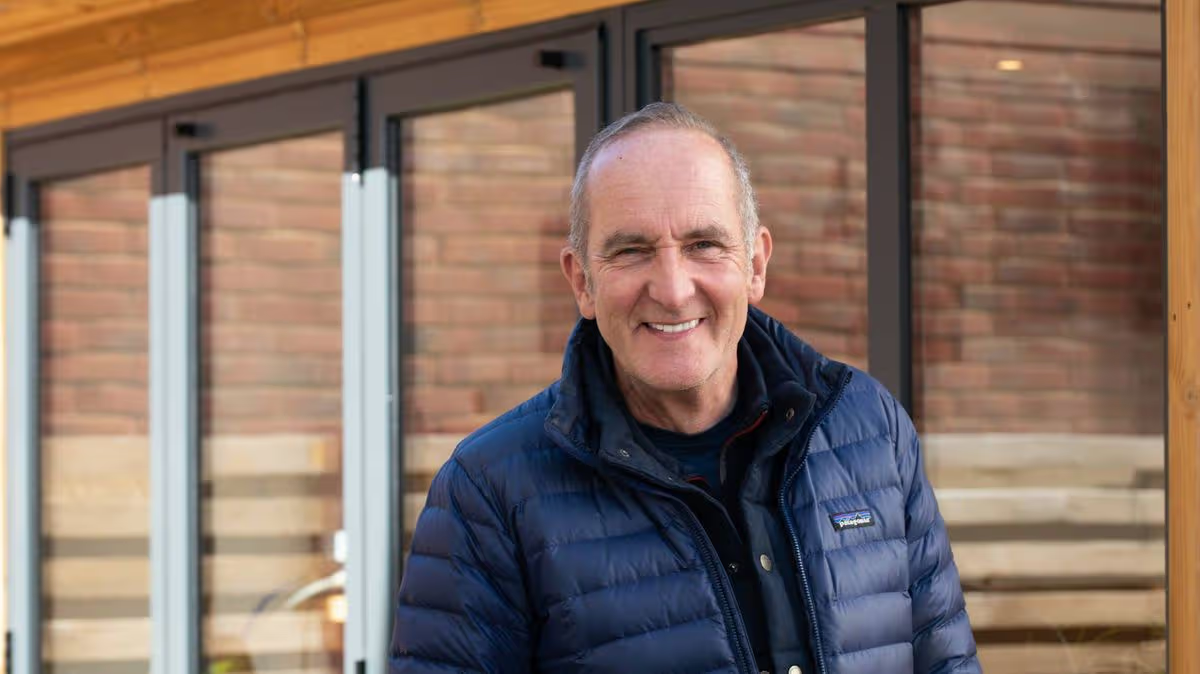
Kevin McCloud, reflecting on the project, offers a perspective that transcends the tabloid headlines. He confirms that Edward Short is now “licking his wounds a bit and enjoying life,” having reached a philosophical and self-critical, yet not regretful, place after a revisit filmed for the show. McCloud is pleased the story was documented, despite its painful outcome, because it reveals the complex and subtle human truths behind such endeavours. “It’s about how these projects affect people and where the human energy comes from,” he observes, noting that the greatest driver of positivity is human love—a force that was abundantly present, even amidst the struggle, in both the original film and the revisit. For McCloud, the Lighthouse story, while tragic in its practical outcome, contained elements of redemption and resolution for its creator.
Drawing from this and countless other case studies, McCloud identifies a universal pattern in self-build projects, one that novices and experienced builders alike seem destined to repeat. The core mistake, he says, is an overreach of hope and self-belief, a confidence fuelled by the illusion that DIY skills translate to building a home. The antidote, he argues, is collaboration: finding an architect who shares your worldview, securing a skilled quantity surveyor, and most critically, managing time realistically. “Better to plan for five years and build for one,” he advises, noting that the inverse—planning briefly but building endlessly—is the financially ruinous path. His fundamental recommendation is to consciously build a home three-quarters of the size initially imagined, a principle rooted in both economic and philosophical reasoning.
McCloud passionately expands on this point: the misconception that physical size equates to lived space. True space, he contends, is a sensory and experiential concept, created by design rather than square footage. A glass window above a shower framing the sky, or a ceiling light that reveals stars and clouds, can deliver a profound sense of expanse and wonder without vast dimensions. “I don’t know how big the house is, if you have something like that. It just blows your mind every time you go into the bathroom,” he muses. This design-led approach to creating space not only enhances daily life but also aligns with more sustainable and financially sensible building practices.
The host identifies the primary financial waste in self-builds as, unequivocally, making the house too large. Nearly everyone, he notes, eventually expresses astonishment at the sheer volume of materials—the lorries of insulation, timber, and concrete—and the embodied energy involved. This realisation often arrives late, when the scaffolding comes down or furniture is moved into unexpectedly palatial rooms, making familiar possessions seem diminutive. McCloud recounts a recent conversation with a builder who perceived her “huge volume” basement bedrooms as “quite small,” judged against her furniture. This perceptual gap, he suggests, highlights how ambition can distort scale until the physical reality is undeniable. Many who set out to build an eco-home end up constructing a vast one, a contradiction that can later prompt embarrassment about the project’s material intensity.
Kevin McCloud’s insights, shared ahead of the Grand Designs Live exhibition in London, distill decades of observing human ambition, resilience, and folly. The saga of the Lighthouse, while a extreme example, underscores a universal truth: building a home is less a technical challenge and more a deeply human journey, where love, overconfidence, and the quest for meaning intertwine. His advice—to plan meticulously, collaborate wisely, and prioritize experiential space over sheer size—serves as a guiding manifesto. It encourages future builders to seek not just a structure, but a soulful and sustainable habitat, one that nurtures the spirit without overwhelming the builder’s life or resources—a lesson etched into history by the poignant story of a lighthouse in Devon that its creator never called home.