



Paragraph 1: A Framework for Sovereignty, A Flashpoint for Dispute
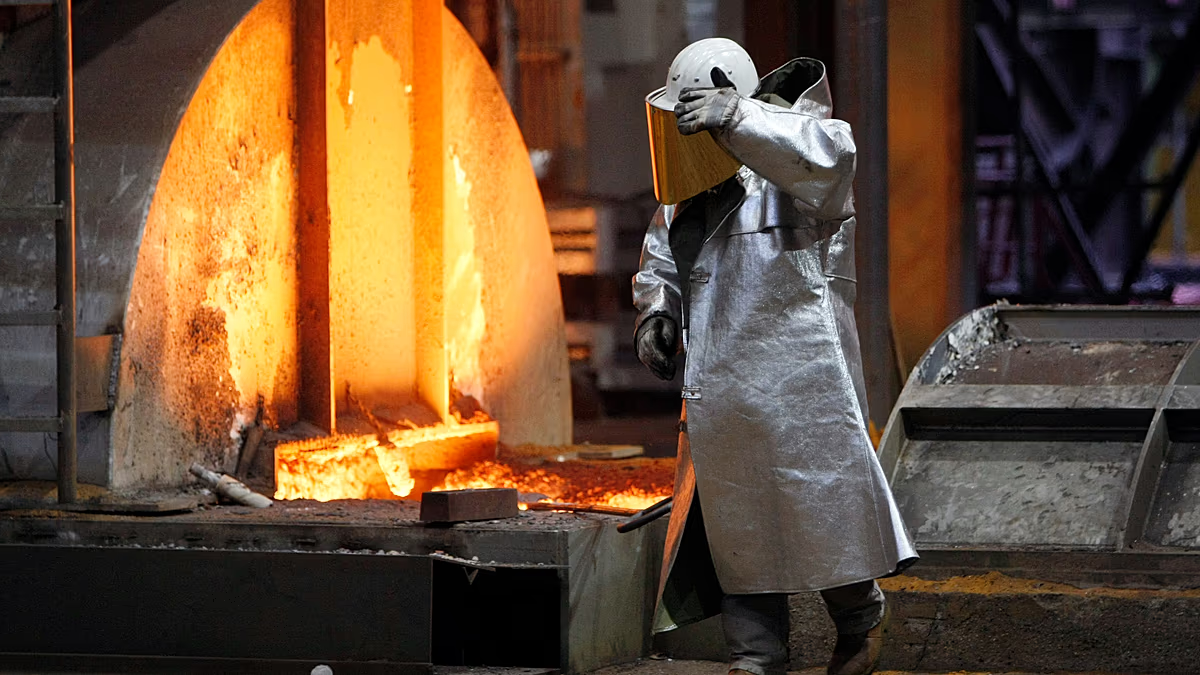
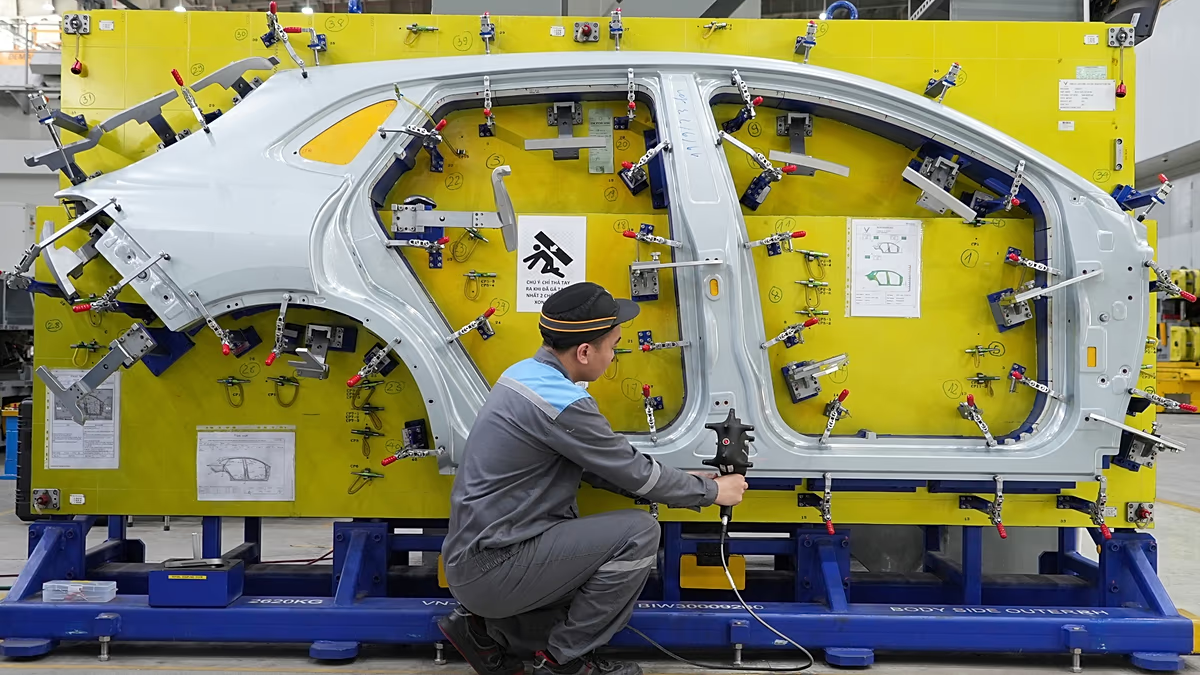
In March, the European Commission unveiled a bold industrial policy initiative known as the Industrial Acceleration Act. Presented as a strategic response to profound economic shifts and geopolitical pressures, the Act’s core mission is to secure the future of European manufacturing. It specifically targets three foundational sectors: the production of clean technologies (like wind turbines and solar panels), automotive manufacturing, and energy-intensive industries such as steel, aluminium, and cement. The Commission’s drive stems from sobering statistics: since 2024, over 200,000 jobs have been lost in Europe’s energy-intensive and automotive sectors, with projections suggesting a staggering 600,000 further losses in car manufacturing alone by 2030. European Commissioner for Industry Stéphane Séjourné framed the Act as essential for job creation, economic security, and reducing external dependencies, arguing it would “direct taxpayers’ money to European production.” However, this inward-focused vision for revitalization has rapidly crystallized into a major point of international contention, drawing sharp criticism from one of the EU’s largest trading partners: China.
Paragraph 2: The Crux of China’s Objection: “EU Origin” and WTO Principles
China’s Ministry of Commerce has formally and publicly denounced the Act, initiating a significant trade disagreement. At the heart of Beijing’s criticism are specific, quantitative thresholds embedded in the proposal. For instance, to qualify for certain public benefits or procurement contracts, electric vehicles would need to contain 70% EU-made content, while aluminium and cement would face a 25% local content requirement. Chinese officials argue that this preferential treatment for “EU origin” goods acts as a formidable barrier to foreign investment and constitutes “institutional discrimination.” Their core legal argument is that such overtly discriminatory measures may violate fundamental principles of the World Trade Organisation (WTO), particularly those concerning national treatment, which obligate members to treat foreign and domestic goods equally. From Beijing’s perspective, the Act is not merely an industrial subsidy program but a protectionist wall that unfairly sidelines Chinese companies—major global players in clean tech, electric vehicles, and industrial materials—from competing on a level playing field within the lucrative EU market.
Paragraph 3: A Staged Response: Dialogue First, Countermeasures as a Last Resort
The Chinese response, articulated by a Ministry of Commerce spokesperson, follows a calculated diplomatic playbook. Beijing has submitted its formal feedback to the European Commission and has expressed a stated preference for resolving the dispute through dialogue. The spokesperson emphasized that China is “ready to engage in dialogue with the EU to mitigate the policy’s impact.” This opening for negotiation suggests an awareness of the complex interdependencies between the two economic giants and a first-step desire to avoid an immediate, escalatory trade conflict. However, this overture is firmly coupled with a clear warning. Should dialogue fail to produce satisfactory adjustments to the Act, China has signalled its readiness to enact “countermeasures to firmly safeguard Beijing’s business interests.” This two-stage approach—offer talks but prepare retaliatory tools—serves as both a diplomatic pressure tactic and a strategic warning, placing the onus on the EU to consider the potential for a damaging reciprocal trade war.
Paragraph 4: The EU’s Rationale: Security, Jobs, and Strategic Autonomy
To understand the depth of this clash, one must appreciate the compelling rationale from the European standpoint. The EU does not frame the Industrial Acceleration Act as protectionism for its own sake, but as a necessary defensive measure in an era of heightened geopolitical tension and fierce global competition. The massive job losses in foundational industries are seen as an existential threat to the continent’s social and economic fabric. Moreover, recent crises—from pandemic-related supply chain breakdowns to energy vulnerabilities exposed by war—have cemented a political consensus around “strategic autonomy” and “economic security.” The Act is a tangible manifestation of this philosophy. From Brussels’ view, supporting homegrown industries in cleantech and manufacturing is essential to ensure Europe is not overly reliant on any single foreign supplier, particularly in sectors critical for the green transition and national resilience. Thus, the conflict pits the EU’s perceived right to shape its industrial destiny and secure its future against China’s demand for non-discriminatory market access.
Paragraph 5: The Road Ahead: Legislative Hurdles and Global Implications
The immediate fate of the Act, and consequently the trajectory of this dispute, now rests with the EU’s internal legislative process. The European Commission’s proposal is merely the starting point; it must now be debated, amended, and ultimately approved by the European Parliament and the European Council, which represents the governments of the 27 member states. This process introduces variables that could either intensify or moderate the conflict with China. Some member states with strong trade ties to China may push for softer language or more flexible rules, while others, more concerned with de-risking, may advocate for even sturdier protections. The final legislative text may therefore differ from the initial proposal, potentially altering the calculus for Beijing. Beyond this bilateral spat, the world is watching closely. The EU’s move represents a significant shift away from pure free-market orthodoxy toward a more interventionist industrial policy, mirroring similar strategies in the United States and elsewhere. A successful Chinese challenge—or a failure that leads to harsh countermeasures—could set a powerful precedent for how such policies are treated under global trade rules, influencing economic statecraft worldwide.
Paragraph 6: A Microcosm of a New Economic World Order
Ultimately, the tension over the Industrial Acceleration Act is a microcosm of a broader, defining struggle in the global economy. It encapsulates the clash between the established rules of globalization, embodied by the WTO’s emphasis on non-discrimination, and the emerging paradigm of “managed trade” driven by national security, supply chain resilience, and geopolitical rivalry. For China, the issue is one of principle and parity: upholding the international trade rules it benefited from during its rise. For the European Union, it is a matter of pragmatic sovereignty and self-preservation in a more contested world. The coming months, defined by EU legislative bargaining and tense diplomatic exchanges, will determine whether these two powerful economies can negotiate a fragile compromise or if they will embark on a path of tit-for-tat restrictions that fragments the global market further. The outcome will resonate far beyond clean tech factories and aluminium smelters, shaping the very architecture of international trade for years to come.