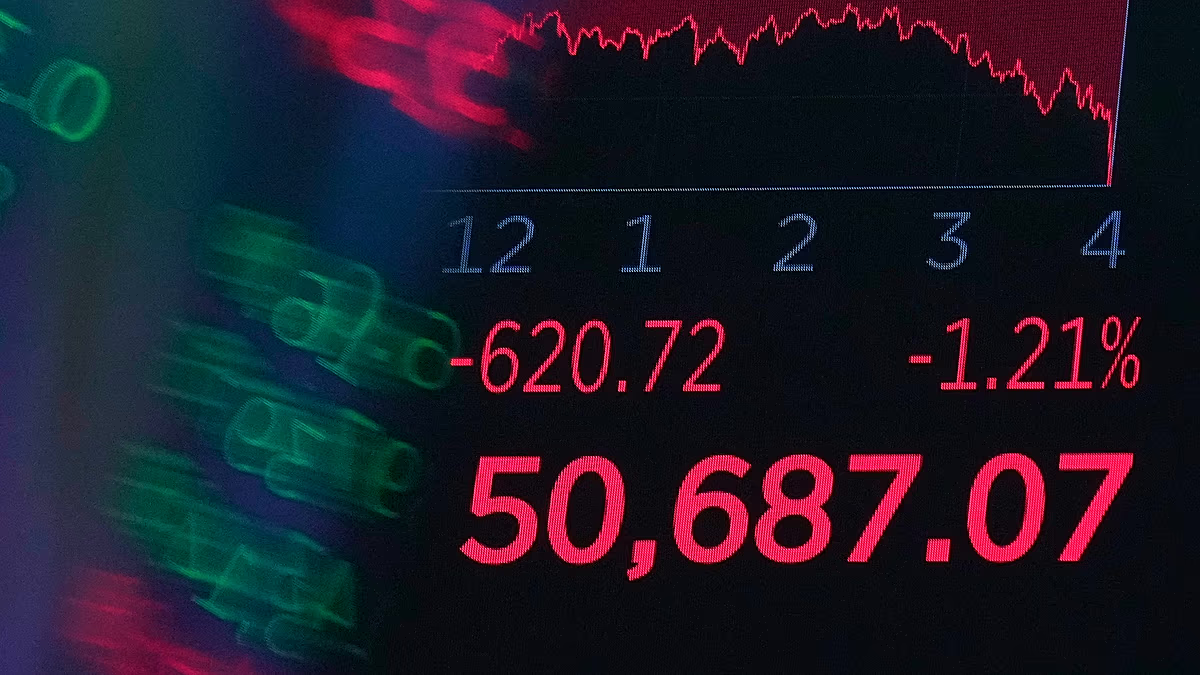




As the European Central Bank enters its customary quiet period ahead of its pivotal meeting next Thursday, a profound and uneasy tension hangs over its deliberations. Policymakers are confronting a deteriorating economic landscape defined by the harsh combination of stagflation—where growth stagnates while inflation persists—and escalating geopolitical instability. Major European economies, including Germany and Italy, have recently slashed their growth forecasts, while energy costs continue their volatile climb. This places the ECB in a painfully difficult position: it must navigate the delicate task of supporting a visibly slowing economy while simultaneously ensuring that inflation, already stirred by external shocks, does not spiral out of control. The institution’s dilemma underscores a fundamental shift in the challenges facing monetary authorities, moving from post-pandemic recovery management to crisis containment in an increasingly fractured world.
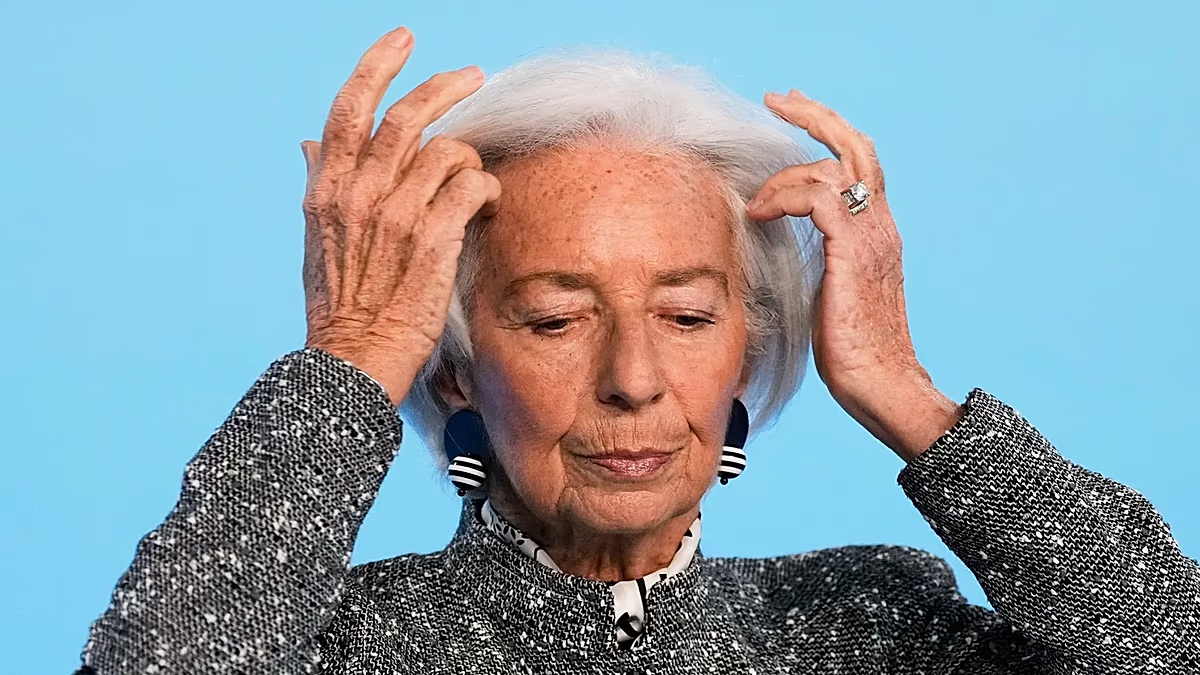
In a recent speech, ECB President Christine Lagarde poignantly captured the extraordinary difficulty of this moment. Speaking at an event in Berlin, she offered no clear directional guidance, instead emphasizing the “exceptionally hard” task of gauging the economic consequences of the ongoing conflict involving Iran. She described a “stop-start nature” characterized by fleeting ceasefires, collapsing peace talks, and the intermittent lifting and reinstatement of naval blockades. This unpredictability, she explained, makes assessing the duration and depth of the impact nearly impossible. Her remarks reflect a central bank gripped by uncertainty, where traditional models and forecasts are rendered inadequate by real-world volatility. Meanwhile, another Governing Council member, Mārtiņš Kazāks of Latvia, echoed this sentiment, stating that “uncertainty remains very high” and that, based on current data, there is no urgent case for adjusting rates. Consequently, the market consensus firmly expects the ECB to hold its interest rates steady next week, adopting a cautious “wait and see” posture to determine whether the current energy-driven price spikes will trigger more dangerous, widespread inflationary effects.
The sobering context for this hesitation is vividly illustrated by the International Monetary Fund’s latest outlook. The IMF has explicitly cited the Iran war as the primary driver behind a significant downgrade of its Eurozone growth forecast for this year, reducing it to 1.1% from an earlier estimate of 1.4%. The organization warns that a prolonged conflict could lead to a lasting increase in energy risk premiums—a permanent elevation in the cost and uncertainty surrounding vital resources. This revision is not merely a statistical adjustment; it is a stark acknowledgment that the geopolitical situation is now the dominant variable in economic forecasting. The war’s ripple effects, from disrupted shipping lanes to volatile commodity markets, have effectively shackled Europe’s recovery prospects. For the ECB, this external pressure means its policy toolkit is now being tested against forces largely beyond its influence, anchoring it in a defensive stance aimed at preventing secondary inflationary waves while hoping the economy does not contract further.
This story of cautious paralysis is not confined to Europe. Across the Atlantic, the Federal Reserve faces a similarly stubborn inflation problem, albeit within the framework of a more resilient domestic economy. Recent data showed U.S. inflation surging to 3.3% in April, fueled by the same global energy price shocks. This resurgence has largely extinguished any lingering hopes for an imminent rate cut from Chair Jerome Powell. While the U.S. labor market remains tight and consumer spending holds up, the narrative has decisively shifted. Earlier projections of multiple rate cuts this year have faded, replaced by a “higher for longer” consensus that has regained traction. Fed policymakers have adopted a more hawkish tone, acknowledging that persistent inflation and geopolitical instability are making the timing of any easing increasingly uncertain. The Fed’s stance, therefore, mirrors the ECB’s in its core dilemma: recognizing the need to support activity eventually, but being compelled to prioritize inflation containment for now, all while watching a conflict that could upend any plan at any moment.
Similarly, the Bank of England finds itself in an almost identical position to its European counterparts. UK inflation also reached 3.3% this month, driven overwhelmingly by higher energy import costs stemming from the same global turmoil. The British economic outlook remains fragile, with growth tepid, yet the central bank maintains a restrictive policy stance, holding its base rate steady. Markets widely expect another hold at next week’s meeting. The narrative here, too, is firmly focused on imported inflation linked to the Iran war. While traders had previously priced in several cuts for the spring and summer, those expectations have evaporated, shifting toward a cautious, “meeting-by-meeting” approach that prioritizes reactive flexibility over proactive planning. This alignment across the three major central banks highlights a synchronized global monetary policy response to a synchronized global shock.
Against this backdrop of economic fragility and volatile energy markets, the prevailing consensus points toward a coordinated pause among the ECB, the Federal Reserve, and the Bank of England next week. With all three institutions expected to hold interest rates at their current levels, the immediate focus for investors and analysts will shift from the decisions themselves—which are now largely anticipated—to the nuanced language and forward guidance offered by policymakers. Every phrase, every qualifying statement will be scrutinized for clues about how long this restrictive stance might last and what thresholds might trigger a change. Ultimately, the path of monetary policy for the remainder of 2026 is being dictated not by domestic economic cycles or traditional inflation dynamics, but by a geopolitical situation unfolding far beyond the control of any central bank governor. The quiet period before the meetings is, therefore, a quiet born not of confidence, but of profound uncertainty, as the world’s foremost financial stewards wait, watch, and hope for clarity in a landscape defined by conflict.