


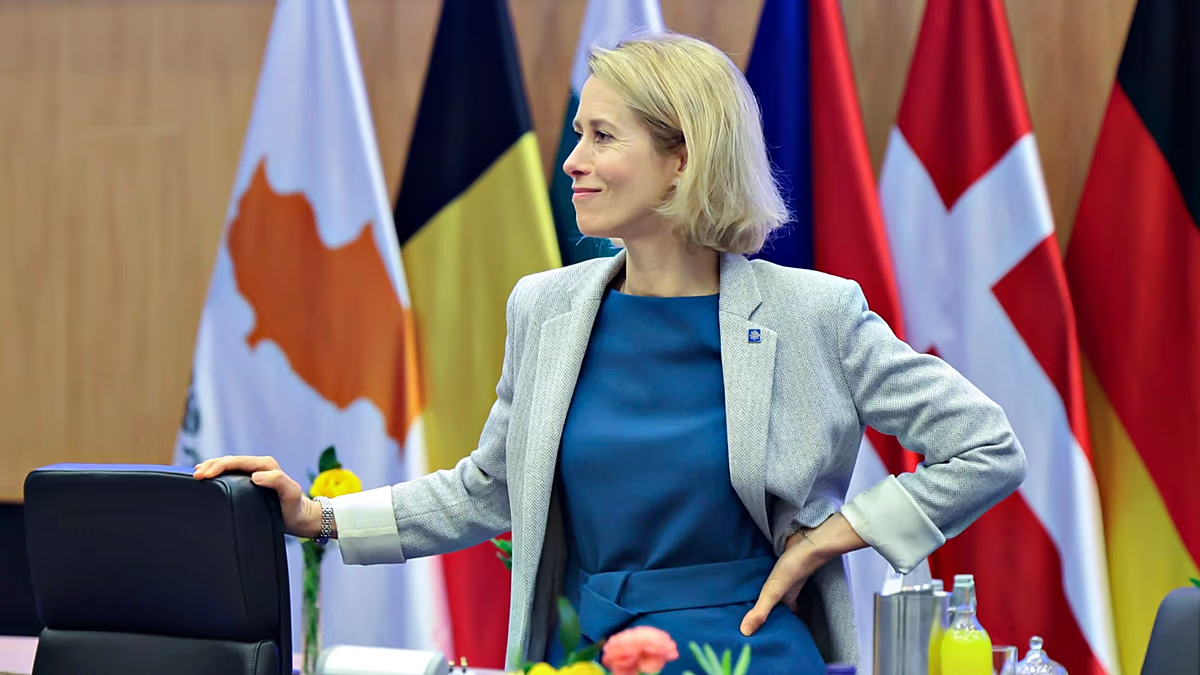
In a time of increasing global instability, the foundational treaties that underpin Western security are receiving unprecedented scrutiny. High Representative Kalla Kallas has sought to clarify the relationship between two key pillars: the European Union’s mutual assistance clause, Article 42.7 of the EU treaties, and NATO’s famous collective defence commitment, Article 5. Speaking on the sidelines of an informal EU summit in Cyprus, Kallas firmly rejected the notion that these articles are in conflict, stating, “I wouldn’t contradict those two because they have been always coexisting.” She emphasized their complementary nature, explaining that the existence of a strong European defense pillar within NATO makes the alliance more robust, and it is not a matter of using one if the other fails. This clarification comes amid growing external pressures and internal discussions about how the EU can act as a credible security guarantor for all its members.
The technical differences between the two articles are significant, shaping their potential application. Article 42.7 is invoked when an EU member state is the victim of “armed aggression”; it allows that nation to request assistance from its fellow members, with aid potentially taking military, diplomatic, economic, or medical forms. In contrast, NATO’s Article 5 is more explicitly martial, declaring that an armed attack against one ally shall be considered an attack against all, with actions taken to “restore and maintain the security of the North Atlantic area.” Until recently, Article 42.7 was a little-known provision, used only once by France in 2015. However, recent geopolitical shocks, including U.S. President Donald Trump’s threats against NATO and the ongoing war in the Middle East, have thrust it into the spotlight, prompting urgent discussions about its practical implementation.
A primary catalyst for this urgent review is the precarious position of EU countries that are not members of NATO, namely Austria, Cyprus, Ireland, and Malta. The vulnerability was starkly highlighted when an Iranian-made drone struck a British base in Cyprus. As Cypriot President Nikos Christodoulides, who placed the issue on the summit agenda, argued, the EU must develop a “clear manual” to ensure it can act as a credible security guarantor. For nations like Cyprus, Article 5 is not an option, making a fully operationalized Article 42.7 their principal recourse for collective defense. This reality has moved the clause from theoretical treaty text to a matter of immediate, practical necessity, driving the High Representative’s work to define clear protocols for response.
To that end, Kallas is working with member states to operationalize Article 42.7 through the examination of three distinct hypothetical scenarios. The first envisions an attack on a non-NATO EU country, directly testing the bloc’s standalone defense commitment. The second considers an attack on a nation that is both an EU and NATO member, probing how the two articles would interact and coordinate. The third scenario addresses a “hybrid” attack—such as cyber warfare or sabotage—that may fall below the traditional threshold for triggering NATO’s Article 5. As Kallas noted, “The treaties are quite general. We need to operationalise this article by mapping what we have done, what the possibilities are, who does what in what case.” A new exercise among EU ambassadors is scheduled to drill into these very questions, underscoring the directive that this work must be done swiftly.
The pressure to solidify these EU mechanisms is intensely amplified by the volatile stance of the United States under President Trump. His public threat to withdraw from NATO, revived after allies refused to deploy warships to the Iranian-controlled Strait of Hormuz, has injected profound uncertainty into transatlantic security. Leaked emails suggesting punitive U.S. options against allies, including suspending Spain’s NATO membership, have further rattled European capitals. In response, nations like France and the UK have proposed a “strictly defensive” multinational force to secure maritime chokepoints, though such plans remain embryonic. Within this tense climate, Kallas sees a role for the EU in bolstering its existing naval missions, Aspides and Atalanta, potentially expanding their mandates to operate in hotspots like the Strait of Hormuz, provided there is unanimous political will.
Ultimately, the drive to clarify and strengthen Article 42.7 represents a pivotal moment in the evolution of European security. It is not an attempt to replace NATO but to ensure the European Union has the capacity and clarity to protect all its citizens, whether through complementary action within the Atlantic alliance or through its own unified response when necessary. As Kallas concluded, the most pragmatic path forward is often to enhance existing structures, ramping up operations that already have command systems in place. The work to create a “clear manual” for mutual assistance is a direct answer to a world where security threats are hybrid, alliances are tested, and the EU must be prepared to stand on its own feet as a reliable pillar of stability and collective defense for every one of its members.