



The Arctic’s Shrinking Shield
For nearly half a century, satellites have kept a watchful eye on the Arctic’s icy crown. The story they tell is one of dramatic and accelerating retreat. In March of 2026, scientists at the US National Snow and Ice Data Center confirmed a worrying milestone: winter sea ice had reached its maximum extent for the year at just 14.33 million square kilometres, the smallest peak ever recorded. This marked the second consecutive year of record lows, a stark testament to a region warming four times faster than the global average. Beyond an environmental alarm, this melting ice is redrawing the map of human activity. Centuries-old dreams of accessing the remote, resource-rich north are becoming reality, opening new sea routes and economic opportunities. As the physical barriers diminish, the geopolitical and strategic significance of the Arctic is intensifying, drawing nations into a complex new chapter for the top of the world.
Navigating a Treacherous New Frontier
The transformation is already measurable. The Arctic Council reports a 40% surge in individual ships and a near-doubling of distances sailed in the region over the past twelve years. While the retreating ice beckons naval, cargo, and cruise vessels, the polar environment remains fiercely hostile. Experts quip that space travel can be simpler than polar navigation. Thinning ice doesn’t just clear paths; it creates new hazards like increased glacier fragmentation and unpredictable icebergs. Beneath the surface, the danger is magnified. Wind and currents drive ice floes together, piling them into submerged “keels” that can plunge dozens of metres deep—a terrifying obstacle for any vessel. For submarines, these icy formations turn the ocean ceiling into a lethal, unpredictable landscape, where a conventional submarine with limited underwater endurance could find surfacing for air impossible. The extreme conditions also magnify other risks, like fire, where confined spaces offer little margin for error, demanding extraordinary skill and resilience from any crew daring to operate below the ice.
Portugal’s Unprecedented Polar Feat
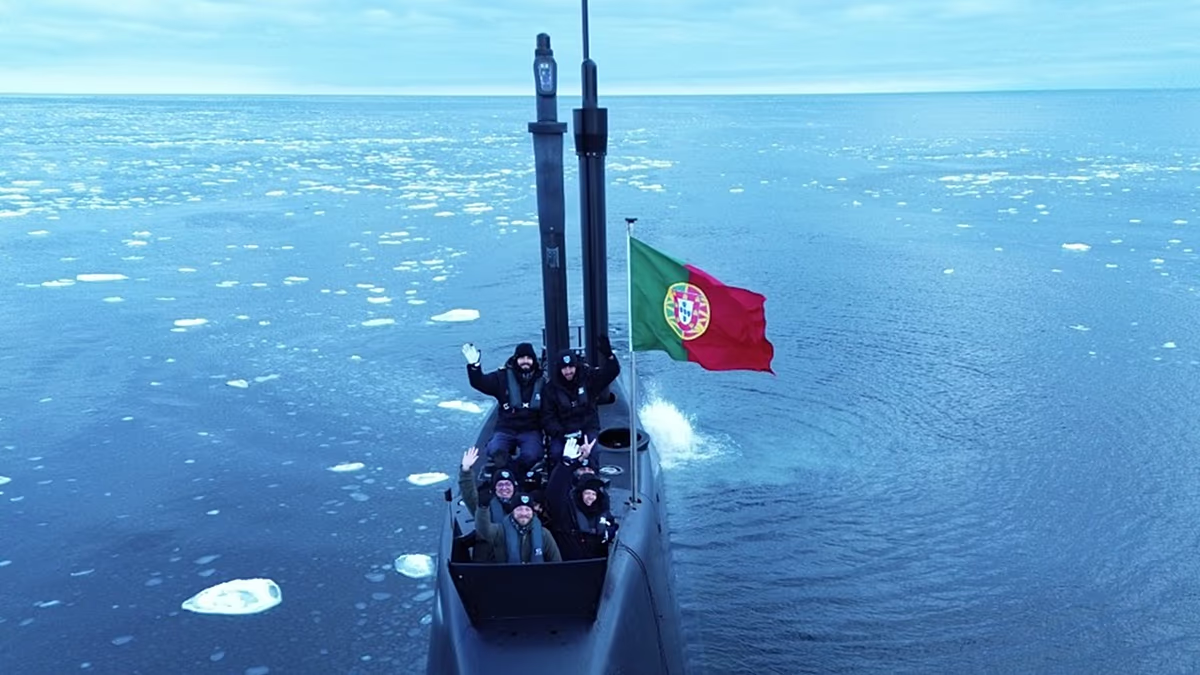
It is in this forbidding theatre that Portugal’s Navy, in mid-2024, authored a remarkable story of audacity and innovation. Defying skepticism from even its closest NATO allies, Portugal dispatched the conventionally powered submarine NRP Arpão under the command of Frigate Captain Taveira Pinto into the depths of the Arctic Ocean. For four days, the crew of thirty navigated beneath the Greenland ice sheet, accomplishing a mission unprecedented in modern history. This feat placed Portugal into an elite club—alongside the US, UK, and Russia—of nations that have operated beneath the polar ice cap, but with a crucial distinction: all others relied on the vast power and endurance of nuclear submarines. Portugal’s success was rooted in the Arpão’s Air-Independent Propulsion (AIP) system, a fuel-cell technology that allows it to generate power underwater for weeks without surfacing. Yet, technology alone was not enough. The mission was the culmination of a decade-long vision and seven months of gruelling, meticulous preparation, involving specialised studies of the Arctic environment and precise modifications to the submarine itself.
Mastering the Chaos of the Marginal Ice Zone
The true brilliance of the Portuguese mission was showcased in the most chaotic area of all: the Marginal Ice Zone (MIZ). This dynamic frontier, where the solid ice pack meets the open sea, is a maelstrom of violent storms, crushing waves, and unpredictably drifting ice floes. So hazardous is it that no Western conventional submarine had dared to operate there since World War II. The Arpão’s crew, however, developed and executed a technique to manoeuvre at periscope depth within this zone—a manoeuvre its commander called the operation’s high point. To achieve this, they employed a suite of bespoke adaptations, including a high-frequency sonar to map the icy ceiling overhead and protective structures on the sail to guard critical masts. This allowed them to transform an area traditionally avoided into one where controlled operations were possible. More than a demonstration of endurance, this was an act of profound tactical innovation, generating lifesaving knowledge in real-time about acoustics, ice assessment, and emergency procedures in an utterly foreign environment.
A Blueprint for Allies: Canada Looks to Portugal’s Example
The ripples of Portugal’s accomplishment extended far beyond its own hull, offering a practical blueprint for other nations. Canada, a giant Arctic nation with vast northern territories to monitor, watched with keen interest. As it plans its largest-ever military procurement—a fleet of up to twelve new conventional submarines to patrol its three oceans—the lessons from the Arpão are invaluable. Canadian Navy Commander Harrison Nguyen-Huynh, who was embedded on the Arpão, praised the Portuguese crew’s calm professionalism and meticulous preparation. He highlighted specific adaptations, like the ice-protection structures on the sail and the specialised upward-looking sonar, as essential insights for Canada’s own programme. The data recorded by the Portuguese on acoustic conditions near ice—where noise from moving ice and water salinity can distort sensor readings—provides a crucial library for future operations. By systematically documenting this hard-won knowledge into a new Arctic navigation manual, Portugal has gifted its allies a foundational doctrine, proving that smaller nations can produce operational knowledge of strategic significance.
Strategic Legacy in a Heating Geopolitical Climate
While Portugal has no immediate plans for another Arctic mission, the legacy of the Arpão voyage is firmly cemented. It arrived at a moment of escalating great-power competition in the High North, marked by increased Russian military activity and China’s declared interest as a “near-Arctic state.” In this context, the mission demonstrated that conventional submarines, often seen as limited, possess unique advantages for modern undersea warfare. Their ability to run exceptionally quietly on batteries makes them potent tools for surveillance and intelligence in contested waters. Politically, Portugal proved itself a credible and innovative NATO ally, showcasing a strategic relevance based not on the scale of its assets but on distinct, high-value skills. The voyage underscored a vital truth for collective defence: deterrence in the Euro-Atlantic area requires mastery of harsh, distant frontiers like the Arctic. By pushing back boundaries long deemed insurmountable, the crew of the Arpão did more than chart unknown waters; they affirmed that in a rapidly changing world, ambition, preparation, and ingenuity can redefine a nation’s role on the global stage.