



The Ripple Effect: How Global Conflict is Reshaping Summer Travel
The spectre of cancelled summer holidays is once again looming over British travellers, but this time, the cause stems not from pandemic-era restrictions, but from geopolitical conflict thousands of miles away. Esteemed travel expert Simon Calder, in a recent update to his podcast, addressed the growing anxiety among holidaymakers as the war in Iran disrupts global oil and gas flows, triggering a specific and acute crisis: worldwide jet fuel shortages. Since the conflict’s escalation in late February, the resulting market pressures have dramatically increased operational costs for airlines, forcing difficult decisions that are beginning to directly impact flight schedules and passenger plans. Calder, responding to a deluge of concerned messages from listeners contemplating abandoning foreign travel altogether, sought to clarify the situation and offer practical advice, framing the current turbulence within the broader landscape of modern travel challenges.
Industry Warnings and Passenger Anxieties
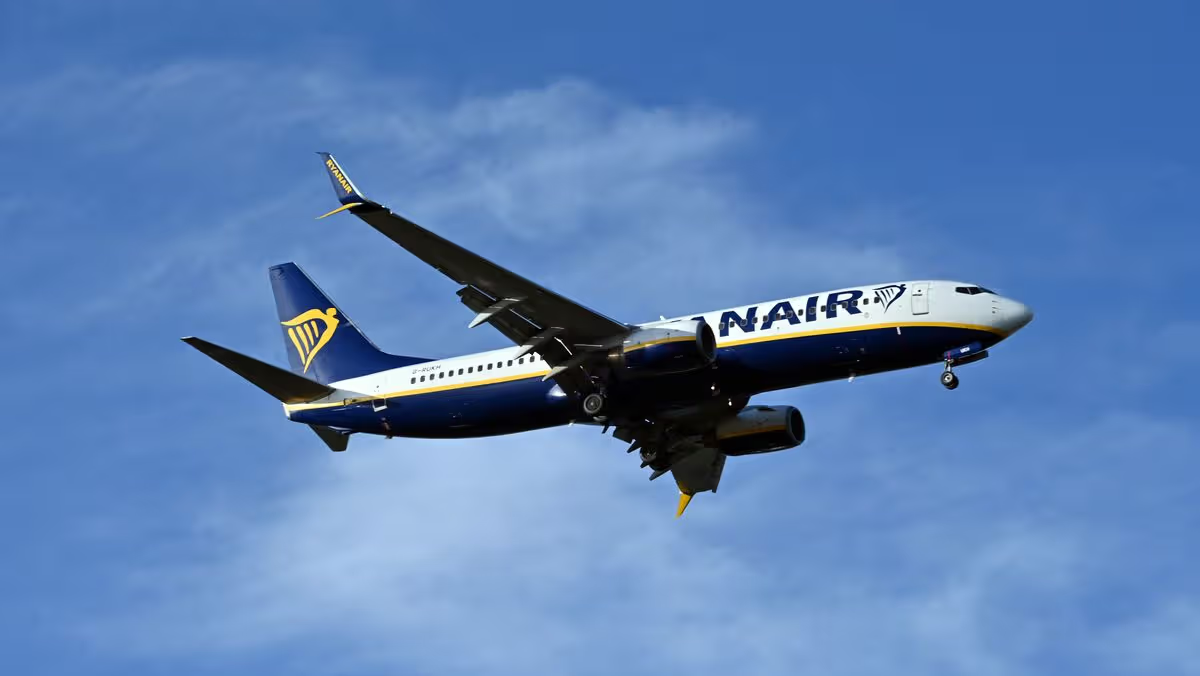
The abstract worry became concrete this week with stark warnings from senior figures. Dan Jorgensen, the EU Energy Commissioner, presented a sobering outlook, stating it is “very likely” that many holidays will be affected by either cancellations or prohibitively expensive tickets, bluntly concluding, “if the jet fuel is not there, then it’s not there.” This sentiment was echoed by the International Energy Agency, which forecast potential severe supply disruptions within mere weeks. These pronouncements followed tangible action from major carriers, most notably the Lufthansa Group’s announcement of 20,000 flight cancellations. For the everyday traveller, headlines such as these transform excited anticipation into nervous uncertainty, prompting Calder to explore not just the problem, but the pathways to solutions available to consumers.
The Tour Operator Safety Net
To demystify the process, Calder engaged in conversation with Ted Wake, Managing Director of Kirker Holidays, posing a direct scenario: what happens when an airline like Lufthansa cancels a flight for a booked customer? Wake’s response outlined the protective role of reputable, ATOL-protected tour operators. He explained that in such events, the operator’s responsibility is to proactively find the nearest sensible alternative flight, even if it involves a different carrier from a possibly different regional airport, and to bear any additional logistical costs incurred. This could include extending a hotel stay by a night to accommodate a new flight time. The emphasis, Wake noted, is on nurturing long-term customer relationships by “ironing out the creases,” ensuring the holiday can proceed with minimal disruption to the traveller. This perspective reframes the crisis: while airlines manage a supply issue, tour operators manage the passenger fallout.
A Dual Challenge: Fuel Shortages and Border Digitisation
Wake and Calder also contextualised the jet fuel situation within another significant shift for UK travellers: the rollout of the EU’s Entry/Exit System (EES). This new digital border process, requiring biometric data like fingerprints and photographs from British citizens upon first entry into the Schengen Area, has already caused substantial delays at airports since its introduction. Travellers now face a dual-layer of potential disruption: logistical challenges at the border compounded by instability in the very means of getting there. Wake suggested that some announced flight reductions, while undoubtedly linked to fuel economics and availability, may also be a “sensible logistical profit management exercise” by airlines anticipating softer demand or seeking to streamline operations in a volatile climate.
Practical Reassurance in a Volatile Climate
Despite the alarming headlines, the tone of the discussion leaned towards practical reassurance. Wake downplayed the scale of the Lufthansa cancellations relative to the airline’s vast overall schedule, suggesting the direct impact on consumers may be less catastrophic than feared, especially for those who have booked packages. Calder’s longstanding advice—that booking through an ATOL-protected tour operator provides a critical safety net—was powerfully reinforced. The message was clear: while airlines are grappling with an unpredictable fuel market, the contractual duty of care for the holiday experience itself falls to the tour operator, who possesses both the incentive and the industry leverage to arrange suitable alternatives.
Navigating the New Normal
Ultimately, the conversation between Calder and Wake painted a picture of a travel industry adapting, yet again, to a “new normal” defined by simultaneous pressures. The acute shock of a fuel crisis, born of distant war, intersects with the structured, permanent change of new border technology. For the British holidaymaker, the advice remains consistent: secure your arrangements through protected means, stay informed through reliable sources like Calder’s analysis, and understand your rights. While individual airlines may cancel routes, the broader ecosystem of travel providers is designed to reroute and recalibrate. The summer of 2026 may demand more flexibility and patience, but it does not necessarily signal a wholesale cancellation of plans—rather, a more complex journey to that long-awaited destination.