



In the early months of 2026, Germany witnessed a quiet but striking societal shift. Between January and March, the Federal Office of Family Affairs and Civil Society Functions (BAFzA) recorded 2,656 applications for conscientious objector status. This three-month figure alone represents more than two-thirds of the total applications registered across the entirety of 2025, which stood at 3,867. This dramatic spike marks a significant departure from recent norms and signals a profound public reaction to a new political reality. It is a statistical tremor reverberating from a deliberate policy shift, suggesting that a new generation is grappling with questions of duty, conscience, and national identity that many thought were settled over a decade ago.
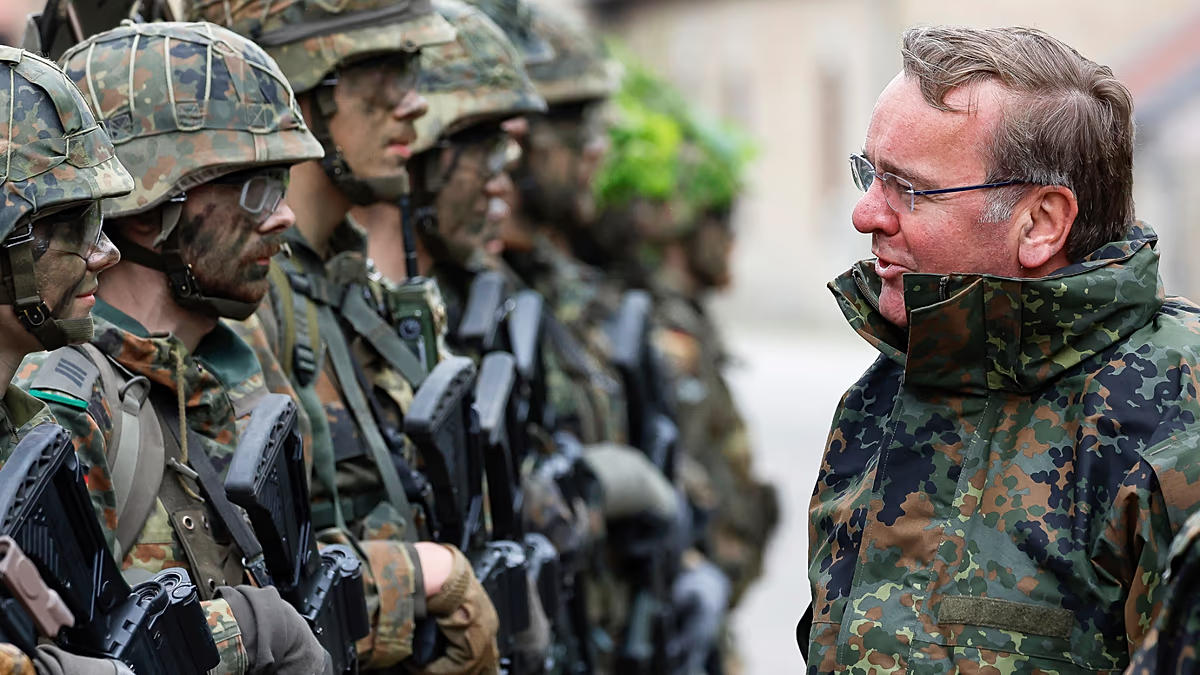
The catalyst for this surge is clear: the entry into force of new military service legislation at the start of 2026. The reform, championed by Defence Minister Boris Pistorius, requires all young men born in 2008 or later to register for potential conscription. While compulsory service is not yet active, the law provides the legal framework for the Bundestag to activate it if voluntary recruitment fails to meet the nation’s needs. This move represents a decisive break from the post-Cold War era. Germany suspended compulsory military service in 2011, a move that reflected a hopeful period of European integration and a belief in a permanently peaceful order. The new law is a direct and sober acknowledgment that this era has ended. As Pistorius has stated, the rationale is a “deteriorating security environment,” a world that has become “more unpredictable and yes, it must also be said, more dangerous.”
This political and strategic recalibration is not occurring in a vacuum. It is part of a broader ambition to fundamentally reshape the Bundeswehr, Germany’s armed forces. Minister Pistorius has set an ambitious target of at least 260,000 active soldiers, supported by a robust reserve force, aiming for a combined total of 460,000 personnel. Achieving this would make the Bundeswehr one of the largest standing armies in Europe, a dramatic transformation for an institution that has long struggled with underfunding and understaffing. The conversation even extends to proposals from reservists’ associations to raise the maximum service age from 65 to 70 and discussions about requiring men of fighting age to seek authorization for extended travel abroad. These debates, while speculative, contribute to a growing public unease, painting a picture of a society preparing for contingencies it never imagined facing again.
The flood of conscientious objector applications is the most immediate and personal expression of this unease. Each application is not just a statistic; it is an individual moral declaration, a formal statement of a personal conviction that prohibits participation in military service. The sheer volume suggests that for thousands of young German men, the theoretical possibility of conscription has become an urgent personal dilemma. They are making a choice now, perhaps seeking clarity or a form of preemptive peace of mind in a climate of renewed geopolitical tension. Their actions speak to a deep-seated culture of pacifism and a cherished right to conscientious objection, principles that remain powerfully held even as official policy pivots.
Yet, the national response is not monolithic. Alongside this wave of objection runs a counter-current of commitment. In 2025, 781 individuals who had previously declared themselves conscientious objectors formally reversed their decision, choosing to make themselves available for service. A further 233 followed suit in the first quarter of 2026. These numbers, though smaller, are profoundly significant. They represent a quiet reconsideration, a change of heart likely influenced by the same grim geopolitical headlines that prompted the new law. For these individuals, a perceived national emergency or a sense of civic duty has overridden prior personal objections. This duality—a surge in conscientious objection alongside a steady trickle of reversed objections—perfectly captures a nation wrestling with its role and responsibilities. Germany is a society in a tense dialogue with itself, balancing a historic aversion to militarism against a newfound perception of vulnerability.
Ultimately, the data from early 2026 reveals a country at a crossroads, navigating the complex legacy of its 20th-century history while confronting the stark realities of the 21st. The soaring numbers of conscientious objectors highlight the enduring strength of pacifist sentiment and the anxiety triggered by any return to conscription, however theoretical. Simultaneously, the government’s drive for a larger military and the hundreds reversing their objection status reflect a hardening consensus that the era of relying solely on diplomacy and soft power may be over. Germany stands between its past and a uncertain future, its young people making deeply personal choices that collectively define the nation’s character. Whether this trend continues through 2026, potentially reaching levels unseen since before conscription was suspended, will be a crucial barometer of how deeply this new reality has taken root in the German psyche.