


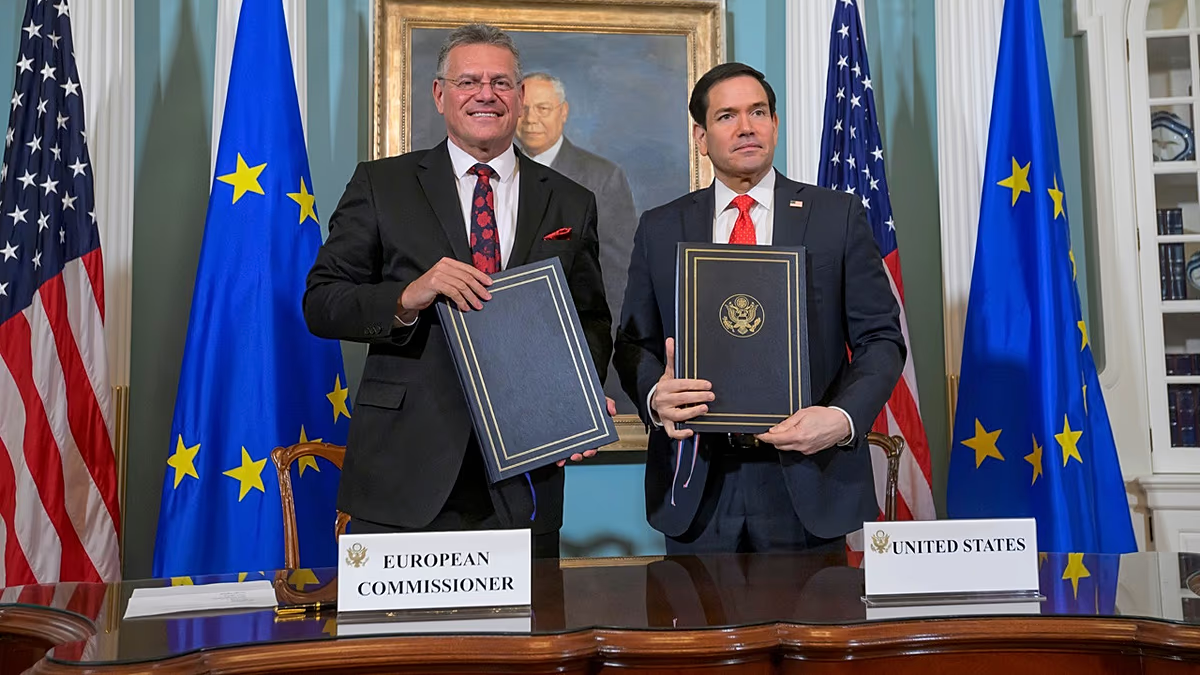
In a significant move underscoring the shifting priorities of Western economic and security policy, the European Union and the United States formally established a new strategic partnership focused on critical minerals. The agreement, signed in Washington by US Secretary of State Marco Rubio and EU Trade Commissioner Maroš Šefčovič, represents a concerted effort to jointly secure the supply of raw materials essential for modern defense systems, clean energy technologies, and advanced electronics. Both officials framed the pact not merely as a trade understanding, but as a foundational step for future economic resilience and national security. Rubio emphasized that over-reliance on one or two geographic sources for these minerals constitutes an “unacceptable risk,” a sentiment powerfully echoed by Šefčovič, who projected that collaboration would allow both partners to grow stronger and achieve their goals more swiftly. This alignment signals a recognition that in an increasingly volatile global landscape, securing these industrial building blocks is a prerequisite for maintaining technological and strategic autonomy.
The partnership, while framed in positive, cooperative terms, is undeniably a direct response to China’s overwhelming dominance in the global processing and supply of many critical minerals. Beijing’s demonstrated willingness to restrict exports of these materials during diplomatic tensions has served as a stark warning to Western capitals. The new EU-US Memorandum of Understanding is therefore a defensive maneuver, aimed at “de-risking” supply chains by systematically fostering diversity in sourcing. The agreement moves beyond rhetoric to explore practical collaboration, including the potential coordination of government subsidies, the creation of strategic stockpiles, and joint investments in research and development. Furthermore, the partners aim to harmonize technical standards, which would simplify trade and strengthen a unified Western market for these vital goods, thereby reducing systemic vulnerabilities.
This collaboration marks a notable, if selective, thaw in a transatlantic relationship that has often been fraught under the Trump administration, which has frequently criticized the EU while supporting populist movements within Europe. The critical minerals pact illustrates that despite broader tensions, shared strategic imperatives can foster pragmatic cooperation. The United States has been actively building a network of such alliances, having already established critical minerals frameworks with partners like Japan, Australia, and Mexico. The inclusion of the EU into this growing web of agreements suggests an emerging, alliance-based model for resource security, positioning collective Western demand against a concentrated source of supply.
However, the shadow of ongoing trade disputes, particularly concerning steel and aluminum, looms over this new cooperative spirit. Commissioner Šefčovič, while celebrating the minerals agreement, was candid about the need for “positive traction” on the enduring issue of US tariffs. European manufacturers continue to face significant levies on metal imports, a point of persistent friction since the Trump administration reinstated sharp tariffs last year. Although a previous deal moderated tariffs on many EU goods, steel and aluminum were conspicuously excluded, leaving a major economic irritant unresolved. Šefčovič pointed out that recent US simplifications of tariff rules were a step forward but did not fully address European concerns, indicating that this file remains very much open and contentious.
The steel issue itself is deeply intertwined with the same challenge that catalyzed the critical minerals pact: global market distortions, largely fueled by Chinese industrial overcapacity. Šefčovič noted that both the US and the EU are confronting this same threat, referencing the EU’s own recent decision to sharply raise tariffs on imported steel. He proposed that the next logical step for the transatlantic partners is to align their approaches toward third countries, creating a coordinated “defensive mechanism” against subsidized and unfairly traded steel. This vision of “steel ring-fencing” suggests a desire to extend the collaborative, defensive logic of the critical minerals agreement into other foundational industrial sectors, presenting a united front against practices that threaten domestic industries on both sides of the Atlantic.
Ultimately, the signing of this Memorandum of Understanding reveals a transatlantic relationship navigating a complex duality. On one hand, there is a compelling and growing imperative for strategic cooperation in the face of shared geopolitical and economic challenges, exemplified by the critical minerals partnership. On the other hand, persistent bilateral trade conflicts over tariffs demonstrate that domestic political and economic pressures continue to generate friction. The path forward will depend on the ability of both sides to compartmentalize these issues—to build upon areas of aligned interest, like supply chain security, while managing and resolving points of disagreement. The success of this minerals partnership could serve as a trust-building model, proving that even amid disagreements, Europe and the United States can still construct the pragmatic alliances necessary for security in a competitive world.