




Paragraph 1: A Strategic Retreat from the Capital
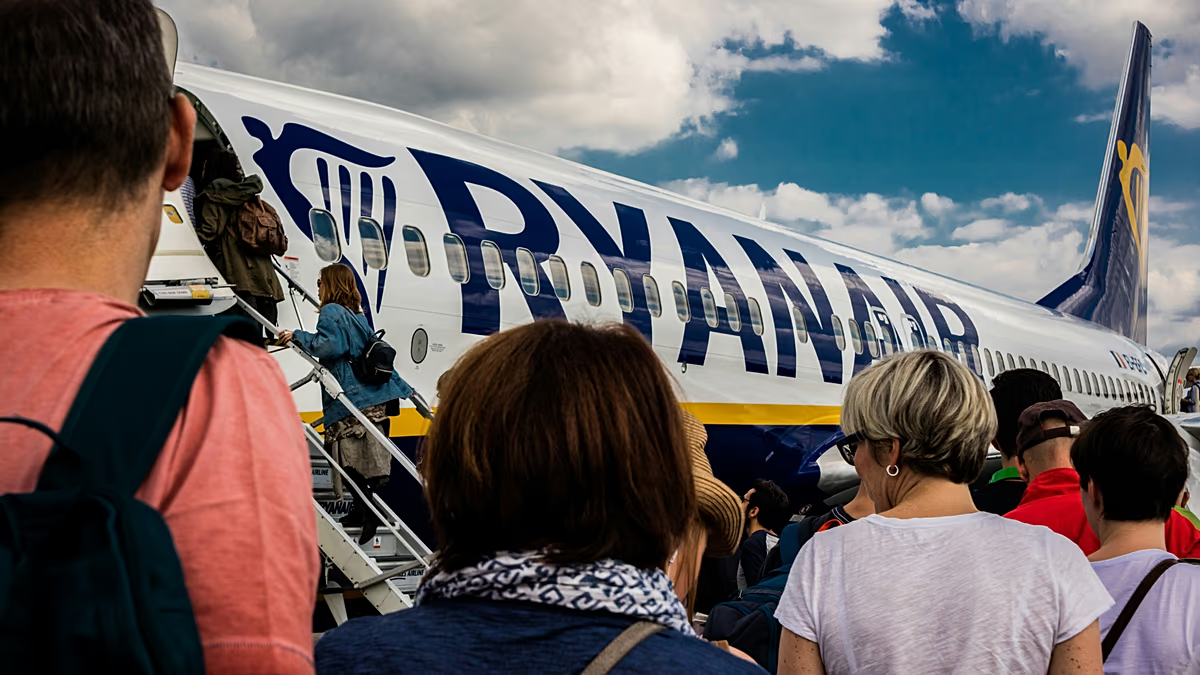
Europe’s largest airline, Ryanair, is making a decisive strategic shift by closing its operational base in Berlin, effective October 24th. This move involves relocating all seven aircraft currently stationed in the German capital. The airline frames this not merely as a business adjustment, but as a forced retreat from a market it describes as fundamentally broken. Ryanair’s winter schedule will see a 50% reduction in flights to and from Berlin, signaling a profound scaling back of its commitment to one of Europe’s key cities. This action is the latest and most significant in a series of withdrawals from Germany, representing a growing rift between the ultra-low-cost carrier and the nation’s aviation policy environment.
Paragraph 2: The Core Complaint: A “Broken” and Tax-Heavy System
Ryanair’s chief grievance, articulated by CEO Eddie Wilson, centres on Germany’s “stupid aviation tax regime.” The airline presents a stark economic case: since 2019, Germany’s aviation tax per passenger has more than doubled, security fees are slated to double again by 2028, air traffic control fees have trebled, and airport fees have risen by 50% since the COVID-19 pandemic with further increases planned. For a business model built on minimising costs to offer rock-bottom fares, these cumulative increases are unsustainable. Wilson labels the entire German commercial aviation model as “broken,” alleging it has “failed people” by prioritizing high taxes and fees over affordable travel and growth. He criticizes the lack of an exit plan to lower these burdens, which he claims are directly responsible for driving airlines away.
Paragraph 3: A Pattern of Withdrawal, Not an Isolated Incident
The Berlin base closure is not an isolated event but part of a clear pattern. Ryanair points out that since 2019, it has already shut down bases in Frankfurt, Düsseldorf, and Stuttgart—resulting in the loss of 13 aircraft—and ceased all flights to several other German cities like Dresden, Leipzig, and Dortmund. This narrative frames the Berlin decision as the inevitable culmination of years of frustration and economic pressure. The airline contrasts Germany’s environment with that of other EU states like Sweden, Slovakia, Albania, and Italy, which it says have abolished similar aviation taxes. Ryanair’s plan is to reallocate its Berlin-based aircraft to these “lower cost airports” abroad, explicitly linking its investment decisions directly to government tax policies.
Paragraph 4: The Airport’s Perspective: Surprise and Contested Claims
The announcement was met with surprise and some contradiction from Berlin Brandenburg Airport itself. In a statement, the airport expressed surprise at Ryanair’s timing, noting that ongoing negotiations with airlines were in progress and that an increase in airport charges was not planned. This reveals a disconnect between the airline’s public portrayal of inevitable, relentless fee hikes and the airport’s current position. The airport’s response suggests Ryanair’s decision may be a strategic negotiating tactic or a final stance following unresolved discussions, adding a layer of complexity to the story beyond a simple reaction to announced increases.
Paragraph 5: A Context of Potential Political Change
Ryanair’s stark announcement curiously coincides with recent news from the German government suggesting a potential policy shift. The Federal Cabinet has approved plans to roll back the national flight tax to 2024 levels, with the Finance Ministry emphasizing the importance of passing these reductions on to travellers. This creates a poignant juxtaposition: as one of Europe’s biggest airlines declares its exit due to high taxes, the government is signalling a move to reduce them. This timing raises questions about whether Ryanair’s decision is a reaction to past conditions, a prediction of future failures to implement relief, or a powerful piece of political pressure to ensure the proposed rollback is real and meaningful.
Paragraph 6: The Human Impact: Passengers and the “Most Failing Airport”
Beyond the corporate and policy drama, the move has tangible human and economic consequences. Ryanair pointedly labels Berlin as the “most failing airport in Europe,” citing a dramatic 27% decline in passenger traffic from 2019 to last year. The closure means reduced choice and potentially higher fares for budget-conscious travellers in the Berlin region. It also represents a loss of local jobs and economic activity associated with the airline’s base operations. Ultimately, Ryanair’s exit frames a high-stakes debate about the purpose of aviation policy: is it a source of tax revenue, or a facilitator of affordable mobility and connectivity? The airline’s action is a stark, real-world answer, arguing that current German policies sacrifice the latter for the former, leaving passengers and the market itself as the ultimate casualties.