



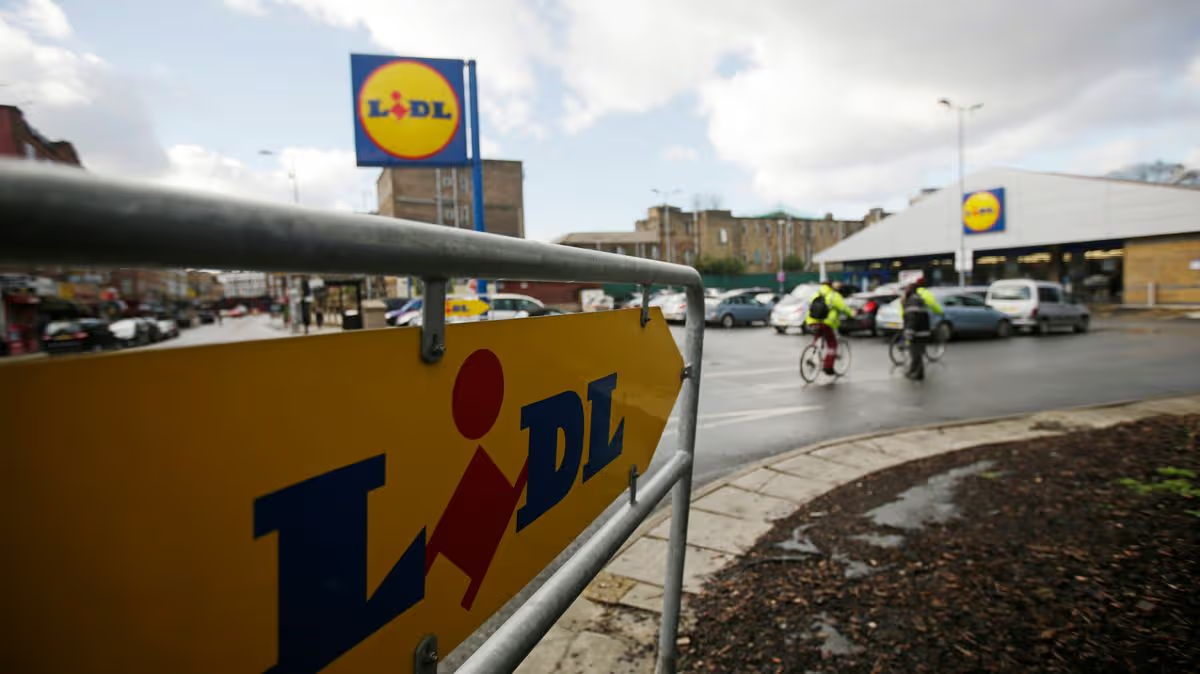
News has broken today that the supermarket giant Lidl has unveiled one of the most ambitious physical expansion plans in modern British retail. As part of a relentless, multi-million-pound growth drive, the budget chain has published a new ‘Site Requirements Brochure’ naming hundreds of target locations across Great Britain where it is actively seeking to build new stores. In a community-focused twist, they are even offering a “competitive finder’s fee” to members of the public who successfully identify a viable, previously unknown plot that leads to a new outlet. This announcement isn’t just about corporate strategy; it’s a direct invitation to towns and neighbourhoods, signalling that the retailer’s distinctive yellow and blue logo could soon be coming to a high street or retail park near you, bringing with it a promise of affordability, jobs, and local investment. For countless communities feeling the pinch of the cost-of-living crisis, the prospect of a new Lidl represents more than just another shop—it’s a potential lifeline.
The sheer scale of the plan is staggering, underscoring Lidl’s position as the UK’s fastest-growing physical supermarket for an unbroken 33 months. Following the recent opening of its 1,000th store, the company is now injecting a further £600 million to launch over 50 new stores in the coming year alone. The newly published list, however, goes far beyond that immediate target, mapping out a long-term vision for nationwide coverage. Scotland is a major focus, with 66 specific locations identified, including eight in Glasgow and eleven in Edinburgh, ranging from city centres like Edinburgh’s Nicolson Street to suburban areas like Bearsden and Bishopbriggs. The message is clear: Lidl is looking for prominent, high-footfall sites—whether freehold, leasehold, or long leasehold—in every corner of the nation, from the Highlands to the Home Counties.
This expansion is framed not merely as a commercial endeavour but as a direct investment in local communities. Richard Taylor, Lidl GB’s Chief Real Estate Officer, emphasises that each new store “delivers more than just affordable products.” He highlights the creation of quality jobs, with entry-level wages starting at £13.45 per hour nationally (rising to £14.45) and even higher in London, alongside what the company calls “some of the most attractive benefits packages in the industry.” Furthermore, Lidl points to its critical community role through partnerships with local charities and its surplus food donation programme. In just one year, via its partner Neighbourly, Lidl redistributed the equivalent of 18.5 million meals, supporting 6.8 million individuals. In this light, a new store is positioned as an anchor of community support, particularly, as Taylor notes, “in uncertain times.”
For residents across England and Wales, the list provides a clear point of reference. The North East and Cumbria are slated for up to 49 potential new stores, including areas like Alnwick, Whitehaven, and various suburbs of Newcastle and Sunderland. Yorkshire and the Humber could see up to 70, with targets in Leeds, Sheffield, York, and smaller towns like Ripon and Otley. In the North West, Greater Manchester is a key battleground with 63 named locations, while Merseyside, Cheshire, and North Wales account for another 52. The Midlands and Central England are similarly in focus, with extensive lists covering Birmingham, Nottingham, Derby, and Staffordshire, suggesting a deep push into the heart of the country.
The southern half of England is equally covered by the blueprint. The list details dozens of opportunities across Bristol, Gloucestershire, and the South West, through the Home Counties around London, and across the entire South Coast. Kent, East Sussex, and East Surrey have 61 named targets, from Ashford to Tunbridge Wells. Notably, London itself is a massive priority, with a combined 232 specific target areas split between North and South London, encompassing everything from major hubs like Stratford and King’s Cross to residential neighbourhoods like Stoke Newington, Muswell Hill, and Balham. Whether you live in a bustling city district, a market town, or a coastal community, the list invites you to scan for your own area.
Ultimately, this announcement is a call to action. Lidl is not just passively planning; it is actively hunting for sites and enlisting the public’s help to do so. The detailed lists for Scotland, Wales, and every English region—from the 66 in Scotland to the 56 in Central Southern England—serve as a definitive checklist for communities wondering, “Are we on the radar?” If your town or neighbourhood is named, the process is officially in motion. If not, the finder’s fee incentive suggests there is still room for new suggestions. As the UK’s grocery landscape continues to evolve, Lidl’s dramatic expansion plan promises to reshape local high streets, offering a potent mix of low prices, employment, and community partnership. The question now hanging in the air for hundreds of communities is a simple one: could your area be next?