

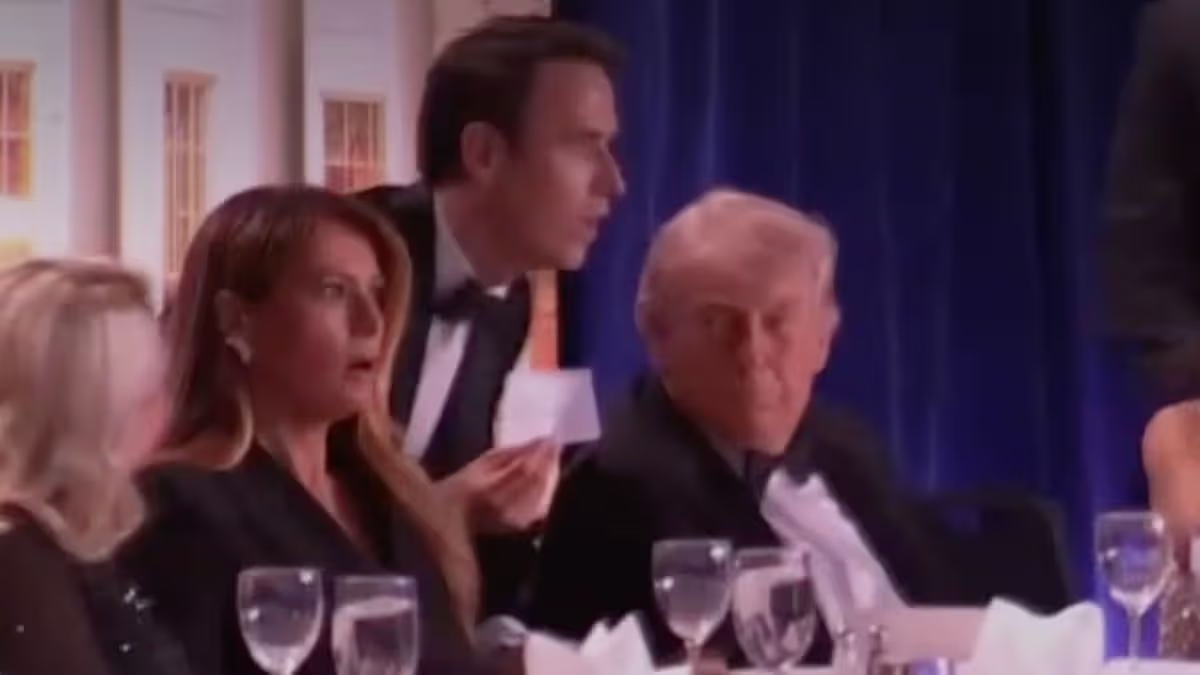
On the evening of April 26, 2026, a spectacle intended to celebrate the free press and Washington’s political life was shattered by the sound of gunfire. The annual White House Correspondents’ Dinner, held at the Washington Hilton, had assembled the nation’s elite — journalists, politicians, and dignitaries — for a night of camaraderie and entertainment. The featured performer was world-renowned mentalist Oz Pearlman, who stood on stage mid-trick, his focus entirely on President Donald Trump, First Lady Melania Trump, and other key figures like press secretary Karoline Leavitt. The atmosphere was one of anticipation, a rare moment of levity in the often-divisive capital. Pearlman, an Emmy Award-winning illusionist who had left a Wall Street career for the stage, felt the thrill of performing for this iconic gathering, joining the ranks of legendary entertainers who had graced the event. In an instant, that thrill would turn to pure terror, forever etching the night into the memory of every attendee.
The transition from performance to panic was abrupt and chaotic. As Pearlman engaged the President with his mentalism, a commotion broke out at the periphery of the ballroom. The sharp, unmistakable reports of gunfire echoed through the space. In his first, frantic moments, Pearlman’s mind leapt to the worst possible scenario: he believed a bomb was about to detonate and kill everyone in the room. Reacting on pure instinct, he and others near the stage dove to the floor. What he saw next was an image he has described as unforgettable: Secret Service agents, acting with swift and brutal efficiency, forced President Trump to the ground in a protective tackle mere feet from where Pearlman lay. For several terrifying seconds, the mentalist found himself locked in a silent, shared gaze with the President of the United States, both men on the floor, surrounded by chaos and the unknown.
The source of the danger was 20-year-old Cole Tomas Allen, who had allegedly opened fire outside the ballroom, shooting a Secret Service agent who survived only thanks to his ballistic vest. The agent’s sacrifice and the swift response of his colleagues prevented the gunman from entering the main dinner area. As shots rang out, the meticulously planned security protocols snapped into action. The President and First Lady were “whisked” away within seconds, while other high-profile guests, including figures like Senator JD Vance, were urgently evacuated from the stage and ballroom. In the aftermath, Pearlman recounted the profound disorientation of those moments, noting how the initial tackle appeared so forceful he feared Trump had been injured. The speed and violence of the protective measures underscored the grave and immediate nature of the threat.
In the wake of the evacuation, a strange and tense silence descended backstage. For several long minutes, trapped in a secure hold with other evacuees, Pearlman and those around him existed in an information vacuum. They did not know the extent of the attack, the whereabouts of the gunman, or even if the President was safe. This period of uncertainty, as Pearlman later told CNN, was uniquely “jarring.” The very people who report on and shape the nation’s news narrative were suddenly stripped of all facts, left with only their fears and the echoing memory of gunshots. It was a stark reminder that in the face of raw violence, status and profession offer no protection, only a shared human vulnerability.
Once the all-clear was given and the immediate danger confirmed to be over, the shock began to settle into sober reflection. Pearlman took to Instagram to confirm his safety and express his profound gratitude for the Secret Service’s decisive actions. He publicly labeled the event “the scariest moment of my life,” a sentiment undoubtedly echoed by hundreds in attendance. The dinner, intended as a celebration of the First Amendment, had instead become a stark demonstration of the dangers that persistently shadow American public life and its leaders. The incident joined the tragic list of assassination attempts on Donald Trump, a somber timeline of political violence that continued to disrupt the nation’s discourse.
Ultimately, the story of that night is not one of politics, but of human reaction amidst profound crisis. Through the lens of Oz Pearlman—a performer trained in perception and illusion—we witness the stripping away of all pretense. The master of reading minds found himself in a moment where every thought was identical: survival. His account provides a poignant, ground-level view of history’s sudden intrusion, a narrative far removed from official statements and press briefings. It underscores the bravery of the protectors, the fragility of public gatherings, and the shared, wordless understanding that can pass between two people, even a president and a mentalist, when faced with mortality. The 2026 White House Correspondents’ Dinner will be remembered not for the jokes or the speeches, but for the moment the spotlight was violently wrested away, revealing the enduring and somber realities of the era.