


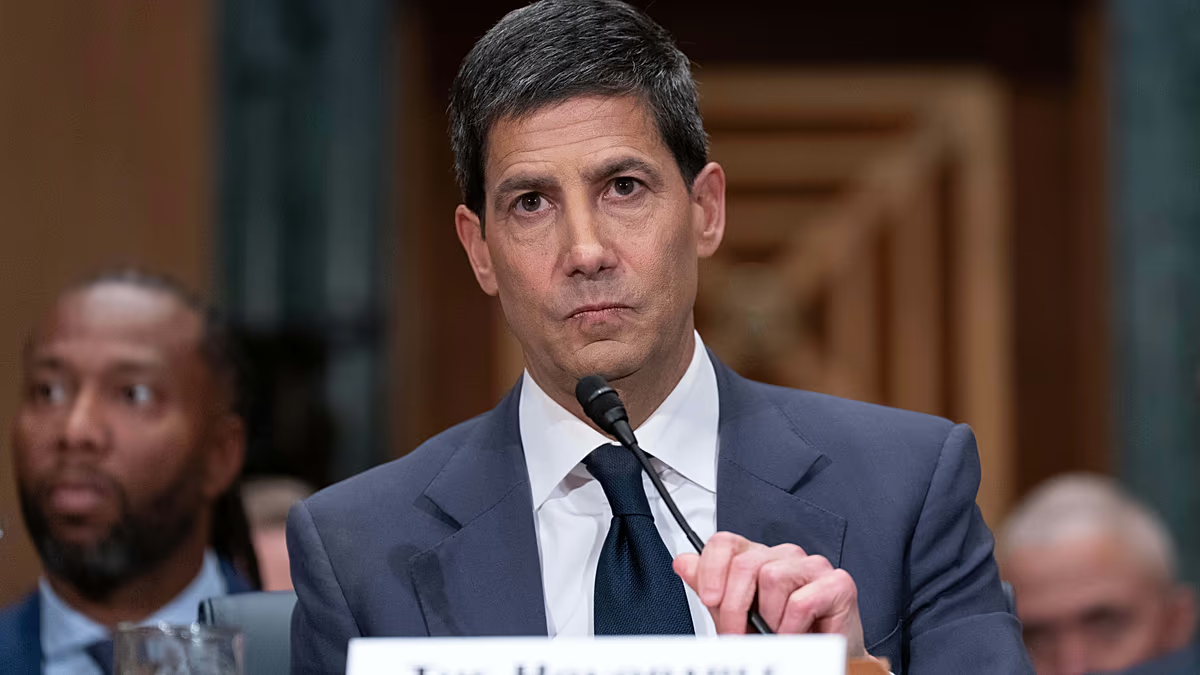
The political landscape surrounding the Federal Reserve shifted significantly with an announcement from Senator Thom Tillis of North Carolina. His decision to end his opposition removes a major obstacle to former President Trump’s effort to replace Chair Jerome Powell with Kevin Warsh, a former Fed governor. Tillis’s stance had been enough to stall the nomination in the GOP-controlled Senate Banking Committee, creating uncertainty as Powell’s term as Chair neared its scheduled end. This pivotal change sets the stage for a consequential confirmation battle, centering on the future leadership and political independence of the nation’s central bank at a sensitive economic time.
Senator Tillis’s reversal came just days after the U.S. Attorney’s office in Washington, D.C., closed its investigation into massive cost overruns for the Fed’s building renovations—a probe that had shadowed Powell. Tillis stated he had received the necessary assurances from the Justice Department that the case was “completely and fully settled,” allowing him to support moving forward. He expressed concern that the investigation had been used as a political “lever” to pressure Powell out prematurely, potentially threatening the Fed’s traditional insulation from partisan politics. With this legal cloud ostensibly dispersed, Tillis declared himself “prepared to move on with the confirmation of Mr. Warsh,” whom he believes “is going to be a great Fed chair.”
This development sets up a critical week for the Federal Reserve. The Senate Banking Committee scheduled a vote on Warsh’s nomination, prompting immediate pushback from Democrats. Senator Elizabeth Warren condemned the move, arguing that no Republican concerned with Fed independence should support Warsh, whom she characterized as being “nothing more than President Trump’s sock puppet.” Concurrently, Fed policymakers are meeting and are widely expected to hold interest rates steady, indirectly rebuffing Trump’s repeated public demands for cuts. A key subplot will be whether Powell, whose term as a Governor extends to 2028, chooses to remain on the Board after stepping down as Chair, a move that would complicate Trump’s ability to reshape the institution.
The closed Justice Department investigation into the Fed’s building project had been a flashpoint. The project’s cost had ballooned, drawing public criticism from Trump, who used it to needle Powell. The probe, led by U.S. Attorney Jeanine Pirro, a Trump ally, was viewed by many, including Tillis, as a politically motivated effort to harass Powell. Their suspicions gained credence when a federal judge quashed subpoenas in the case, stating their purpose appeared to be “to harass and pressure Powell to resign.” Prosecutors had even acknowledged in court they had found no evidence of a crime. This pattern aligned with other unsuccessful Justice Department efforts under Trump to prosecute his perceived adversaries, raising profound questions about the weaponization of legal authority.
In the midst of this political maelstrom, nominee Kevin Warsh has sought to present himself as an independent figure. During his confirmation hearing, he told senators he never promised the White House he would cut rates and pledged to be “an independent actor” if confirmed. His assurances, however, stand in direct contrast to President Trump’s own CNBC interview, where he stated he “would” be disappointed if Warsh did not cut rates immediately. This tension highlights the central dilemma of Warsh’s nomination: is he a truly independent technocrat or a candidate selected precisely for his perceived alignment with the President’s preferred low-rate policies?
As the process moves forward, the implications extend far beyond a single personnel change. The episode has exposed the intense political pressures bearing down on the Federal Reserve, an institution whose credibility relies heavily on its non-partisan stewardship of the economy. The use of a Justice Department investigation to potentially influence its leadership marks a dangerous precedent. With Trump expressing confidence in Warsh’s smooth confirmation and continued fixation on the Fed building’s costs, the coming vote will serve as a stark test of the Senate’s commitment to preserving the central bank’s operational independence from the transient demands of any administration. The outcome will shape monetary policy and institutional norms for years to come.